
Illustration by PHOTO ILLUSTRATION BY THE GLOBE AND MAIL; SOURCES: Getty Images, Trump: Evan Vucci/AP Photo, Carney: Adrian Wyld/THE CANADIAN PRESS
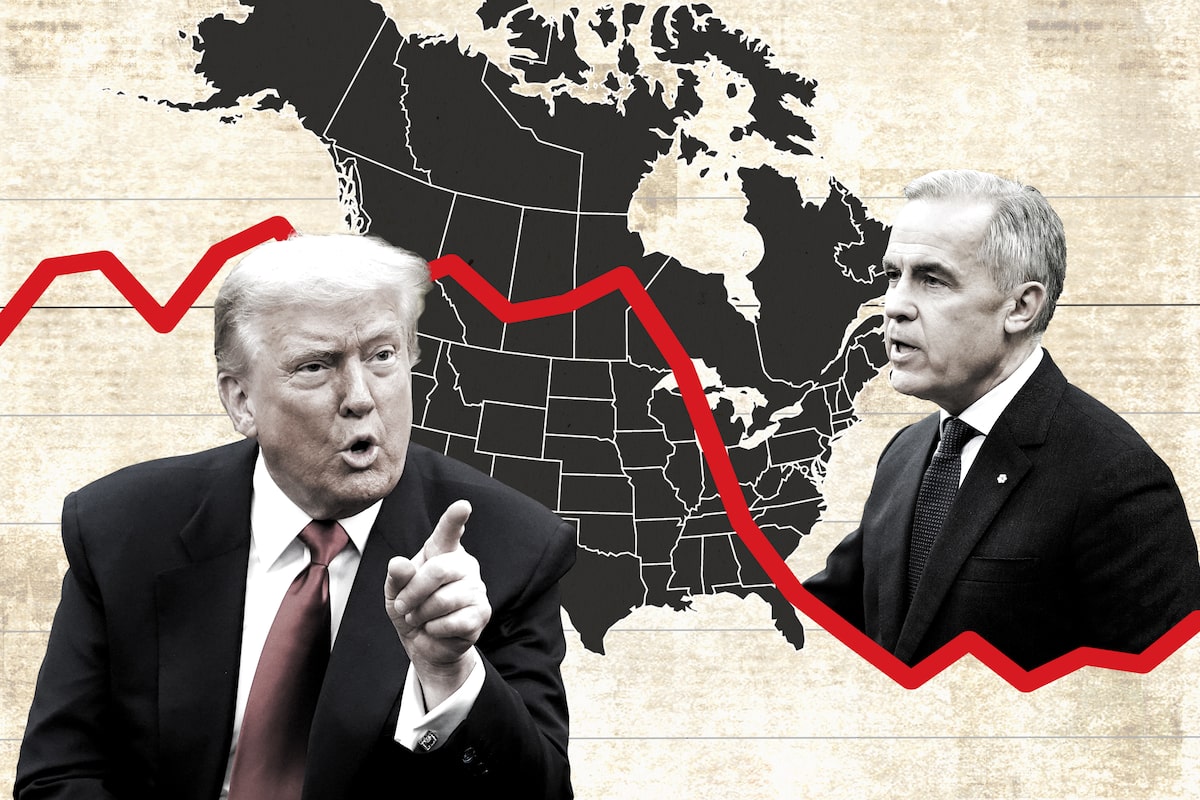
Prime Minister Mark Carney likes to call U.S. President Donald Trump “transformative.” One year after Mr. Trump first unleashed his threats of tariffs and territorial expansion, Canada has indeed been transformed.
It was a year ago this week when Mr. Trump threatened to hit Canada, Mexico and China with 25-per-cent tariffs unless they stopped migrants and drugs from entering the United States, and a year since he first floated his notion of Canada as the 51st state in a meeting with then-prime-minister Justin Trudeau.
To some degree, Mr. Trump has followed through on his tariff threats. While most Canadian exports are crossing the border duty-free, a bevy of products and industries are getting slammed by tariffs that run as high as 50 per cent.
Today, Canada is a country changed – politically, culturally and economically. Mr. Trump reshaped last spring’s federal election, sparked a backlash against U.S. consumer goods and travel destinations, forced a wholesale change in trade flows and left Canadians feeling more unified, but also more precarious.
Here are 29 ways Canada has changed during this remarkable year.
Our views of the United States have turned deeply negative. Since Mr. Trump returned to the White House spouting anti-Canadian rhetoric, people have soured on our southern neighbours in a way not seen since, well, the last time Mr. Trump was president. Two-thirds of Canadians view the U.S. unfavourably, a sharp reversal from a decade ago, when just one-quarter felt that way.
We re-elected the Liberals. Through most of 2024, Conservatives looked like shoo-ins to form the next government. Once Mr. Trudeau resigned, Mr. Carney quickly emerged as the Liberal leadership front-runner, billing himself as Canada’s best defender against Mr. Trump. He carried that message into the election and paved the way for a historic reversal of party fortunes.
We’ve taken a permanent economic hit. Bank of Canada Governor Tiff Macklem has stressed the economy is undergoing structural changes because of U.S. protectionism. And while the Canadian economy is projected to grow, it’s on a weaker path than it would have been in the absence of hefty tariffs.
We’ve rediscovered (some of) our lost national pride. Between 2016 and late 2024, the share of people expressing intense pride in Canada fell sharply, but Mr. Trump’s policies toward Canada have reversed that, at least somewhat.
We’re spending more on Canadian-made goods – and shunning American products. Surveys show that Canadians are voting with their wallets and trying to support domestically produced items. But there are limits to this moment of consumer nationalism. A recent Bank of Canada survey found that three-quarters of respondents weren’t willing to spend more than an additional 10 per cent on a Canadian-made product.
We’ve gone cold turkey on American booze. Provincial and territorial leaders took swift action this spring to block imports of American beer, wine and spirits in response to Mr. Trump’s early tariffs on Canada. And while those rules have loosened a bit, import bans are still in effect for much of the country, including Ontario.
We’ve slammed the brakes on trips to the U.S. Whether out of principle or fear of being detained, southbound travel has plunged by one-third from last year. That’s big trouble for U.S. tourist destinations, since Canada is the largest source of foreign visitors. The U.S. Travel Association said tourism spending is set to fall US$5.7-billion in 2025.
We’re spending more tourism dollars at home. There are strong signs that domestic tourism enjoyed a surge this summer, with spending in the second quarter rising sharply. From campgrounds to hotels to RV rentals, all reported strong bookings from Canadian travellers.
We’re travelling abroad more to non-U.S. destinations. Some Canadian travellers who ditched the United States opted to head to other countries instead, passenger screening data show. This also captures the uptick in foreign travellers who chose to visit Canada instead of the U.S. this year.
We’re dining out more. Finding a table at restaurants has been more difficult as people took money they saved by cancelling U.S. trips and spent it on meals and entertainment at home. Restaurant reservation data from OpenTable show annual growth in Canada is particularly strong compared with other countries.
Our exports are slumping. As U.S. tariffs began to take effect in March, Canadian exports took a nosedive and haven’t come close to mounting a full recovery. Canada typically sends about three-quarters of its goods exports to the U.S. – hence why the trade war has delivered lasting economic damage.
We’re losing jobs in trade-exposed sectors. These are rough times for workers in the auto, steel, aluminum and lumber industries, with many companies laying off staff. Outside these sectors, employment is holding steady, but businesses are hesitant to add staff because of a choppy economic outlook.
We’re more worried about job security. While Canada’s overall job market has held up relatively well in the face of the trade war, anxiety about job security has worsened. The Bank of Canada’s labour market index, based on consumer surveys, is at the lowest level since the pandemic.
We’re relying more on jobless benefits. The number of people receiving Employment Insurance payments for unemployment has risen by around 56,000 this year. There is, however, a glimmer of hope: Recipients have fallen for two consecutive months, and the labour market has churned out a combined 127,000 positions over September and October.
Our companies are gripped by uncertainty. On earnings calls, companies and analysts are focused on the precarious business environment, talking about “uncertainty” nearly as much as they were during the COVID-19 pandemic. The worry is that this state of unease will translate into lowered levels of investment.
Our companies are facing rising costs. Tariffs, countertariffs and changes in supply chains are pushing up costs for Canadian businesses. Some companies have responded by raising prices. But for many, the ability to pass these expenses along to customers is constrained by weak demand, limiting the overall impact on inflation.
We’ve lost businesses that depend on U.S. trade. The number of active businesses in sectors dependent on U.S. demand, such as manufacturing and mining, oil and gas extraction, was already in decline, but Mr. Trump’s policies appear to have accelerated that trend.
We’re diversifying our exports, with a big caveat. For years, economists have encouraged Canadian businesses to expand their markets beyond the U.S. There are signs that’s finally happening, though one commodity – gold – has accounted for a large share of Canada’s non-U.S. export growth thanks to rising prices for the shiny metal.
We’re shipping more aluminum to the rest of the world. Canadian aluminum exports to the United States have plunged in the face of a 50-per-cent tariff. But aluminum producers in Quebec have managed to shift some of their metal exports to European markets. Diversification has been harder for the steel sector, given the glut in global steel markets.
We’re suddenly more interested in USMCA. Canadians started paying attention to the continental free-trade agreement, which replaced NAFTA in 2020, after Mr. Trump exempted USMCA-compliant products from his blanket tariffs. Expect another spike in interest from Canadians if next year’s review of the trade deal brings its fate into question.
Our exports have become USMCA-compliant. Before the trade war, U.S. tariffs were so low that it didn’t really matter if Canadian companies claimed their exports were USMCA-compliant. Now, without USMCA certification, the duty is generally 35 per cent (or 10 per cent for key resources), so businesses are rushing to certify their products to take advantage of the USMCA tariff carve-out.
We’re buying more Mexican than U.S.-made cars. In the face of tariffs and countertariffs, importers are bringing in more vehicles assembled in Mexico than in the U.S. for the first time. Given that Canada is the largest foreign buyer of U.S.-made passenger vehicles, it’s a test of Mr. Trump’s claim his country doesn’t need Canada.
Our politicians are dwelling on The Donald. With Mr. Trump threatening to tear up the USMCA, the President is a regular topic of discussion in Parliament, whether that’s House of Commons debates or committee meetings.
We became more protectionist, at least temporarily. Canada was one of only two countries, alongside China, to punch back at Mr. Trump with countertariffs. But by early September, Ottawa rolled back most of these countermeasures in a bid to restart stalled trade talks. Between March and August, the government generated $5.1-billion more in tariff revenue than the same period last year, well short of the $20-billion the Liberals promised in their spring election platform.
We’re spending more on national defence. Canada has long been a laggard in meeting NATO’s military spending target of 2 per cent of gross domestic product. With Mr. Trump demanding U.S. allies ramp up their defence investment, and Mr. Carney looking for ways to bolster Canada’s industrial base, suddenly Canada is taking defence spending seriously.
We’re seizing more drugs at the border. Mr. Trump has claimed fentanyl is “pouring” across the Canada-U.S. border to justify his broad-based tariffs on Canada. Even if data show that’s not the case, Canada has stepped up drug seizures at the border as it tightens security in the face of Mr. Trump’s demands.
We’re stepping up international outreach. Mr. Carney has racked up frequent-flyer points, travelling the world to shore up Canada’s relationship with non-U.S. allies and find new markets for Canadian goods. This has included stops in Europe, Asia and the Middle East.
We’re removing internal trade barriers, finally. The shock of not being able to ship goods tariff-free into the United States has convinced Canadian politicians to get serious about improving the internal market. Ottawa and the provinces have passed legislation to reduce regulatory hurdles to moving goods and workers across the country, although there’s more work to be done.
Our stock market is now outperforming the U.S. markets. At the outset of Mr. Trump’s trade war with Canada, many expected Canadian investments to suffer. But since Mr. Trump was elected, Canadian markets are beating their U.S. counterparts, a reversal from the same period the previous year. It’s a reminder that for all the upheaval of the last year, Canada has proven more resilient than what many expected at the start of the tariff crisis.