
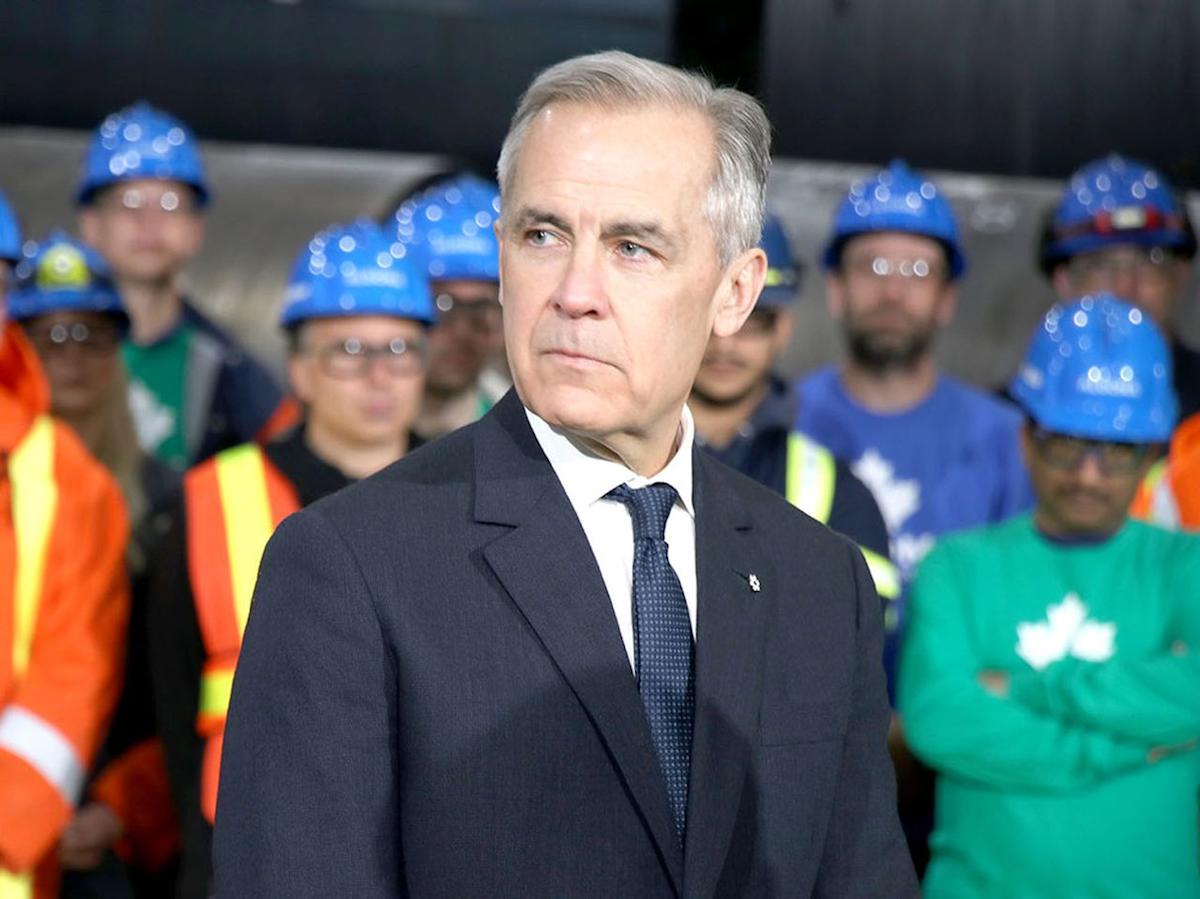
New restrictions on foreign steel imports and policies designed to make it cheaper to ship steel to Western Canada are being implemented by the federal government, Prime Minister Mark Carney announced on Wednesday.
Canadian steel producers are trying to increase sales within the country to offset declining sales in the United States, where 50 per cent tariffs remain in place and increasingly make their products less competitive.
Carney’s announcements are part of a package of support for the steel industry as well as the lumber sector, which have been among the hardest hit by the U.S.-Canada trade war.
“The Canadian steel and lumber sectors will always be at the heart of Canada’s competitiveness, our security and our strength,” Carney said. “These are sectors that reflect our nations character, resilient and forward looking with a history of reinventing themselves at pivotal moments.”
Carney was flanked by several cabinet ministers as well as Ron Bedard, chief executive of ArcelorMittal Dofasco, who he thanked “for helping us design some of these support measures.”
One new federal policy restricts steel imports from companies in countries that lack a free-trade agreement with Canada to 20 per cent of the volume they shipped here in 2024. Above that threshold, a 50 per cent tariff kicks in. Similarly, it restricts companies in countries that have free-trade agreements with Canada — not including the U.S. and Mexico — to 75 per cent of their 2024 shipments here, above which the 50 per cent tariff kicks in.
The moves tighten existing federal policies announced in July that allowed non-free trade countries to ship 50 per cent of their 2024 volume to Canada before the 50 per cent duty rate kicked in, while free-trade countries were allowed to ship 100 per cent of what they sent in 2024 before the higher duty rate applied.
A separate policy creates a 25 per cent tariff on “steel-derivative products” — essentially one step up from raw steel — such as wind towers, prefabricated buildings, fasteners and wires. Some in the industry had complained that the original quotas were too narrowly tailored to apply to raw materials and that overseas steel producers had responded by shipping steel that had been fabricated or modified so that it was not caught in the tariff net.
The federal government is also creating a “steel compliance team” within the Canada Border Services Agency to ensure that its policies are better enforced.
Carney has said Canada is one of the countries “most exposed to the fundamental restructuring of the global steel industry.” It exports a lot of steel, but also uses a lot of steel per capita, so it has been “disproportionately open” to foreign steel to satisfy its own needs, he said this summer.
Story Continues
The new 20 per cent quota on non-free trade countries comes closer to domestic steel producers’ calls earlier this year for the federal government to cut all steel imports — including from countries with free-trade agreements — to 20 per cent of their 2024 shipment volumes.
But until Wednesday, Carney had been reluctant to impose significant quotas on free-trade partners’ steel imports. While he has not gone as far as the steel sector wanted, it is a step in the direction they requested.
Still, some steel producers say the policy needs to be tightened even further.
“They’re going to get to the point I told them to get to seven months ago,” Barry Zekelman, owner of Atlas Tube Inc. in Harrow, Ont., who also sits on the board of directors of the Canadian Steel Producers Association, said. “Why do they have to drag this out and make it so painful?”
He is also calling for the federal government to enact a hard quota on foreign steel imports. Carney’s policy, known as a tariff rate quota, imposes a limit on the amount of steel that can be imported duty free. Zekelman said he wants a “hard quota” that limits the total volume of steel that can be imported at any duty rate.
Still, he applauded the federal government’s other announcement that it will seek to lower the cost of rail shipments of domestically produced steel by 50 per cent.
The government provided few details on that policy, but said it would work with Canadian National Railway Co. and Canadian Pacific Kansas City Ltd. to cut freight rates on interprovincial steel and lumber shipments by half beginning next spring.
That move responds to concerns that it is too expensive to ship domestic steel from Ontario and Quebec, where many of the mills are based, to Western Canada.
Ravi Kahlon, British Columbia’s minister of jobs and economic development, earlier this year said his province is concerned that steel import restrictions would cause prices to increase and potentially lead to shortages.
B.C. imports about $4-billion worth of steel every year, he said, in part because bringing heavy steel shipments over the mountains and across the prairies can be more expensive than floating it across the Pacific Ocean by barge.
The federal government also said it would implement its “Buy Canadian” strategy and require that all defence and construction projects worth more than $25 million prioritize Canadian materials, including steel and lumber.
The Donald Trump administration imposed tariffs on steel and aluminum from June 2018 to May 2019 during his first term in office, though only 25 per cent rather than the current 50 per cent.
Steel and aluminum exports fell by 50 per cent during that time, according to a Statistics Canada report released on Wednesday, but U.S. importers largely paid the costs through higher prices. Still, the agency said exporters that maintained relationships with U.S. customers also increased investments during this period.
This time around, tariffs may be higher and last longer, the report said.
“The point to be taken is that declining output, employment and investment in industries affected by tariffs are not a foregone conclusion,” the report said.
• Email: gfriedman@postmedia.com