
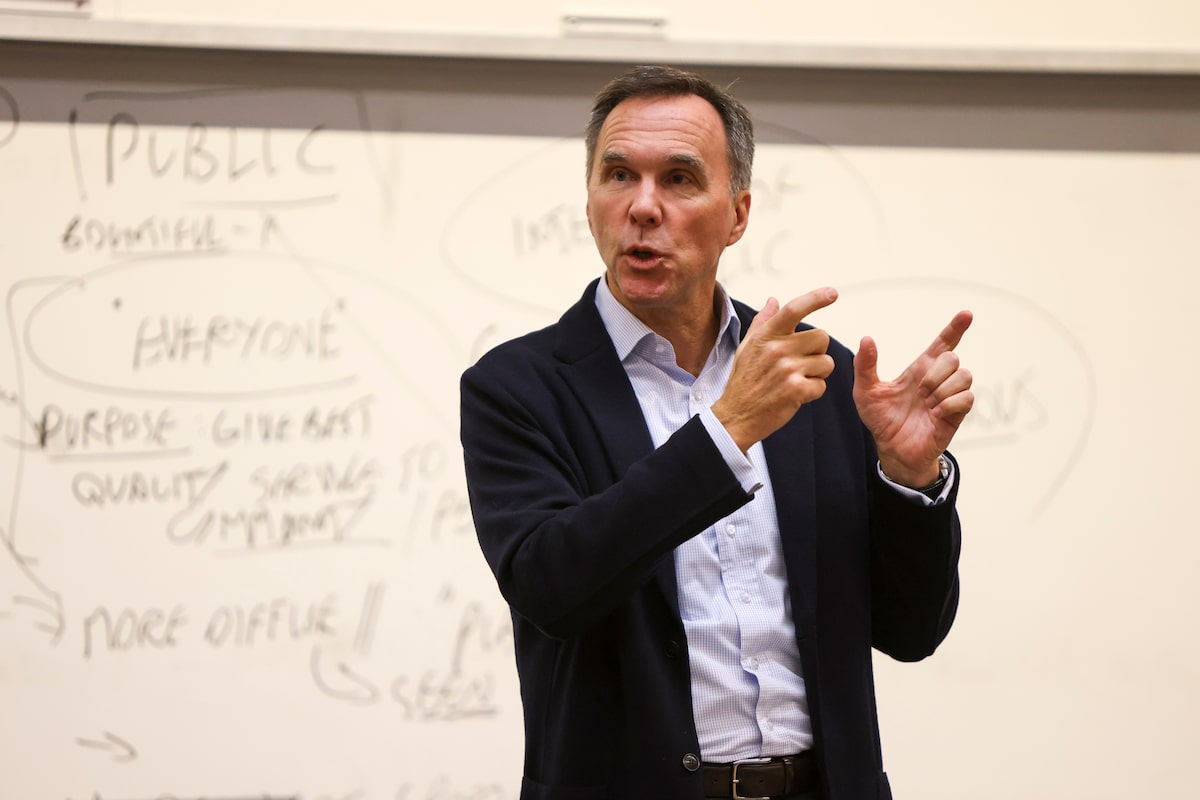
Former Finance Minister Bill Morneau discussed the high-pressure 2018 Trans Mountain negotiations with MBA students at Western University during a Lessons from CEOs on Managing Strategic Transformation class, on Nov. 19.Nicole Osborne/The Globe and Mail
As Alberta, British Columbia and Ottawa face off over a potential second pipeline to the Pacific coast, the politician who championed the Trans Mountain pipeline expansion held a referendum on the project with Western University business students.
Former federal finance minister Bill Morneau struggled to win votes for his government’s decision to have taxpayers take over what proved to be a nation-building piece of infrastructure, with a hefty $34-billion price tag.
Last Wednesday, eight days before Prime Minister Mark Carney and Alberta Premier Danielle Smith were scheduled to announce a grand bargain on the country’s energy future in Calgary, Mr. Morneau took the stage before 75 students at the Ivey School of Business to revisit the high-pressure negotiations between former Trans Mountain owner Kinder Morgan Inc. and the two provinces in the spring of 2018.
It was riveting theatre. And a select group of MBA and undergrad students got to play a role.
By the time Mr. Morneau finished up, an audience of future business leaders had a sense of how tough it is to make a perfect decisions with imperfect data. Potential CEOs realized every choice they make in their corporate careers will leave someone unhappy.
Ivey dean Julian Birkinshaw and lecturer Doug Murphy, former chief executive officer of Corus Entertainment Inc., lured Mr. Morneau to the London, Ont., campus as part of a course called Navigating Change – Lessons from CEOs Managing Strategic Transformation in Uncertain Times.
Ivey School of Business dean Julian Birkinshaw.Nicole Osborne/The Globe and Mail
Earlier this fall, Bank of Montreal CEO Darryl White, Sleep Country Canada co-founder Christine Magee and six other executives also made the trip to Ivey to revisit key decisions.
While Mr. Morneau sat among the students, Dr. Birkinshaw and Mr. Murphy took the class through a Trans Mountain case study. The two professors started in 2012, when oil prices were soaring and Kinder Morgan announced plans to twin their original pipeline and nearly triple its capacity.
The Houston-based utility put a $5.4-billion price tag on the project. Expanding Trans Mountain enjoyed support from all the era’s political leaders: B.C. premier Christy Clark, Alberta’s Alison Redford and prime minister Stephen Harper.
By April, 2018, the landscape had changed completely. The pipeline’s cost had soared to $7.4-billion. The oil market was in a slump. B.C. had narrowly elected NDP premier John Horgan, who clung to power with support from the Green Party. The province, along with Indigenous and environmental groups, were in court attempting to block Trans Mountain’s expansion.
On April 18, Kinder Morgan announced it had suspended all activity on Trans Mountain. CEO Steve Kean said the company would walk away from the project at the end of May, seven weeks later, unless all political and legal issues were resolved in its favour.
At this point, the professors asked a highly engaged class to sketch out Mr. Morneau’s options, as the face of the federal government. Within minutes, the students decided the minister had four potential choices:
– Remove the risks to Kinder Morgan, or any other owner, with indemnities that transferred the cost of delays to the federal government.
– Forge a partnership with domestic pipeline companies or funds such the Canada Pension Plan Investment Board to buy Trans Mountain.
– Have the government buy the pipeline.
– Walk away and let Kinder Morgan abandon the project.
Once the class worked through all possible alternatives, they took a vote on which option they would have picked. Before revealing the tally, here is how Mr. Morneau explained what happened in the real world, with candour and transparency seldom seen on Parliament Hill.
“Kinder Morgan gamed us,” Mr. Morneau said. He said face-to-face talks with Mr. Kean showed the CEO had decided Trans Mountain no longer made economic sense and wanted out, no matter what Ottawa offered.
‘Abandoning Trans Mountain would have fed into the sense of political alienation in Alberta and fanned the flames of western separatism,’ Mr. Morneau told students.Nicole Osborne/The Globe and Mail
Politically, Mr. Morneau said the Canadian government could never give a Houston-based company indemnities on the project that could run to billions of dollars.
Practically, Mr. Morneau said the seven-week timeline dictated by Kinder Morgan meant there was little opportunity to find private-sector buyers. Mr. Morneau, a pension consultant prior to entering politics, explained the government respects the independence of public-sector funds such as CPPIB, and would never force a pension plan to invest in an asset with the uncertainty of Trans Mountain.
Walking away was also never an option. There was a strong business case for the project. In addition, the federal Liberals championed a carbon tax, an unpopular policy in Alberta. Mr. Morneau said expanding Trans Mountain balanced the impact of the new tax, “although it was never an easy quid pro quo for Albertans to accept.”
Albertans were already fuming over U.S. president Barack Obama’s 2015 decision to shut down the Keystone XL pipeline and Ottawa’s decision to block the Northern Gateway pipeline in 2016. Mr. Morneau said: “Abandoning Trans Mountain would have fed into the sense of political alienation in Alberta and fanned the flames of western separatism.”
In the referendum, a vast majority of the 75-person class opted for the government putting together a public/private partnership, potentially tapping pension-fund money, to buy Trans Mountain. Only seven students supported the government’s decision to buy the pipeline.Nicole Osborne/The Globe and Mail
In late May, two days before Kinder Morgan’s deadline, the federal government purchased Trans Mountain for $4.5-billion. The project ran into massive cost overruns during the COVID-19 pandemic. It opened in May, 2024, and has achieved its policy goals.
Expanding Trans Mountain shrank the gap between world oil prices and what Alberta producers receive, boosting revenues for both oil companies and provincial and federal governments, and lessened Canada’s dependence on exports to the United States.
How did the Ivey students vote? In the 75-person class, the vast majority opted for the government putting together some kind of public/private partnership, tapping pension-fund money. Twelve voted for giving Kinder Morgan some form of government indemnity. Two said Mr. Morneau should have abandoned the project.
Opinion: Approving a pipeline project is easy. Making it happen will be difficult and painful
Opinion: As pipeline politics begin anew, Ottawa must fast-track the courts
Just seven business students supported the government’s decision to buy Trans Mountain.
As the class wound down, a student asked Mr. Morneau whether he had any advice for the current Prime Minister, as Mr. Carney negotiates with B.C. and Alberta politicians.
“I’m hugely supportive of what the federal government is doing, with initiatives like the Major Projects Office,” Mr. Morneau said. He said Mr. Carney has made speeding up the regulatory process a priority, a much-needed measure because “time is the enemy of deals.”
“There is a Canada-first mentality now that is different from when I was in office, so I am encouraged,” Mr. Morneau said. “There’s a better spirit in this country around nation-building projects.”