
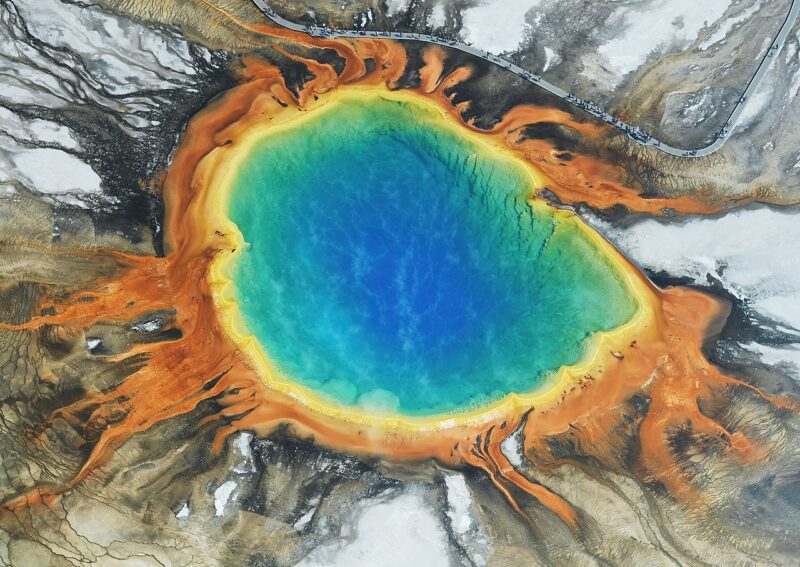
 This is a view looking down at the famous Grand Prismatic Spring in Yellowstone National Park. The spring gets its colorful hues from bacteria. A new study said that Yellowstone earthquakes, like the swarms in 2021, disrupt the underground microbial communities. Image via Carsten Steger/ Wikimedia Commons (CC-BY-4.0).
Yellowstone earthquakes disrupt life underground
Yellowstone National Park is famous for its geologic activity. And that includes earthquakes. While it is often rumored to be ready to erupt in an earth-shaking volcanic cataclysm, Yellowstone naturally has thousands of small earthquakes a year. In 2021 for example, Yellowstone experienced 27 earthquake swarms, or clusters of earthquakes at a similar place and time. Just one earthquake swarm beneath Yellowstone Lake in 2021 consisted of 825 quakes. And now a team of scientists said on November 25, 2025, they’ve studied changes in underground ecosystems affected by the Yellowstone earthquake swarm.
The team published their peer-reviewed results in journal PNAS Nexus on November 25, 2025.
Life underground
Did you know that roughly 30% of life on Earth, by weight, lives underground? Much of this life is in the form of microbes. And this subterranean life is made evident at Yellowstone, where we can see the thermal features that harbor heat-loving organisms. Bubbling mudpots, geysers and hot springs are all home to life. In fact, in the rainbow-hued Grand Prismatic Spring, the colors that we see are largely thanks to the microbial mats of heat-loving bacteria that live there.
These microbes get energy from the minerals and chemical reactions that occur in the water. So when earthquakes shake things up, they make changes to subterranean environments. Earthquakes break rocks, change the flow of water and expose fresh minerals. This activity can create new chemical reactions and alter what was previously available for the local life.
Looking at the life below
The researchers in the study sampled the conditions underground using a 100-meter (328-foot) borehole on the west side of Yellowstone Lake. They took five fluid samples over 2021, noting the increased concentrations of hydrogen, sulfide and dissolved organic carbon after seismic activity. They found that the changes in the chemical composition of the water were accompanied by a change in the concentration of bacteria and algae. In fact, they found the microbial ecosystems changed over time. This is in contrast to similar underground populations that live in relatively stable continental bedrock.
They also found that, about a month after the swarm, the chemistry and microbiology began to return to their initial compositions. The paper said:
These results provide new insight into how microbial life is maintained in Earth’s subsurface, both today and in its distant past … These observations may be extended to other rocky planets where seismic activity has been detected, such as Mars, suggesting that such activity could expand planetary habitability.
A closer look at Yellowstone earthquakes
While earthquakes in Yellowstone, even very small ones, can affect the underground life there, they have relatively little impact on the life above ground. If you’ve ever visited Yellowstone, there’s a good chance there was a small earthquake as you walked along the boardwalks and drove past the vistas, and you never even noticed.
As the USGS says:
The vast majority of Yellowstone earthquakes are very small, over 90% are in the range of magnitude zero to two.
And even a magnitude three earthquake is small. You might mistake it for a truck rumbling by.
And since you’re wondering: Will we ever get a supereruption at Yellowstone? The USGS says:
Although another catastrophic eruption at Yellowstone is possible, scientists are not convinced that one will ever happen.
Read about Yellowstone supervolcano eruptions that occurred millions of years ago.
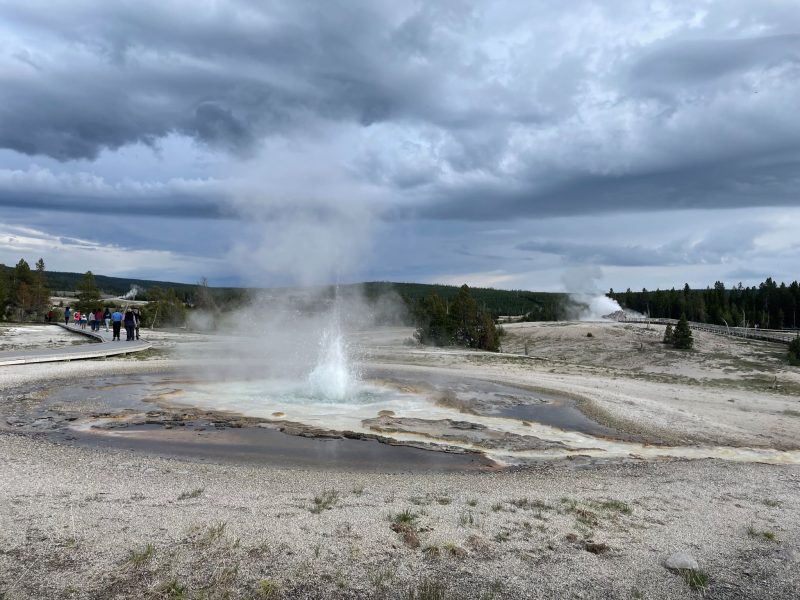 View at EarthSky Community Photos. | EarthSky’s Kelly Kizer Whitt captured this image on May 30, 2023. She wrote: “Here’s a look at Sawmill Geyser, with Castle Geyser in the background. The Upper Geyser Basin is famous in Yellowstone as the location of Old Faithful, but in late May and early June of 2023, some other geysers were garnering attention due to new activity, including Castle Geyser.” Thanks, Kelly!
Bottom line: Yellowstone earthquakes are regular occurrences in this geologic hotspot. Scientists have studied how they change life underground.
Source: Seismic shifts in the geochemical and microbial composition of a Yellowstone aquifer
Kelly Kizer Whitt
View Articles
About the Author:
Kelly Kizer Whitt – EarthSky’s nature and travel vlogger on YouTube – writes and edits some of the most fascinating stories at EarthSky.org. She’s been writing about science, with a focus on astronomy, for decades. She began her career at Astronomy Magazine and made regular contributions to other outlets, including AstronomyToday and the Sierra Club. She has nine published books, including a children’s picture book, Solar System Forecast, and a young adult dystopian novel, A Different Sky.