

Artificial intelligence is now nearly universal in Israel’s high-tech sector, with 95% of employees using AI tools regularly and 78% using them daily, according to a new nationwide survey of more than 500 tech workers released Tuesday by the Israel Innovation Authority and the Brookdale Institute.
For comparison, a major report published last May by Microsoft and LinkedIn found that only 75% of high-tech employees worldwide, three out of four, use AI at work.
3 View gallery
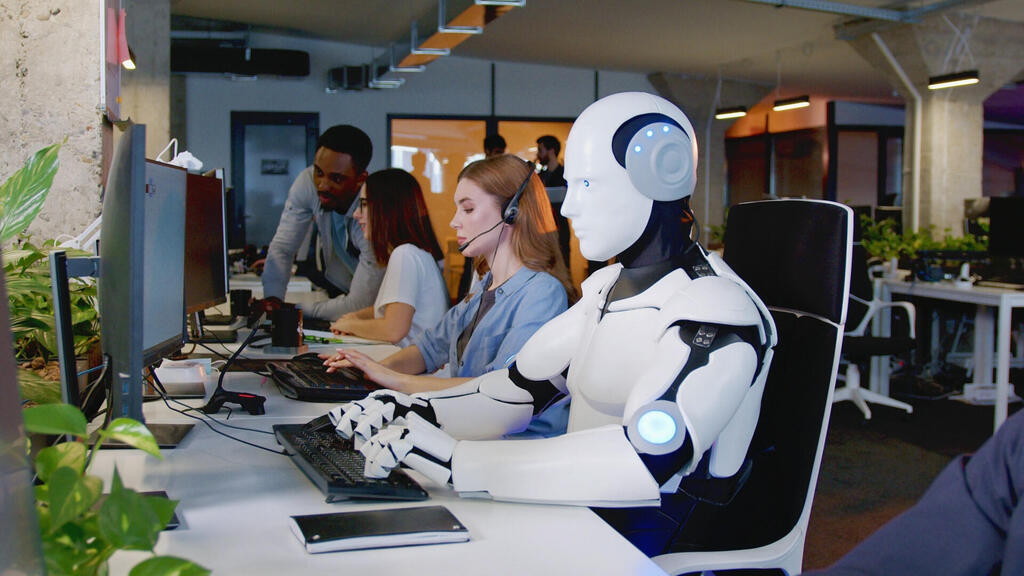
(Photo: VesnaArt, Shutterstock)
According to the new survey, the labor market revolution is already unfolding across Israel. AI tools are used for a wide variety of tasks, doubling productivity and half of respondents say the technology shortens their work time by dozens of percents.
Usage rate is highest among employees ages 25 to 34 and those early in their careers, but usage does not depend on rank or role. The revolution affects developers, marketers, HR staff and product managers alike, all of whom are integrating AI tools into their routines.
Beyond efficiency, high-tech employees report that AI is changing the nature of their tasks, strengthening self-learning abilities and expanding their areas of responsibility. Most say the technology clearly boosts productivity: 70% report major improvements in output quality, 50% report a significant reduction in work time and 40% report a cut of more than half in task performance time.
The survey also found that most employees do not rely on a single tool but integrate AI into a wide spectrum of tasks, with a quarter using it for more than six types of tasks. Developers and other technical staff rely on it mainly for code writing, debugging and documentation. Workers in nontechnical roles use it to generate content, search information, produce summaries and analyze data.
3 View gallery

But the numbers also show the concerns the technology raises for certain groups. Senior and veteran employees use AI less, and 37% expressed serious concern about their job security because of it. Among employees without an academic degree, 39% voiced similar worries, compared with just 26.5% of those with a degree.
A similar survey by Ernst & Young in the U.S. found the opposite trend. Gen Z and millennials (roughly ages 13 to 44) were more worried that AI would replace their jobs, while Gen X and baby boomers (ages 45 to 80), who have generally established their careers, tended to feel more secure professionally and viewed AI as a tool that assists rather than replaces them.
Geography also plays a role in people’s reluctance to embrace the technology: 40% of employees in peripheral regions say they are significantly concerned about the impact of technological change on their jobs, compared with only 24% of those living in the center.
In other words, artificial intelligence may widen existing gaps between the center and the periphery and between workers with higher and lower levels of training unless efforts are made to expand access to tools and professional courses.
3 View gallery

(Illustration: Shutterstock)
Israel Innovation Authority CEO Dror Bin says that the AI survey reveals the depth of the transformation underway in the Israeli high-tech sector. The fact that nearly all employees in the industry already use AI tools is not a future projection but a present reality reshaping high-tech employment.
“The Israeli high-tech industry is responding quickly, adopting the tools, testing new work models and integrating AI into development, marketing and management processes,” he says.
Still, he notes that this revolution requires carefully balancing rising productivity and rapid growth with the impact on the labor market. Alongside improved efficiency and innovation, new opportunities are emerging, roles are shifting and new professions are forming, but others may disappear.
“To prevent widening gaps between high-tech and the rest of the Israeli economy, we must ensure that artificial intelligence is broadly adopted across all industries and across government activity, including education, health and beyond”, explains Bin.
Significant gaps also appear between different types of companies. In startups, where rapid innovation might be expected, only 64% of technical employees use AI tools designed for coding, compared with 77% in international R&D centers, in service firms and software houses. This may indicate that younger companies tend to be more cautious when adopting new tools.
Despite the concerns, the survey suggests that high-tech workers overall remain optimistic about AI’s impact on their careers, with 68% viewing it as an opportunity for growth.
In practice, most companies worldwide are not yet firing employees, suggesting that “a robot will replace them tomorrow morning”. Still, several major U.S. tech firms have made cuts tied directly to AI use.
Translation and content companies such as Duolingo, TransPerfect and Lionbridge have carried out significant layoffs as AI tools increasingly serve as substitutes.
Large banks, including Bank of America and JPMorgan, have executed targeted reductions of hundreds of employees after finding AI effective at tasks such as data verification, risk management and handling customer requests.
Fintech giant Klarna announced a hiring freeze after its CEO revealed that AI had completed the equivalent workload of 700 customer service agents and cut response times from 11 minutes to 2.
At IBM, CEO Arvind Krishna decided to freeze hiring for human resources and accounting roles and estimated that about 7,800 positions at the company would be replaced by AI within five years.