

A planet’s habitability is determined by a confluence of many factors. So far, our explorations of potentially habitable worlds beyond our solar system have focused exclusively on their position in the “Goldilocks Zone” of their solar system, where their temperature determines whether or not liquid water can exist on their surface, and, more recently, what their atmospheres are composed of. That’s in part due to the technical limitations of the instruments available to us – even the powerful James Webb Space Telescope is capable only of seeing atmospheres of very large planets nearby. But in the coming decades, we’ll get new tools, like the Habitable Worlds Observatory, that are more specifically tailored to search for those potentially habitable worlds. So what should we use them to look for? A new paper available in pre-print on arXiv by Benjamin Farcy of the University of Maryland and his colleagues, argues that we should look to how a planet formed to understand its chances of harboring life.
To be clear, HWO won’t be able to see into the past – at least not anymore than would be allowed by how far the light from these worlds has to travel to get to us. However, it can glean insights into how the planet was formed based on current measurable values. Dr. Farcy and his co-authors describe four different aspects of a planet that are determined early in its formation that have a major impact on its ability to harbor complex life down the road.
The first major theme is the bulk composition – mainly of the four major elements that make up 93% of terrestrial planets. These are magnesium, iron, silicon, and oxygen. Ultimately, the ratio of these elements determine whether or not the planet has plate tectonics, which are necessary to maintain a relatively stable environment over millions of years. Conveniently, it’s also possible to determine the ratios of these elements in a planet by looking at the ratios in the planet’s host star – they should be equivalent since they were both formed out of the same available matter.
Fraser discusses the potential results of finding atmospheres with JWST, the current best telescope for the job.
A second factor is the abundance of “volatiles”. In planetary formation, volatiles are considered any element that has a relatively low condensation temperature, where at least 50% of an element turns into gas. As a gas, they are much more easily blown away by the solar wind, so planets like Mercury, which was formed in a very hot region of the solar system, lacks many volatiles, while Mars, which was formed farther out, is flush with them. Since volatiles, such as Carbon, Hydrogen, Nitrogen, Oxygen, Phosphorus, and Sulfur (CHNOPS) are the key ingredients for life, their availability on a planet is a critical determining factor of its development on a planet.
However, there’s another major factor in planetary formation that has a major impact on the habitability of a planet, and it’s driven by one particular volatile in particular – oxygen. The availability of oxygen to an early-stage planet controls a value called the Oxygen Fugacity. This plays a critical role in the third factor – the size of a planet’s core.
The balance between pure iron and iron oxide (rust) is critical in the formation of an early planet’s core. Pure iron will generally fall towards the core, creating a larger one, whereas iron oxide will end up in the mantle, decreasing the size of the core. Core is one of the major factors of habitability as it controls one of the most important protective features of a planet – it’s magnetic field. A large core creates a strong magnetic field, protecting the elements, and potential life forms, on the planet’s surface from solar radiation, whereas a small core might produce a weak field, allowing the solar wind to strip away many useful elements, and radiation to fry the planet’s landscape.
NASA video describing the Habitable Worlds Observatory. Credit – NASA Goddard Youtube Channel
The last two factors create a new type of Goldilocks Zone, which is that a planet must have a small enough amount of volatiles (particularly oxygen) to develop a large, metallic core, and thereby a geodynamo, but also enough volatiles to be able to develop life once the planet has stabilized. Too little volatiles, and a planet would end up like Mercury, whose core takes up 85% of its size and creates a strong magnetic field, but is a barren wasteland. Too many volatiles, and it would end up like Mars, who has an abundance of volatiles, but such a small core that its magnetic field hasn’t protected its surface for billions of years, allowing it to also become a barren wasteland. Earth, in this scenario, has just the right amount of volatiles – allowing it to have a strong, protective magnetic field, while also having enough left-over volatiles to develop and support life for billions of years.
A final factor in determining a world’s habitability early in its life cycle is its “heat engine”. This is driven one of two ways – either by radioactive elements in the core of the planet, or as is the case for some Moons in our own solar system, by tidal heating that flexes a planet enough to warm up its insides. Three elements mainly drive the radioactive heating of the mantle – potassium, thorium, and uranium – and luckily the abundance of two of the three can easily be found in the spectrograph of the host star. The third, uranium, isn’t easy to track, but it does have an equivalent in europium, which astronomers use as a proxy for uranium’s abundance.
HWO should be able to see the three factors that will help us understand the early development cycle of the exoplanets its studying. It will be able to find the spectral signature of the star, which helps understand the availability of volatiles and radioactive elements. It can detect the presence of a magnetic field by using a technique called spectropolarimetry, which observes how light waves are twisted by that magnetic field. And it will watch for “volcanic breath” in the atmosphere (mainly sulfur dioxide and hydrogen sulfide) that indicate that there are active volcanoes, and therefore plate tectonics, on a planet’s surface. A combination of these factors, more-so than just looking for where a planet is in relation to the “Goldilocks Zone” of its star, is a much more comprehensive way to look at its potential habitability.
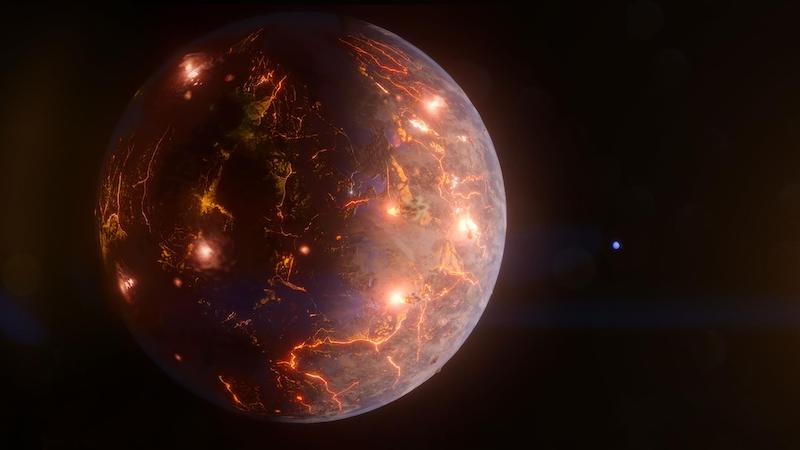 Artist’s concept of an exoplanet covered in volcanoes. Credit – NASA / Goddard Space Flight Center / Chris Smith (KRBwyle)
Unfortunately, that means we will have to wait until the 2040s to get a true glimpse of these planet’s histories. HWO is scheduled to launch then, though if past Great Observatories are any indication, that timeline might be optimistic. As more work is done in terms of what it should be looking for, the mission designers and engineers working on it will have plenty to consider about what we should look for in our best future planet hunter.
Learn More:
B. Farcy et al – Habitable from the start: How initial planetary formation conditions may create habitable worlds
UT – HWO Could Find Irrefutable Signs Of Life On Exoplanets
UT – A Second Instrument On HWO Could Track Down Nearby Earth-Size Planets