
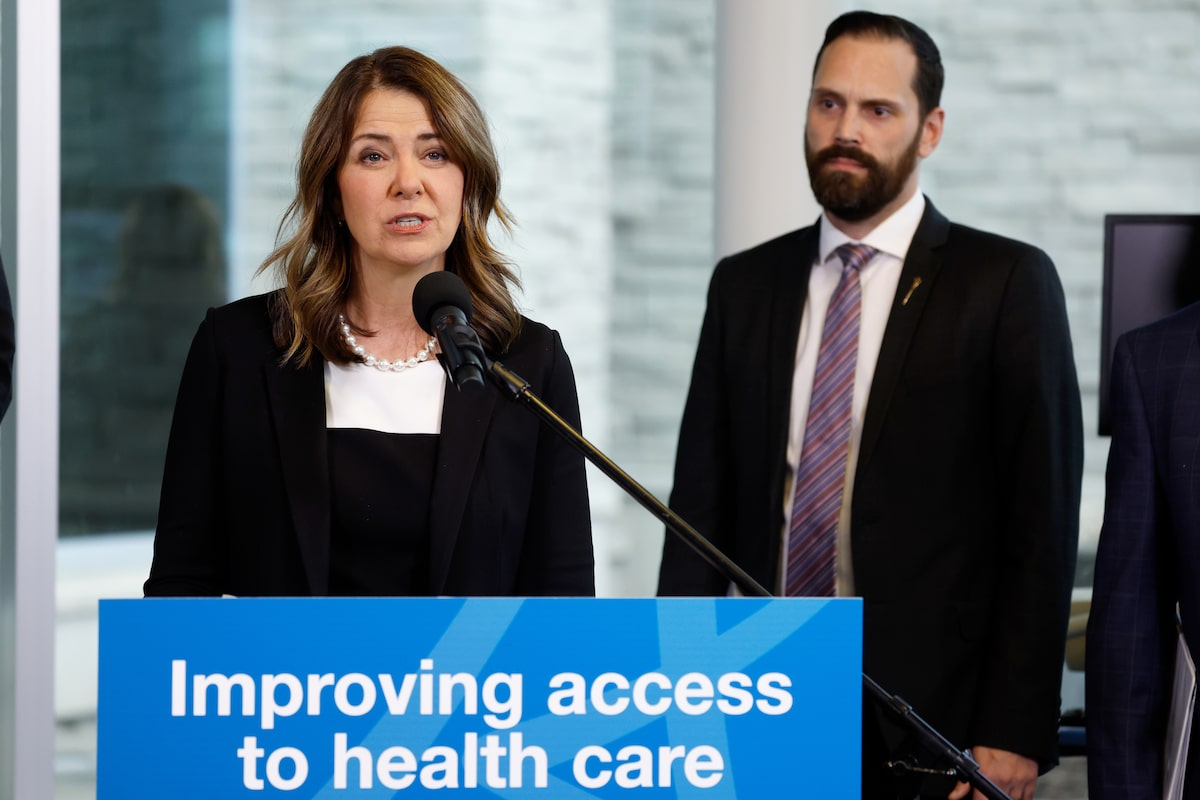
Alberta Premier Danielle Smith, left, and Minister of Hospitals Matt Jones in Calgary earlier this month.Jeff McIntosh/The Canadian Press
Yes, the Canadian health care system is a mess. Though we spend more than all but a handful of developed countries on health care, we achieve middling outcomes, leaving Canada near the bottom of the international rankings in terms of value for money.
Example: Though health care now consumes nearly half of provincial own-source revenues, surgery wait times, now 30 weeks, on average, from referral to treatment, are longer than ever. As the population continues to age, the system can only grow more costly, or more sclerotic, or both.
So yes, it should be possible to discuss bold reforms to Canadian health care, without exciting hysterical claims that the end is nigh, either for medicare or for Canada. And yes, there is nothing particularly new about “two-tier” care: the better off can already avail themselves of faster care by various means.
But no, that does not mean the Alberta United Conservative government’s “dual practice” proposal is a good idea. Radical reforms should not be rejected just because they are radical, but reforms that would do nothing to address the system’s fundamental problems, while adding some of their own, should be.
Robyn Urback: Canadians are protecting the mirage of single-tier health care. It doesn’t exist
The proposal is to allow some doctors to practise in both the public and private systems, charging patients for some procedures while providing others “free” through the publicly funded system.
Currently doctors in all provinces are required to choose: if they want to start charging patients they have to opt out of medicare altogether, and do all their own billing. Most decline to do so.
The Alberta plan, one of several proposed reforms contained in a sweeping new bill, would not apply to primary care doctors, at least “at this time.” Neither would it apply to emergency procedures, or cancer treatments. But patients seeking faster access to elective surgeries such as cataracts or hip replacements could pay a doctor to perform them, rather than either waiting in line or going out of province.
Probably this would shorten wait times – for those who could afford the fees. But proponents claim it would also reduce wait times for those who remained in the public system. After all, every patient who exits the public system for private care makes the lineup for public care one patient shorter, right? Yes, some benefit more than others, but if everyone is better off to some degree, isn’t that progress?
The Editorial Board: Alberta’s (welcome) healthcare heresy
This is where the Alberta plan fails. Just because you divide what was previously one line into two doesn’t change either the number of patients or, crucially, the number of hours in a doctor’s day. All you’ve done is reshuffle the order in which the doctor sees them, replacing medical necessity as the triage criterion with ability to pay.
At best it’s a wash: Doctors spend more hours treating patients privately and fewer hours treating patients in the public system. But in fact it’s likely to be rather worse than that.
To maximize the returns on their private hours, doctors will be likely to focus these on patients who can be treated more quickly, leaving the more difficult, time-consuming cases to the public system.
And doctors can game the system in other ways: for example, by bundling services together, charging for, say, a diagnostic service with the promise of faster access to a treatment provided by the public system. The incentive, in fact, is for doctors to make the public line go slower, so as to maximize the allure of such shortcuts.
These are not just hypothetical concerns. They are the experience in countries that allow dual practice. They can be mitigated, but only by complex and intrusive regulations: for example, by requiring doctors to devote a certain number of hours each month to the public system. Or the government could insist that they reserve private practice for evenings and weekends.
Surgeons will be focus of Alberta’s public-private health care model, Smith says
Each has its problems. You can make doctors put in a certain number of hours on the job, but you can’t very well monitor what they do in that time: ask the government of Quebec, whose attempt to set a minimum number of patients doctors must see is currently embroiling the province. As for working after hours: doctors already work long hours as it is. It’s not clear it’s in patients’ interests for them to moonlight beyond that. At some point, the risks of fatigue outweigh the gains.
Still, some countries, such as France or Australia, have been able to make dual practice work tolerably well, by means of such restrictions, even if others, such as Ireland or Spain, have not. It would be worth discussing whether the guardrails in Alberta’s plan are likely to put it in the former or the latter camp – except there aren’t any. The government has talked about making doctors work a minimum number of hours in the public system, or after hours in the private system. But there is no guarantee of these in the bill itself; it simply empowers the government to set such conditions later in regulations and physician agreements.
And if it did? Then you’ve maybe fixed one problem – that you just created. What you haven’t done is fix any of the other problems in the system – the ones that are really driving costs and creating shortages. Which is really the issue with dual practice: Even if doesn’t prove a disaster, it is still a distraction. It produces all of the outrage of real reform, with none of the policy payoffs.
Gary Mason: Alberta is about to test public-private health care. Canada will be watching
Indeed, for all the excitement it has aroused on the right, the Alberta plan is fundamentally driven by the same fallacy that underlies the left’s proposals for “fixing” health care: the idea that what the system really needs is more money. All it’s done is substitute private money for public money.
But if more money were what the system needed, we’d have fixed health care long ago. We spend more than 12 per cent of GDP on health care today – 9 per cent public, 3 per cent private – or roughly $9,000 per capita. That’s nearly twice what it was 30 years ago, after inflation, when wait times were a third what they are now.
The reason other countries’ health care systems work better than ours isn’t because they spend more money – in most cases they don’t. Neither is it because they allow dual practice: if anything, it’s in spite of it. It’s because their systems are more efficient (or less inefficient); they get more therapeutic bang for each health care buck. We ration care because we waste money. If we didn’t waste so much money, we wouldn’t have to ration care.
That’s not simply a matter of spending less money, either. Rather, it’s about improving incentives for those in the system – doctors, hospital administrators, etc. – to spend money more carefully.
How to improve incentives is no mystery. It borrows many of the insights of market economics – the need for prices, with the information they contain on scarcity, and competition, to ensure that information is actually put to use. But it applies these within a publicly funded system. Rather than compete for patients’ fees, participants compete for public funds.
The problem with public health care isn’t the public funding part. There’s lots of good reasons for it. Private insurance markets are prone to failure, especially for something as tricky as health care, where the consumer is also the product – where you can improve outcomes (keeping costs, and therefore prices, down) by limiting inputs (excluding customers who are likely to get sick).
User fees, aside from equity concerns (in theory surmountable, for example, by means of publicly funded “medical savings accounts”), are also inefficient. Patients are at such an informational disadvantage relative to their doctors that they are in no position to play the kind of role that consumers do in other sectors, deciding what gets produced at what price and by whom.
So the “single payer” model makes sense. The problem is when the single payer is also the sole purchaser. It’s hard to believe now, but the case for medicare used to be that it would cost less: Governments would use their monopoly purchasing power to drive costs down. It didn’t work out that way, because providers also organized themselves as monopolies, and because governments have to get re-elected. It was easier just to pay more, and pass the costs onto the next generation.
Alberta expands use of private surgical centres in bid to shorten procedure wait-lists
To make a market, you need separate sets of competitors on either side of the exchange: purchasers and providers. That’s possible within our system, but it means changes to how each are compensated.
On the provider side, it means moving hospitals off the current “global” system of funding, based on their inputs, and onto a system that pays them based on their outputs, i.e. the treatments they perform: so-called “activity-based funding.”
Why is that critical? Because once you know the price at which a hospital is willing to perform each procedure, it is possible for competition to arise: a rival outfit can offer to perform the same procedure for less. And since it’s all publicly funded, there’s no reason to limit the competition to public hospitals: private clinics can also do the job.
And on the purchaser side? Who, first of all, should be the purchaser? Not the patient: that’s the point of public funding. And not the provincial Minister of Health: we’ve seen the results of that. One early model of reform centred on dividing the purchasing role between several quasi-governmental regional health authorities. They haven’t worked out too well: too big, too bureaucratic, and with no incentive to compete for patients.
So why not groups of doctors? Primary care is only partly about providing care directly to the patient; as important, it’s about commissioning care from other, more specialized providers. Under the current system, doctors in general practice simply refer the patient: someone else foots the bill.
The Decibel: The controversial push to expand private health care in Alberta
But what if doctors were responsible for purchasing the treatment, out of their own budgets? What if they were allocated a certain amount for every patient they enrolled, adjusted for risk (patients in costlier risk groups would come with more funds), out of which to purchase any needed care – and kept whatever was left over, as profit?
The system needs someone to be the watchdog on costs. Who better than doctors: more cost-conscious than remote bureaucrats, more patient-sensitive than private insurers or health-maintenance organizations. Localizing the budget constraint in this way ensures decisions about health care spending are made below the political radar, based on the particulars of each situation, rather than one-size-fits-all.
Provinces are already attempting to move doctors toward this sort of funding model, called “capitation,” and away from traditional fee-for-service. The idea is to reduce incentives for overtreatment in their own practice. But it could be the basis for a more fundamental reform, one in which doctors act as surrogate consumers on behalf of their patients.
That’s radical reform: market-oriented, doctor-driven, patient-focused, and likely to do a lot more good than just giving doctors more room to game the current system.