
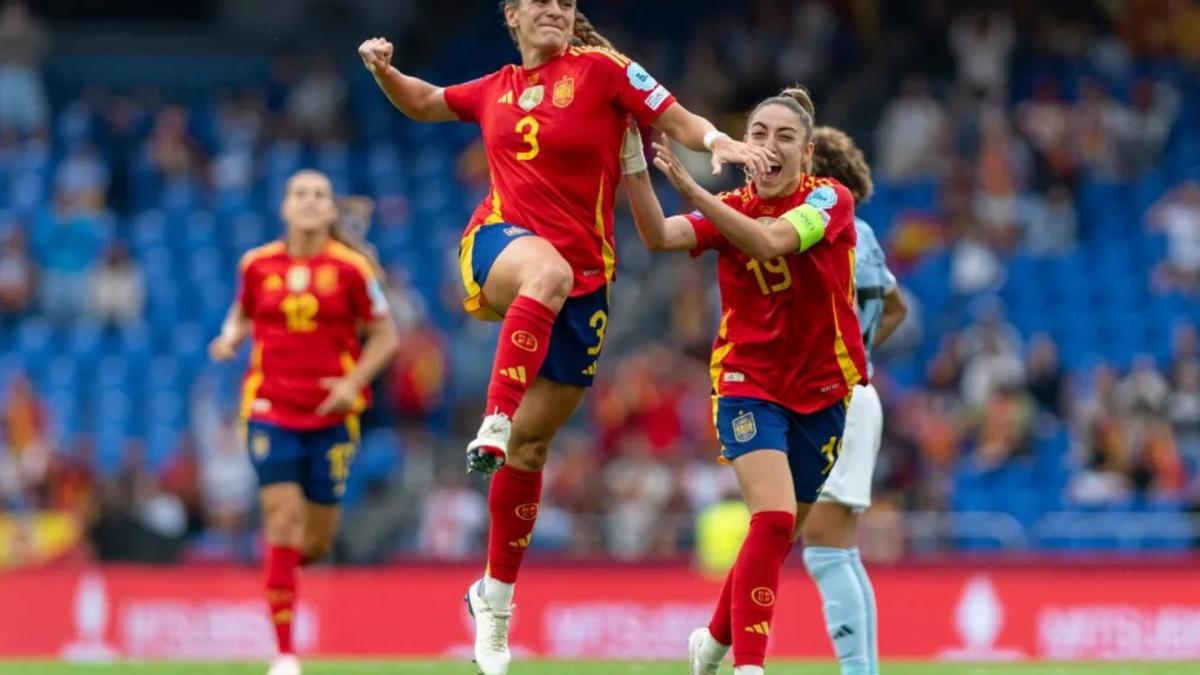
Tere Abelleira, a player for Real Madrid and the Spanish National Team, tore the anterior cruciate ligament (ACL) in her left knee in February and underwent successful surgery in March. However, she has missed the end of the season because this injury requires a fairly long recovery time.
Anterior cruciate ligament (ACL) injuries, one of the most common in the world of sports, are especially frequent in soccer and even more so among female soccer players. Why? It is due to a combination of various factors, as explained by José Reina, a specialist in Traumatology and Orthopedic Surgery at the Hospiten Rambla University Hospital.
This ligament, located inside the knee joint, is a bundle of collagen fibers that runs obliquely between the femur and the tibia. Its function is very important because it is the main obstacle to anterior displacement of the tibia and limits the rotation of this bone, as well as the external and internal angulation of the knee (deviation from its normal alignment) when it is fully extended.
Of the four most important ligaments in the knee, which connect the femur to the tibia, the ACL is the most frequently injured. And what’s more, these injuries are often long and complex to recover from.
ACL Injuries in Female Soccer Players
Female soccer players have a 2 to 8 times greater risk of suffering ACL injuries. “In adolescent players, the relative risk is 3.12 compared to other sports. The incidence rate is 0.148 per 1,000 athletic exposures, the highest among school sports for girls,” Reina points out. “In professional leagues, such as the Spanish and German leagues, between 9.6 and 11 ACL tears are reported per season, which equates to an average of 0.7 injuries per team each season.”
The impact on the careers of professional players is considerable, with an average of 292 days lost due to injury. Fifty-four percent of these injuries occur without contact, 34% through indirect contact, and 11% through direct contact.
Regarding the most frequent injury mechanisms, the specialist cites “rapid changes of direction and sudden decelerations, which are more common during matches than in training.” This suggests, he adds, “that the intensity of competitive play is a significant risk factor, especially during the first half of a match.”
Knee Injury
Reasons Why Female Soccer Players Suffer More ACL Injuries
The main factors behind the higher prevalence of ACL injuries in female soccer players can be grouped into four main categories: anatomical and biomechanical factors, hormonal factors, neuromuscular factors, and external factors:
Biomechanical and Anatomical Factors
Women exhibit increased internal hip rotation and a greater tendency towards dynamic knee valgus (a movement pattern in which the knees move inward) during activities such as changes of direction, landings, and pivoting on the knee. This increases the load and torsional moments on the ACL, raising the risk of rupture.
Regarding the influence of anatomy, Reina points out that women “have a wider Q angle (formed by the quadriceps pull line and the patellar tendon pull line) due to a wider pelvis.” This characteristic “can predispose to greater knee valgus and, consequently, to a higher risk of anterior cruciate ligament (ACL) injury.” Another differentiating anatomical factor would be “a narrower intercondylar width (distance between the condyles or articular surfaces of the femur) and greater joint laxity, which also contribute to the risk of ACL injury.”
Hormonal factors
Hormonal changes that occur during the menstrual cycle can influence anterior cruciate ligament laxity, increasing the risk of injury.
Neuromuscular factors
Female players tend to have a lower hamstring-to-quadriceps strength ratio, as well as less neuromuscular activation of the knee stabilizer muscles. These conditions can also predispose to a higher risk of ACL injury.
External factors
Soccer field conditions, such as artificial surfaces or dry weather, can also have a significant impact on the risk of ACL injury.
How to Prevent ACL Injuries
The most effective preventative measures to reduce the incidence of ACL tears in female soccer players “include neuromuscular and biomechanical training programs,” explains the orthopedic surgeon. “These interventions focus on improving muscle strength, proprioception, landing technique, and core stability.”
Here are some of the most useful interventions for this purpose:
Strengthening exercises focused on the hamstrings, glutes, and core.Plyometric exercises designed to improve power and optimize landing technique.Proprioceptive and balance activities aimed at improving joint stability and neuromuscular control.Landing and deceleration techniques.