
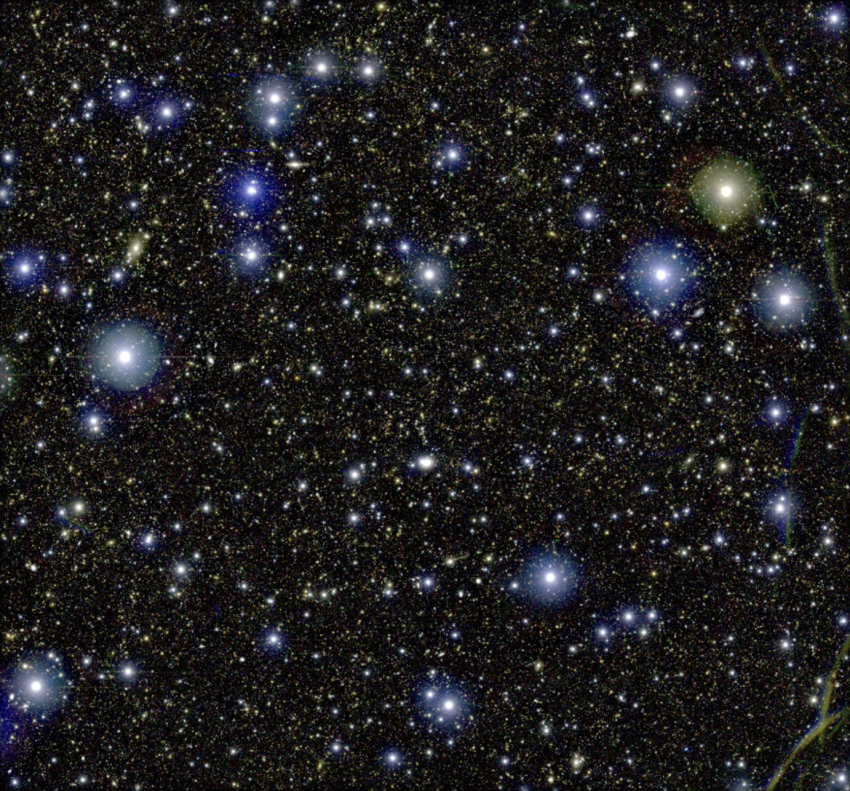
The evolution of each individual galaxy is shaped by its surroundings, according to new research. The Deep Extragalactic Visible Legacy Survey (DEVILS), an endeavour of ICRAR and the University of Western Australia, has released its first data. It includes catalogues of morphological, redshift, photometric and spectroscopic data, as well as group environments and halo data for thousands of galaxies.
DEVILS first data release is in new research published in the Monthly Notices of the Royal Astronomical Society. It’s titled “Deep Extragalactic VIsible Legacy Survey (DEVILS): first data release covering the D10 (COSMOS) region,” and the lead author is Luke Davies. Davies is an Associate Professor at the University of Western Australia node of ICRAR.
This data release comes after 10 years of dedicated observations and data analysis. While there are many astronomical surveys that focus on galaxies, DEVILS is different. It focuses on galaxies that existed up to five billion years ago, and by comparing them to modern galaxies, it examines how they’ve changed up until the present day. It’s giving astronomers a detailed look at and a new understanding of galaxies.
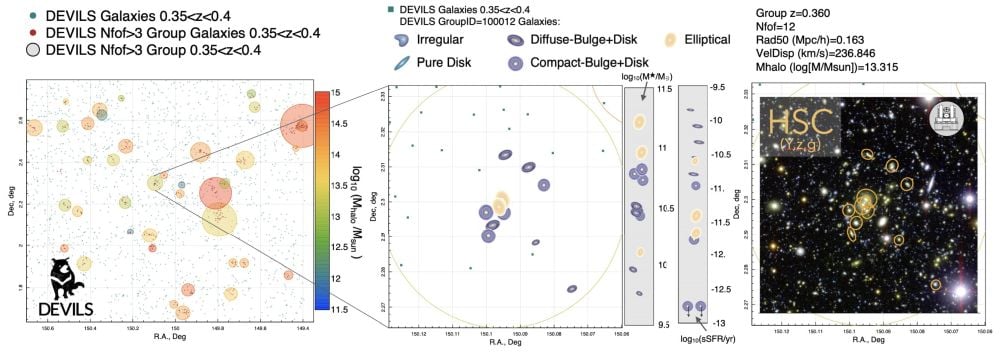 *This image shows some of the diagnostics available in DEVILS Data Release 1. The left panel shows the distribution of isolated galaxies (green points), group galaxies (red points), and dark matter haloes (coloured circles) at around 3.5 to 4 billion years light-years away. Haloes are coloured by halo mass, and their circle size represents the group physical extent. The middle panel shows a zoom-in of one of the groups. Group galaxies are shown based on their morphological type, and grey bars show the stellar mass and SFR distribution of the group galaxies. The right panel is a Subaru Hyper Suprime-Cam image of the group, with group galaxies shown in orange. Image Credit: Davies et al. 2025 MNRAS. DEVILS*
“While previous surveys during this period of universal history have explored the broad evolution of galaxy properties, they have inherently lacked the capacity to determine the finer details of the cosmic landscape,” lead author Davies said in a press release. “In the DEVILS survey, we have been able to zoom in and focus on mapping out the small-scale environment of galaxies – such as mountains, hills, valleys and plateaus as compared to large-scale environments such as oceans or continents.”
One of the main takeaways is that galaxies in crowded environments grow slower than isolated galaxies.
“Briefly, galaxies can be broadly classified into two main categories: blue, gas-rich, star-forming systems, and red, gas-poor, quiescent systems with little or no ongoing star formation,” the researchers write. “All galaxies are believed to begin as low-mass, blue, star-forming systems, gradually transitioning into quiescent systems over time.” As the Universe ages, the fraction of quiescent systems grows.
“In dense environments – such as galaxy clusters, groups, or even close galaxy pairs – the supply of cold gas needed for ongoing star formation can be heated, disrupted or removed, ultimately leading to quenching,” the researchers explain. There are a handful of physical mechanisms responsible for this, including ram-pressure stripping and tidal interactions. These mechanisms affect the movement of star-forming gas between galaxies, empowering star-formation in some and inhibiting it in others.
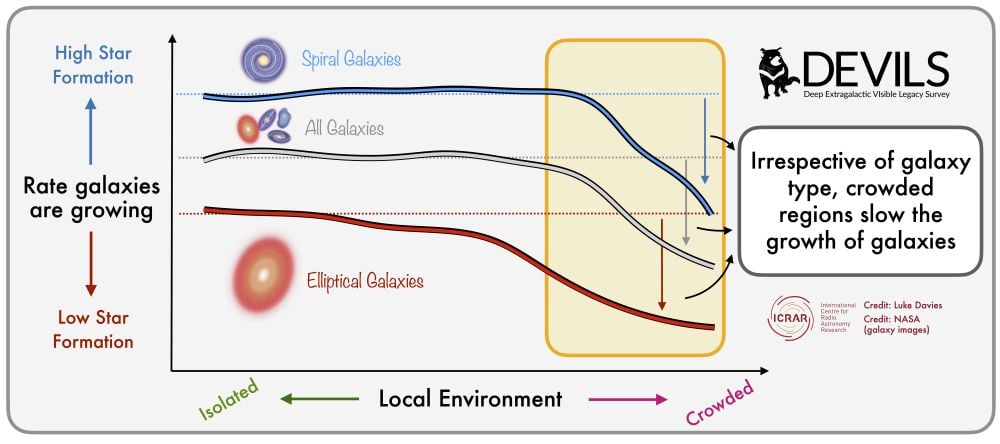 This graphic shows how the rate at which galaxies form stars and grow is inhibited in crowded environments. Image Credit: L. Davies. Licence type: Attribution (CC BY 4.0)
“Galaxies that are surrounded by lots of other galaxies – the bustling city centres of the cosmos – tend to grow more slowly and have very different structures compared to their isolated counterparts,” Davies said.
Davies compares galaxies to human beings. “Our upbringing and environment influence who we are,” Davies said. “Someone who has lived their whole life in the city may have a very different personality compared to someone who lives remotely or in an isolated community. Galaxies are no different.”
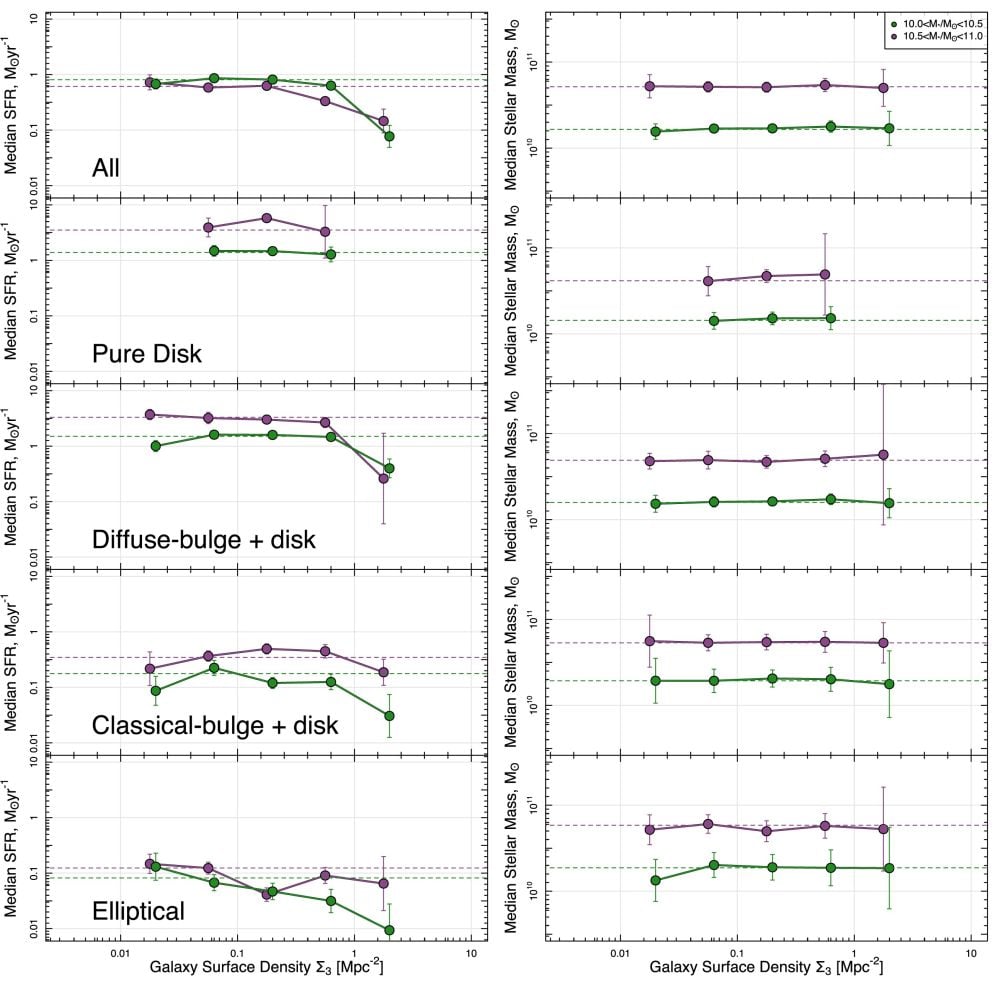 This figure shows the star formation rates for different morphological classes of galaxies. Galaxy surface density describes how densely-packed a region is with galaxies. COSMOS 2020 is a separate survey of galaxies. The left column shows the median star formation rates, and the right column shows stellar mass. “In DEVILS strong trends are observed of SFR decreasing with local density and weak trends of stellar mass increasing with local density,” the authors write. Image Credit: Davies et al. 2025 MNRAS. DEVILS.
The DEVILS data will find its way into the work of other researchers, just as data from other surveys does. But Davies and his team intend to expand DEVILS even further.
“DEVILS forms the basis of our future plans in exploring this key area of astrophysics research,” he said. “DEVILS has given us a detailed picture of galaxy evolution and next year, we will start collecting data for WAVES (Wide Area VISTA Extragalactic Survey). WAVES will allow us to significantly expand the number of galaxies and environments we study, plus help us build an even clearer picture of how the universe came to look the way it does today.”