
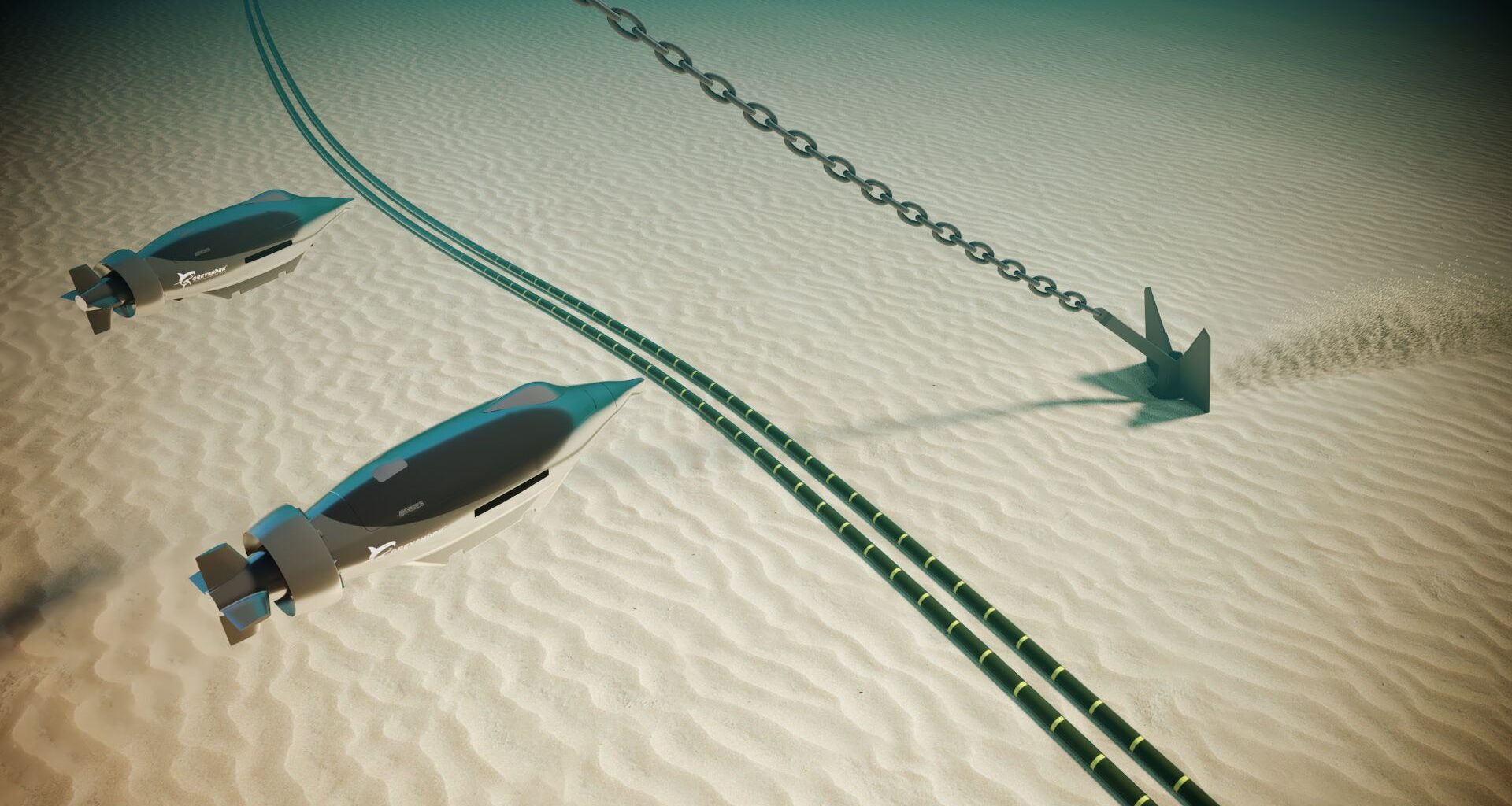
A German defense technology firm has introduced a new autonomous underwater robot designed to patrol, map, and protect the world’s rapidly expanding network of subsea cables, the infrastructure carrying more than 95 percent of global internet traffic and an estimated $10 trillion in financial transfers every day.
Euroatlas said its new system, called Greyshark, is intended to provide long-duration reconnaissance and surveillance in coastal and deep-water environments.
The shark-shaped vehicle is built around a suite of advanced sensors and autonomous behaviors that allow it to operate without human oversight across long distances.
Shark-shaped underwater robot
The company says the robot can cover more area by working together with other robots. These robots can communicate securely underwater.
They can sit quietly on the seabed and only wake up when they notice something unusual, like a suspicious boat or activity near important infrastructure.
Greyshark is being introduced amid efforts by countries to protect their underwater cables. This cable network spans over 1.3 million kilometers (800,000 miles) and is becoming a growing concern due to geopolitical tensions and a rise in unexplained damage in the Baltic and other areas.
EUROATLAS unveiled its new GREYSHARK autonomous underwater vehicles designed for long-range ISR and subsea infrastructure monitoring.The Bravo and Foxtrot variants use an AI-driven mission stack,17-sensor suites+ Level 5 autonomy to conduct multi-mission underwater operations pic.twitter.com/smRrdI66H6
— Valhalla (@ELMObrokenWings) November 27, 2025
The North Atlantic Treaty Organization launched a new initiative this month, called Baltic Sentry, to expand surveillance of vessels following several cases of cables being cut or disrupted in 2024.
NATO Secretary-General Mark Rutte recently said the alliance would increase patrol aircraft, warships, and unmanned systems and take “robust” action, including boarding or seizing ships suspected of tampering with undersea lines.
He said the alliance would monitor Russia’s so-called “shadow fleet,” vessels operating without clear ownership and suspected of carrying embargoed goods.
“There is reason for grave concern,” Rutte said, adding that the undersea infrastructure is essential not only for electricity supplies but also for global communications. He said NATO would do “what it takes” to ensure network security.
Euroatlas says Greyshark was built with that mission in mind. The vehicle is designed to map cable routes, survey infrastructure corridors, and detect anomalies or interference.
It can also support installation and maintenance work for new data lines and energy connectors, including the major intercontinental projects now being built by Meta, Amazon Web Services, and European transmission operators.
Securing 800,000 miles of global subsea cables
Greyshark reports contact information to other units, nearby friendly vessels, or regional monitoring centers using encrypted acoustic communications.
The company said the robot can also “deter” hostile reconnaissance by deploying in a swarm pattern, using active sensors to search in parallel and track specific vessel types in real time.
“Patrol and protect a critical sea area with single or multiple Greyshark,” the company said in a statement.
“Make them hold their position passively on the seabed and activate at critical events, such as the identification of a specific vessel.”
Autonome Unterwasserdrohnen können in Häfen oder von Schiffen relativ leicht zu Wasser gebracht werden.
Der Greyshark von Euroatlas kann 16 Wochen autonom operieren und dabei 8000 Seemeilen zurücklegen. Derzeit wird das AUV in der Ostsee getestet.
1/2 pic.twitter.com/IZb6k1kS4k
— Grünfink (@Grnfink2) November 21, 2025
Greyshark connects with standard maritime situational-awareness networks. It travels at about 10 knots and has a minimum operating range of 1,000 nautical miles. Its non-metallic hull, quiet electric motor, and low sonar signature help make it hard to detect.
Using sonar, lidar, cameras, and electromagnetic sensors, the robot can detect mines, track undersea structures, and conduct change-detection analysis on harbors, pipelines, and cable corridors.
Euroatlas says its navigation system allows it to operate while fully submerged throughout its mission range. A full support system is offered for transport, deployment, refueling, and maintenance.
The company says the robot’s ability to work without a surface vessel makes it well-suited for persistent monitoring. Data collected during patrols can be transferred while the robot is deployed or after its return.
As subsea networks grow in strategic importance, and as recent incidents highlight their vulnerability, Euroatlas said autonomous systems like Greyshark will play a larger role in safeguarding the infrastructure that underpins global communications and the digital economy.