
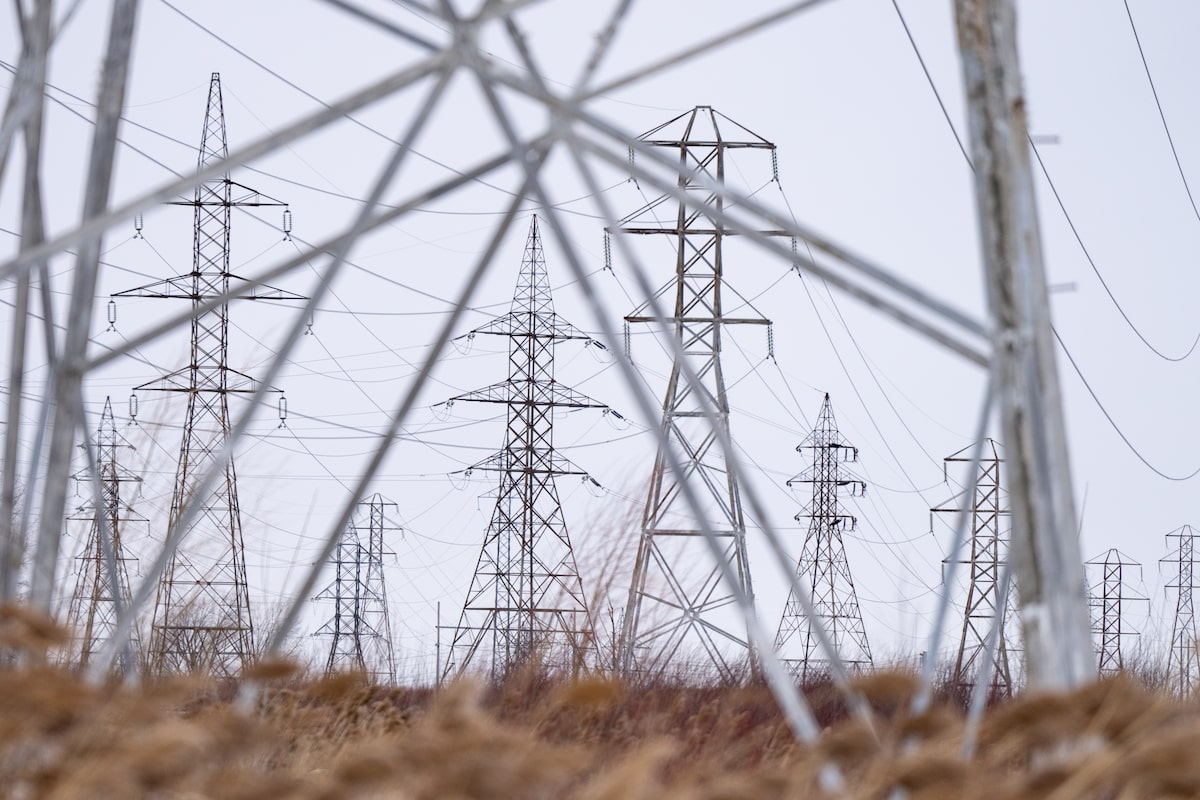
Electricity lines in Beauharnois, Que., in January of 2025. Hydro-Québec is now buying more power from outside the province than it is exporting.Christinne Muschi/The Canadian Press
Hydro-Québec is now buying more power from outside the province than it’s exporting, a significant reversal from years past caused by a drop in its northern water reservoirs at a time of surging demand.
The utility, Canada’s biggest producer of electricity, purchased about 10 terawatt-hours of power at a price of 5 cents a kilowatt-hour for the first nine months of the year, according to its latest quarterly report published Friday. It sold about 8 twh at 15 cents a kwh over the same time outside Quebec.
“While the reservoirs are prudently managed and Hydro-Québec has the resources necessary to respond to the demand for electricity, the situation resulted in a decrease in sales on external markets,” chief financial officer Maxime Aucoin said in a statement. He predicted 2025 will be a record year for imports.
Electricity reliability could be strained by rise of AI data centres, report warns
Ontario power rates to rise on higher nuclear generation costs, conservation spending
The provincial Crown corporation has 28 large reservoirs that it uses to produce hydropower, fed by rain and snow melt. The largest is the Caniapiscau reservoir (surface area: 4,359 square kilometres) that supplies the power stations of La Grande in the James Bay region. Local media reports over the summer said that reservoir was only at about 44-per-cent capacity.
Water cycles are unpredictable. After an eight-year period of high water inflows from 2013 to 2021, volumes in Hydro-Québec reservoirs have since decreased to below average levels, according to Pierre-Olivier Pineau, an energy specialist at Montreal’s HEC business school.
“It’s not surprising and we should not be alarmed,” Mr. Pineau said in an interview. “Markets and interconnections are there to balance supply and demand.”
The sheer size of Hydro-Québec’s system and its storage capacity give the power producer flexibility in handling its reserves, exporting electricity when prices are high and importing when they’re low, Mr. Aucoin said. The company has generated more than $600-million in profit this way since January, part of the $2.83-billion in net income it reported for the first nine months of the year.
Quebec sells most of its electricity exports on the northeast spot market, although two long-term supply deals with Massachusetts and New York are set to come online over the next several weeks. The bigger of the two, called the Champlain Hudson Power Express (CHPE), will provide one-fifth of the city of New York’s power when it starts next May.
The utility has planned for the launch of those two export contracts and won’t back down on its commitments despite the challenging water-level conditions, chief executive Claudine Bouchard told reporters earlier this month. “There’s no way out” of the deals, she said.
Demand for electricity in Quebec is expected to double by 2050. In response, Hydro-Québec is pushing forward with a $200-billion plan to develop new clean-power generation facilities and improve the reliability of its grid.
The effort, which is at the centre of Premier François Legault’s strategy to counter the economic pain of U.S. tariffs, involves tripling its wind-power production and building 5,000 kilometres of new transmission lines among other initiatives.