
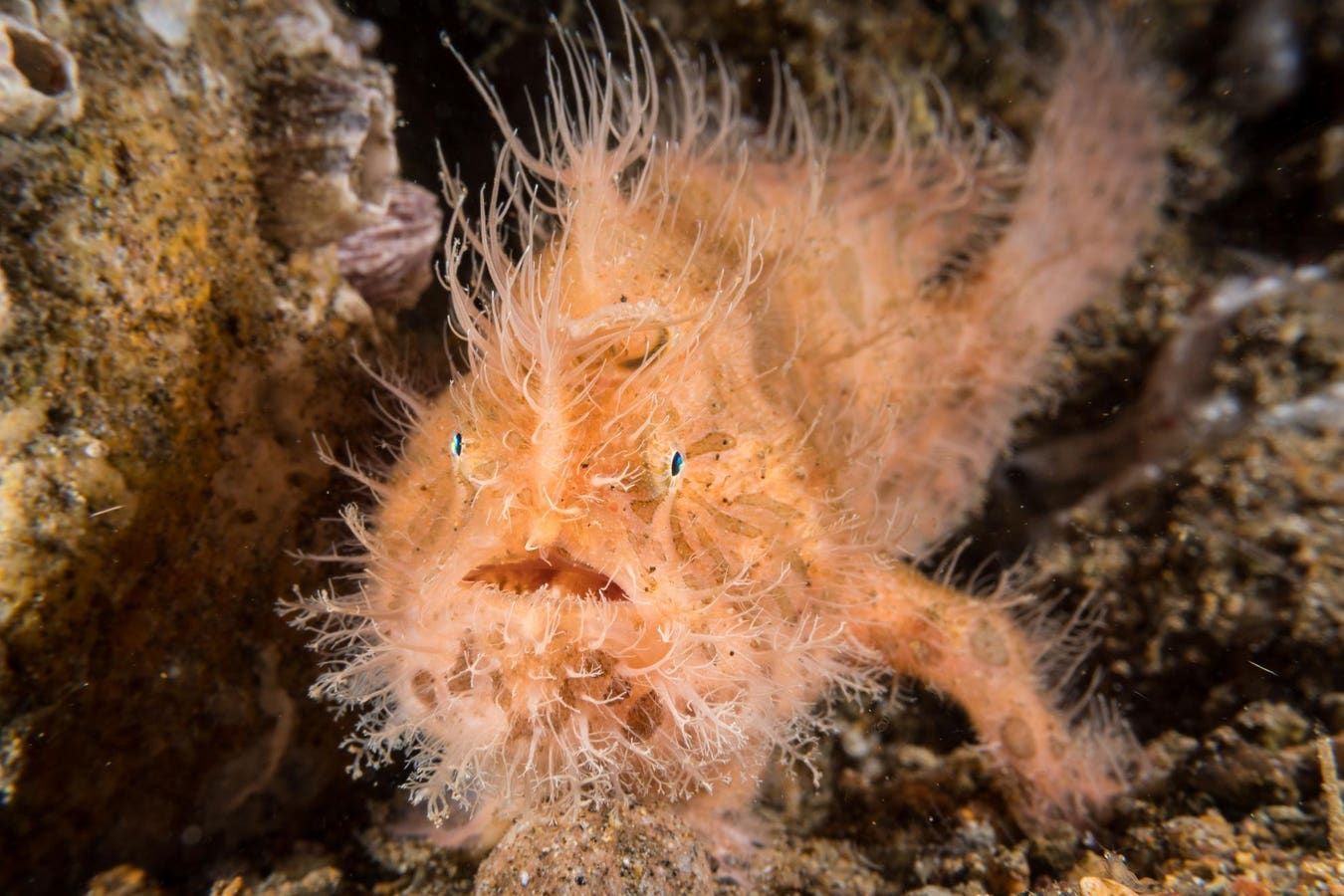
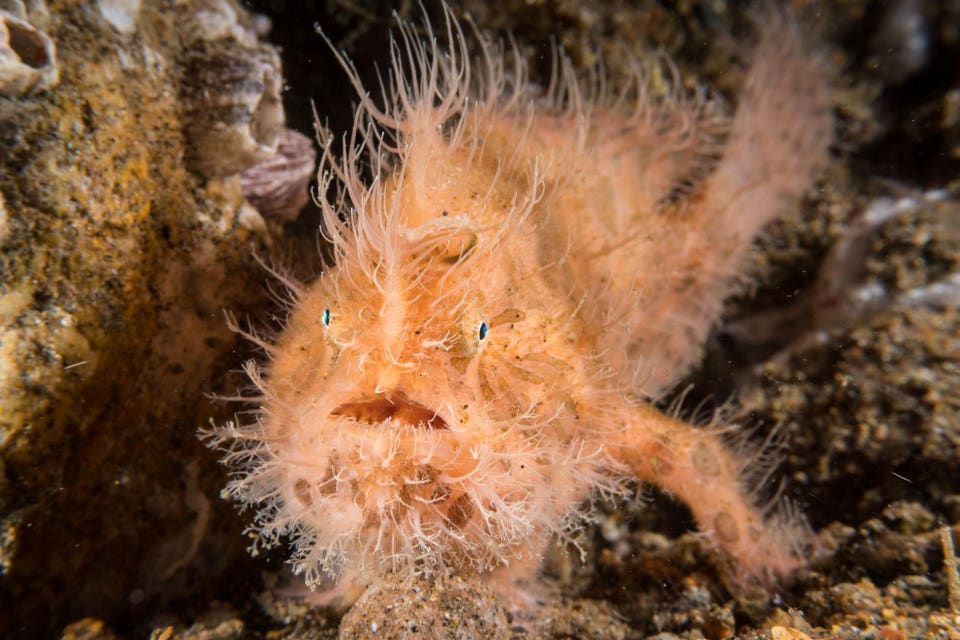
A new study reveals how frogfish mastered their eerie fishing trick: by rearranging their motor neurons. Here’s the surprising science behind it.
getty
Anglerfish are some of the most bizarre and fearsome predators lurking in the ocean’s depths. Known for their haunting appearance and unique hunting methods, these fish have evolved to use a rod-like fin with “bait” to lure in prey. But as researchers have recently discovered, the success of this remarkable skill doesn’t rest solely on the structure of their fins; it also depends on a specialized adaptation within their nervous systems. One particular family of anglerfish has mastered the use of this adaptation to hunt with incredible precision: the frogfish (family Antennariidae).
Through a study conducted at Nagoya University, scientists have uncovered how the frogfish’s nervous system underwent neural rewiring to enable its astonishing “fishing” behavior.
The Art Of ‘Frogfishing’
Anglerfish, as you may already know, are famous for their bioluminescent “lure” positioned atop their heads: a fleshy appendage known as the esca, as explained by research from the Journal of the Marine Biological Association of the United Kingdom. The soft, glowing light it emits is nearly impossible for prey to resist. Hypnotized by the dazzling glow, small fish approach for a closer inspection — only to be devoured in a single, lightning-fast gulp.
Thanks to their remarkable anatomical advantages, anglerfish are considered apex predators of the deep sea. Despite their many differences in size and shape, members of this family are united by their ingenious hunting adaptations. Frogfish, one such member of the anglerfish family, are no exception.
Unlike their bioluminescent cousins, frogfish take a different approach to lure in prey. While the traditional anglerfish relies on the incandescence of its “lure,” frogfish, on the other hand, rely on the shape of their “rod”: a specialized front dorsal fin known as the illicium. The frogfish’s “rod,” in particular, is highly distinctive, as it ends in a tip that resembles a clam worm.
Naturally, this resemblance makes it all too easy for the frogfish to entice small fish and crustaceans, who regularly eat clam worms. By deceptively waving their worm-like fin back and forth, frogfish can mimic the natural movements of their prey’s favorite snack. Enticed by the lifelike bait, curious fish and crustaceans are lured in — which makes them ridiculously easy targets for the frogfish’s ambush.
Their already phenomenal “fishing” skills are further compounded by their superb camouflage capabilities, as well as their alarmingly quick reaction time, according to 2024 research from Scientific Data. With their unique ability to alter their bodies’ coloration, they blend seamlessly into surrounding rocks, coral and sea sponges; this way, frogfish become practically invisible to their prey.
On top of this, when the moment strikes, they execute their attack at astonishing speeds; they need only a mere six milliseconds to snatch and swallow their meal, which is over 90% faster than the blink of a human eye. This makes their strike one of the fastest feeding motions in the entire animal kingdom, let alone in the ocean.
The Neurons Behind The Frogfish’s Fishing Rod
The frogfish’s uncanny hunting abilities, however, aren’t just a product of physical prowess. They are also made possible by an extraordinary change in their nervous system, according to an October 2024 study from The Journal of Comparative Neurology. The authors of the study, researchers from Nagoya University, recently uncovered the neural mechanisms behind the frogfish’s illicium, revealing how its nervous system evolved to match the fin’s unique function.
Specifically, the researchers used tracer injections to map the motor neurons responsible for moving the frogfish’s dorsal fins — namely, the hairy frogfish (Antennarius striatus).
The hairy frogfish can borderline inhale its prey. It only takes six thousandths of a second for this apex predator to expand its jaw up to 12 times its normal size, and then vacuum their prey in with lightning speed.
getty
With this technique, which can be likened to mapping out electrical wiring, they identified a surprising difference in the neurons controlling the illicium. While most fish have motor neurons for their fins located much lower down in the spinal cord (the ventrolateral zone), the illicium’s motor neurons have shifted to the dorsolateral zone — a completely different position in the spine, near the top.
This relocation emphasizes the illicium’s specialized role as a hunting tool. Unlike the frogfish’s other fins, which are used for swimming and balance, the illicium requires incredibly fine motor control to mimic the movements of a clam worm.
By relocating its motor neurons, the frogfish’s nervous system was able to adapt to the fin’s evolving function. While this may seem like a small change, this neural adaptation is incredibly rare. Moreover, it provides a striking example of how evolution operates at the intersection of anatomy and behavior.
What Makes This Frogfish Discovery So Exciting?
The ability to rewire the nervous system to support a new function is an incredible demonstration of evolutionary flexibility — and this finding is so much more than a mere idiosyncrasy amongst frogfish. In reality, this could broaden our current understanding of how evolution could very well shape the nervous system of vertebrates.
It’s worth noting that, typically, a fish’s fins serve very straightforward roles, like swimming or providing stability. For frogfish, however, their illicium is no longer just an ordinary fin. Through evolutionary time, it has slowly morphed into a precision-engineered fishing rod, complete with what looks like live bait.
For this adaptation to succeed, the nervous system had to evolve in tandem with the fin itself. The shift of motor neurons to the dorsolateral zone allowed the frogfish to gain precise control over its illicium’s movements. This, in turn, enabled it to function as an effective hunting tool.
This finding is even more fascinating when viewed in contrast with other species. For instance, the authors of the study note that the whitespotted pygmy filefish also uses its first dorsal fin — but, for an entirely different purpose: intimidating predators.
In this context, the motor neurons controlling the fin remain in the ventrolateral zone, alongside the neurons for its other fins. In other words, frogfish’s neural adaptation wasn’t just a general evolutionary trend; it was a highly specific response to the illicium’s unique role in hunting.
In all, this discovery is one of the many testaments to the extraordinary ways evolution can mold not just the bodies of organisms, but the very neural systems that control them. The frogfish is just one stunning example of how closely intertwined form, function and neural control can be.
Are you an animal lover who owns a pet? Take the science-backed Pet Personality Test to know how well you know your little friend.
Do you have an eye for nature photography? Join my Nature Photography Club and take your photos to the next level.