
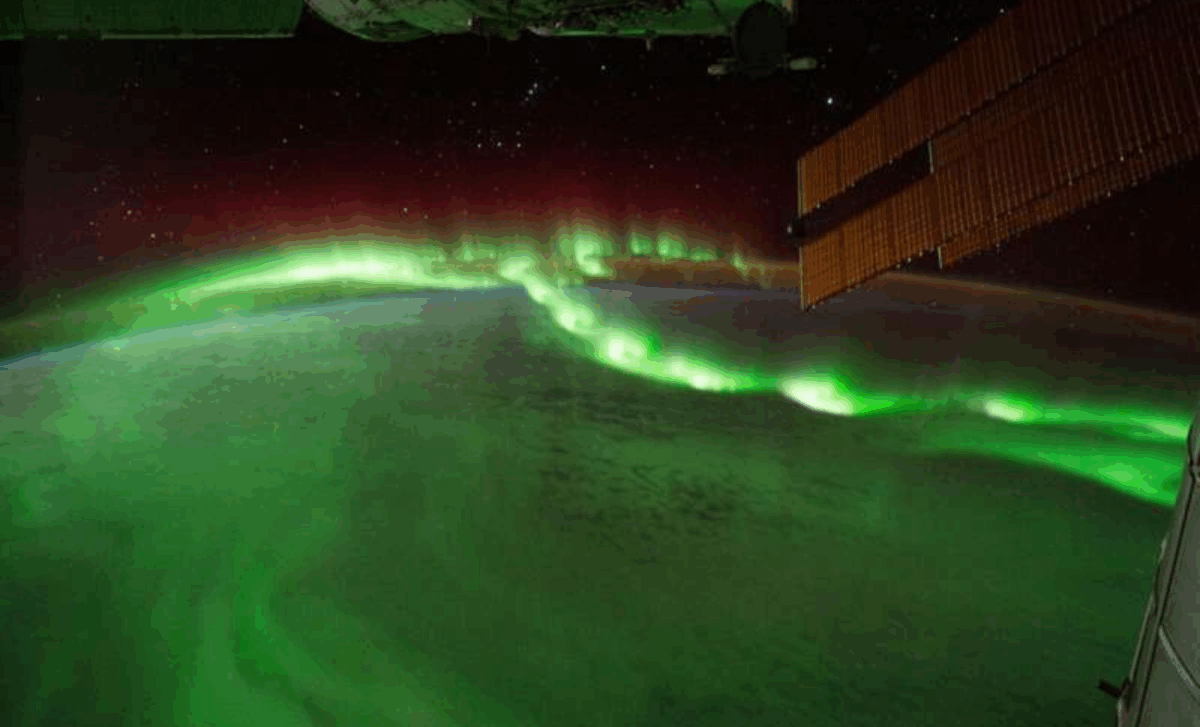
A mysterious radio wave has been linked for the first time to the sudden bursts of auroral storms that paint the skies in vivid green and red. The discovery could transform how we predict space weather and understand the solar wind’s grip on Earth’s magnetic field.
Using advanced ground-based observatories, scientists have traced a distinct radio signature that appears just moments before intense auroral outbursts begin.
Their findings are published in Nature Communications.
The Sound Before the Sky Erupts
For decades, physicists have known that auroral substorms—the sudden, explosive brightenings of the northern and southern lights—stem from the violent release of energy stored in Earth’s magnetosphere. But what triggers that release has remained elusive. The new research, led by an international team from the University of Southampton, connects a specific type of low-frequency radio wave to the moment this energy erupts, revealing a long-missing piece of the puzzle. Their findings are published in Nature Communications, marking one of the clearest links ever observed between radio emissions and auroral activity.
“The aurora borealis and aurora australis are caused by charged particles from space colliding with atoms and molecules in our atmosphere,” explains physicist Dr. Daniel Whiter of the University of Southampton. “Particles ejected from the sun flow out through the solar system carrying the sun’s magnetic field with them, and this ‘solar wind’ is the source of energy for the aurora.
“Auroral substorms are caused by the accumulation and then release of magnetic energy stored in Earth’s magnetosphere during its interaction with the solar wind flow. However, what exactly triggers this energy to suddenly unload in spectacular fashion isn’t fully understood.”
Researchers discovered that just before an auroral storm intensifies, the magnetosphere emits distinct radio waves detectable by specialized instruments. These waves may serve as an early-warning system—allowing scientists to predict geomagnetic disturbances that can disrupt satellites, GPS systems, and power grids.
Listening to Earth’s Magnetic Pulse
By comparing data from multiple Arctic observatories, scientists identified a repeating signal pattern that coincided precisely with the onset of auroral storms. This radio precursor appears to be generated when energy stored in Earth’s magnetic tail is rapidly transferred toward the poles, igniting the shimmering displays in the upper atmosphere.
The discovery helps scientists “listen” to the invisible processes shaping space weather. Using this newfound signal, models of magnetospheric dynamics can now simulate the chain reaction that culminates in a substorm. This connection between magnetic energy release and radio emissions also deepens our understanding of space plasma physics, offering a rare glimpse into how energy flows through our planet’s cosmic shield.
Astronomers are optimistic that future satellite missions could map these radio signatures in real time, creating a global auroral warning network. Such advancements could protect critical infrastructure and bring us closer to decoding the hidden rhythm of Earth’s magnetic environment.
A New Era in Space Weather Forecasting
This research marks a turning point in how scientists monitor the sun–Earth connection. If these radio signatures are consistently detected, they could become a new metric for forecasting geomagnetic storms before they reach their most disruptive phase.
The findings, published in Nature Communications, open a pathway toward a future where auroral substorms are not just seen—but heard—by an array of sensitive instruments designed to monitor the solar wind’s interaction with our planet. With each new observation, the intricate choreography between the solar wind, Earth’s magnetosphere, and the auroral lights becomes clearer, drawing us closer to understanding the forces that color our night skies.