
As the autumn season begins to close itself out, the last month of 2025 promises to bring astronomy lovers even more viewing and learning opportunities than usual. From a shockingly high moon to two separate meteor showers, here are some of December’s most anticipated astronomical phenomena and rocket launches.
The full moon of December, commonly nicknamed the Cold Moon, will rise at 6:14 PM (Eastern Time) on December 14. Following the moons of October and November, the Cold Moon will be the third of three consecutive supermoons, which occur when a full moon rises during the nearest point in its orbit around Earth (or its “perigee”). Generally, the visual differences between a supermoon and a regular moon will not be noticeable to a casual observer, though the supermoon is actually larger and brighter. This Cold Moon is also sometimes referred to as the Frost Exploding Trees Moon, the Snow Moon, and the Winter Maker Moon, and, this year, it will seem to be higher up in the sky in the Northern Hemisphere compared to any other full moon until 2042. It will also be the final supermoon until November 2026.
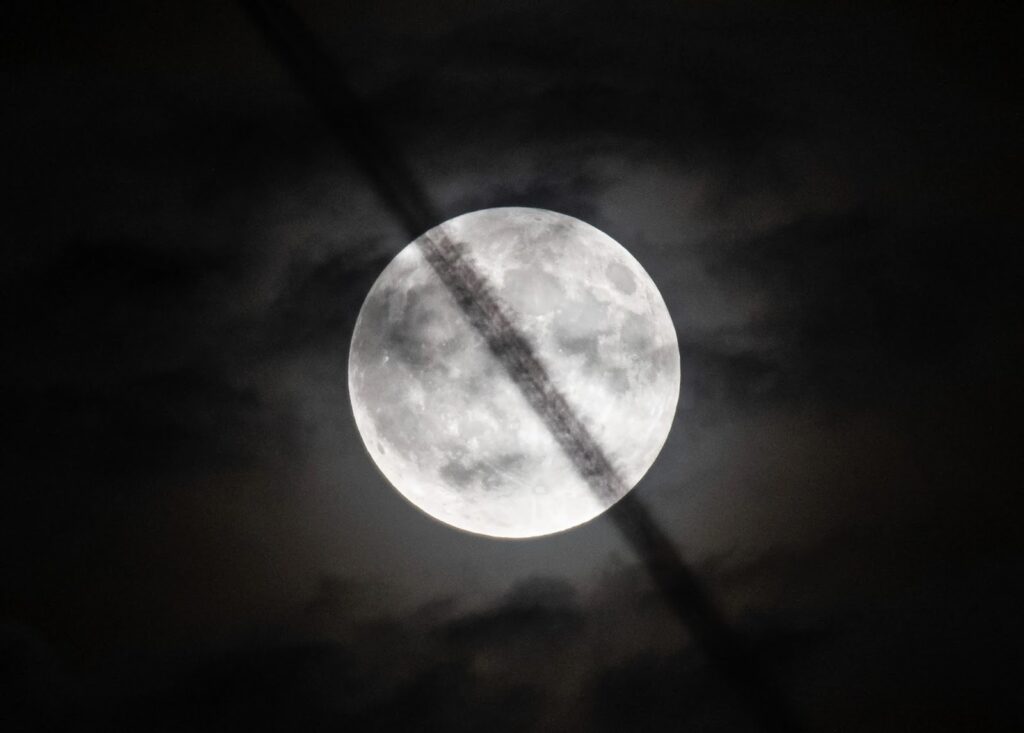 (One of four supermoons to light up the sky in 2024. Image Credits: NASA/Jordan Salkin)
The Geminids meteor shower will be peaking just after midnight during the night between December 13 and December 14. Known to be the “king of meteor showers,” the Geminids are consistently one of the strongest and most reliable annual meteor showers with an average rate of 60 to 150 brightly coloured meteors each hour. The Geminids have an average duration ranging from the beginning of December to December 21, and unlike the majority of other annual showers, which come from the debris of comets, the Geminids originate from an asteroid called 3200 Phaethon. When the Geminids meteor shower was first observed in the 1800s, it was a more minor shower with only 10 to 20 visible meteors per hour. However, in the years since, that rate has greatly increased in frequency, with one possible explanation being that the gravitational pull of Jupiter has been bringing 3200 Phaethon’s debris closer to our planet. While we have been aware of other major yearly showers for far longer than the Geminids (for example, the Perseids and Leonids showers were first noted in 36 AD and 902 AD respectively), this shower has quickly cemented itself as being worth the watch, and hopeful observers will certainly catch some burning streaks in the sky if they decide to stay up.
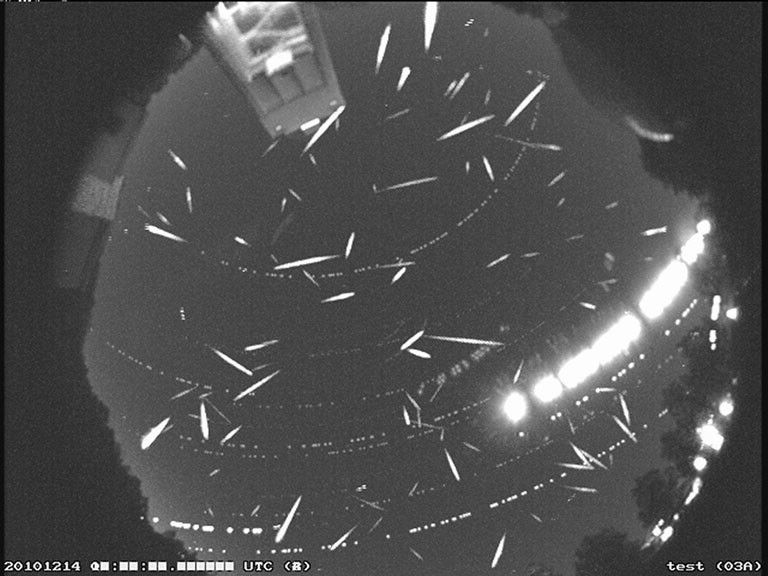 (A composite image of the 2014 Geminids meteor shower, containing over 100 meteors streaking across the sky. Image Credits: NASA/MSFC/Danielle Moser, NASA’s Meteoroid Environment Office)
This year, the December solstice will fall on December 21. This marks the shortest day of the year in the Northern Hemisphere, as well as the first day of astronomical winter (those measuring weather patterns break up the year into simpler three-month periods for tracking purposes, meaning that meteorological winter begins on December 1 and ends on the final day of February). In the Southern Hemisphere, on the other hand, December 21 will be both the longest day of the year and the first day of astronomical summer. Various cultures celebrate the December solstice differently around the world, with some common traditions including dancing, feasting with family and friends, and giving gifts.
Between December 21 and December 22, the second meteor shower of December, or the Ursids shower, will reach its peak. Compared to their Geminids predecessor, this will be a very minor shower, with a typical rate of only 5 to 10 visible meteors every hour. In the past, the Ursids have been known to surprise viewers with unexpected bursts of hundreds of meteors at a time, though a special show like this is not predicted for the 2025 season. Typically peaking near the winter solstice, the Ursids tend to be overlooked due to both the holiday season and the first shower of the month, though their proximity to the new moon will make for ideal viewing conditions this year. This will be the final meteor shower of 2025, and has definitely earned that title!
Overall, this month is sure to contain a variety of fascinating astronomical events. Whether you choose to try your luck at spotting the Geminids or Ursids meteor showers or would rather celebrate the Northern Hemisphere’s winter solstice, December will have an astronomy learning opportunity for everyone. Good luck, and happy observing!