
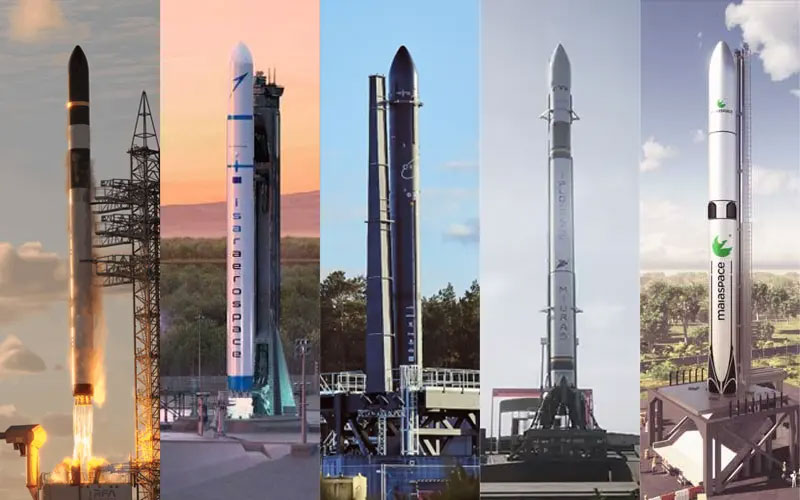
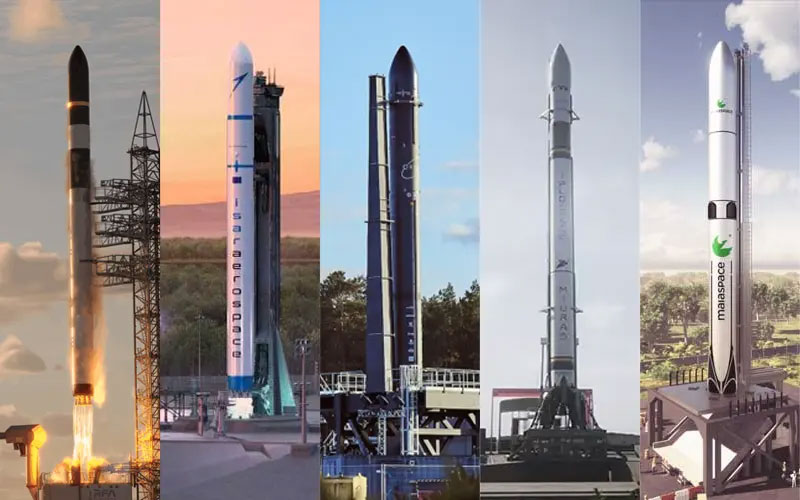
 Credit: Isar Aerospace / Rocket Factory Augsburg / PLD Space / MaiaSpace / Orbex / European Spaceflight
The European Space Agency’s (ESA) European Launcher Challenge has seen a significant financial commitment from its Member States during the agency’s Ministerial Council meeting in Bremen (CM25) this week. The agency will sign framework contracts with the five shortlisted companies in 2026, after which each will be required to successfully demonstrate its launch system by 2027 at the latest “to confirm selection under the European Launcher Challenge.”
ESA published a call for proposals for its European Launcher Challenge in March 2025. The programme was created following an agreement at the agency’s Council meeting in Seville in November 2023 and aims to foster the development of future European commercial launch services. Instead of financing rocket development directly, ESA will purchase launch services and co-fund capacity upgrades, with companies required to leverage significant private investment to develop their vehicles.
In July 2025, ESA shortlisted Isar Aerospace, Rocket Factory Augsburg, PLD Space, MaiaSpace, and Orbex to proceed to the initiative’s next phase. It then began discussions with the host country of each company to assess its willingness to contribute to that company’s participation in the European Launcher Challenge.
During his post-CM25 address, ESA Director General Josef Aschbacher revealed that Member States had committed double the anticipated amount for the European Launcher Challenge, with the final figure exceeding €900 million. While the funding model’s structure suggests that only the UK, Spain, France, and Germany contributed, post-CM25 disclosures have indicated that a few additional countries also committed funds to the programme.
Germany, with two companies among the shortlist, is unsurprisingly a large contributor to the programme, committing €363 million. In its statement, the country described the programme as “crucial to ensuring that Europe does not fall behind technologically and competitively in the global space sector.”
The Spanish Space Agency specifically mentioned PLD Space and its MIURA 5 rocket in its statement, noting that it had contributed €169 million to the European Launcher Challenge.
“We are boosting national industry with an investment of €169 million so that the MIURA 5 rocket from PLD Space is part of the future generation of European launchers.”
The UK Space Agency announced that it had contributed £162 million (€184 million) for launch programmes, including the European Launcher Challenge. It did, however, provide no breakdown of how much of the funding would go towards Orbex through the European Launcher Challenge. However, since the UK is not involved in either the Ariane 6 or Vega C programmes, it’s likely the bulk of its contribution is for the challenge.
“This commitment supports the aim of securing assured access to space for the UK, enhancing our national security in an uncertain world, and ensuring the UK benefits from the fast-growing global space market, which makes an outsized contribution to our economy,” a 27 November UK Space Agency announcement revealed.
In a statement, Mari Amanda Eldholm, Senior Advisor of Industrial Policy at the Norwegian Space Agency, revealed that Norway had contributed €55 million to space transportation, which she explained “includes the European Launcher Challenge.” Eldholm said that its contribution would go towards developing launch services from Andøya spaceport with Andøya Space, the spaceport’s commercial operator, and Germany’s Isar Aerospace, which maintains a launch pad at the facility.
In a breakdown of its contributions at CM25, Czechia has committed €200,000 to the European Launcher Challenge. An announcement from the Czech Space Portal earlier this year indicates that the country’s involvement in the programme may be tied to opportunities for Czech industry to contribute to Orbex and its medium-lift Proxima rocket.
Prior to CM25, a Netherlands Space Office (NSO) report indicated that, for the country to contribute to the programme, it would require additional government resources in the amount of €20 million. There are no public announcements yet that the NSO has received the funding it planned to contribute to the programme. However, given that the country’s pre-CM25 plan envisaged roughly €340 million in ESA spending and the final commitment exceeded €450 million, it is conceivable that sufficient budget space was created for a potential subscription to the programme.
France is the only country with a company shortlisted that has not made a public comment on its commitments to the programme. The closest indication yet comes from a report by the French news outlet La Tribune, which stated that €1.7 billion was committed to launchers, including Ariane 6, the Guiana Space Centre, Vega-C, and the European Launcher Challenge. However, the report did not include a breakdown of how this amount was distributed across those programmes.
The next stage of the programme will see ESA signing framework agreements with each participating company in 2026. Each company will then be required to successfully demonstrate its launch system by no later than 2027. If successful, ESA will commit to procuring launch services, with missions to be flown by 2030 at the latest.
As a separate element of the programme, each company may also be required to demonstrate, no later than 2028, a proposed capacity upgrade that has not previously been flown in order to unlock additional funding.
Keep European Spaceflight Independent
Your donation will help European Spaceflight to continue digging into the stories others miss. Every euro keeps our reporting alive.