
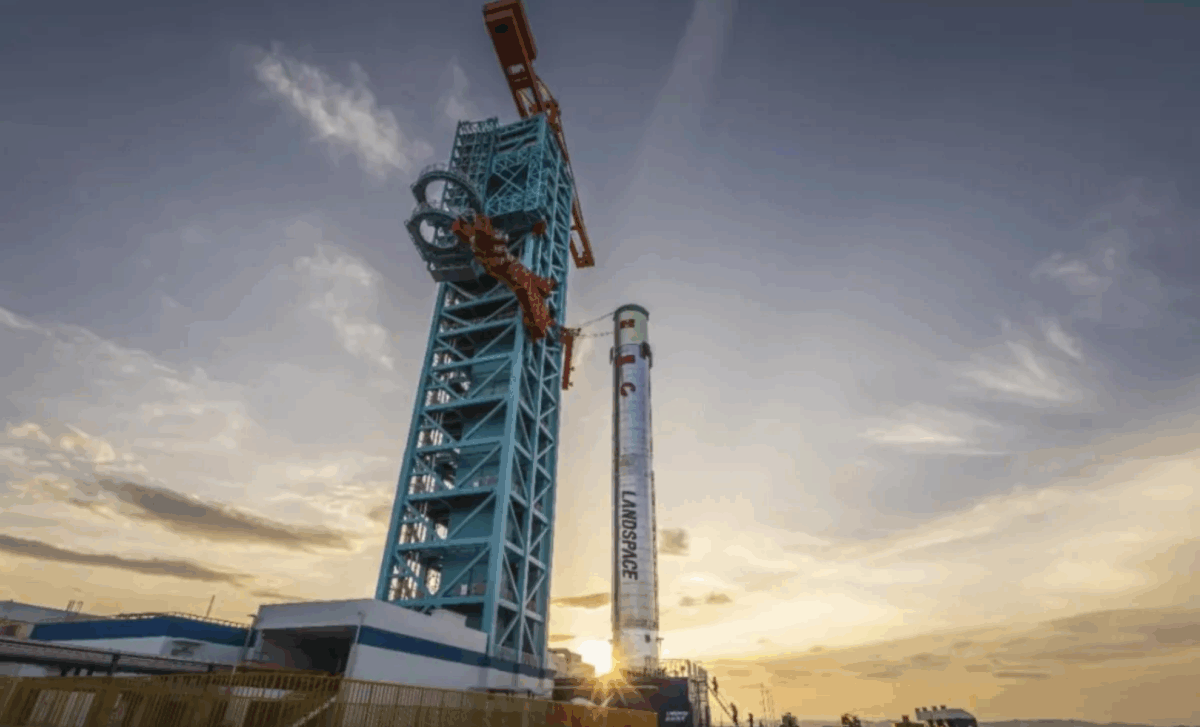
In a bold stride toward revolutionizing space exploration, China has lined up three contenders for its first reusable rocket launch, setting the stage for a historic leap in rocket technology. According to a recent report from South China Morning Post, these rockets—Long March 12A, Zhuque-3, and Tianlong-3—are poised to push the boundaries of reusable rocket technology, similar to SpaceX’s Falcon 9. The stakes are high as China aims to not only make its mark in the global space race but also to establish itself as a dominant player in satellite communications with ambitious plans to build massive internet constellations.
China’s Ambitious Quest for Reusable Rocket Technology
The race to achieve reusable rocket launches in China is heating up, with three major rocket projects on the horizon. The Long March 12A, Zhuque-3, and Tianlong-3 have all been developed to enter the competition, each showcasing China’s capabilities in the space industry. The potential success of these rockets could not only catapult China into the ranks of reusable rocket pioneers but also transform how space missions are conducted globally. As the rockets stand ready for their flights at the Jiuquan Satellite Launch Centre, experts agree that the successful landing of China’s first reusable rocket would mark a milestone in the country’s space ambitions. As reported by South China Morning Post,
“Pulling off China’s first rocket landing would be huge,” one anonymous source emphasized, underscoring the significance of such a feat. “State-owned contractors may try to leverage their influence to go first.”
This intense competition among state-backed firms highlights the strategic importance of these launches, as China races to showcase its growing dominance in space technology. However, despite the excitement, the development and testing of these rockets have faced setbacks. “But it has been postponed again,” the source added, signaling that technical challenges remain before China can achieve its reusable rocket dreams.
Why #Zhuque3 could beat Falcon 9 on cost#China‘s Zhuque-3 #rocket is about to make its debut, and the biggest headline isn’t just reuse — it’s the possibility of flying cheaper than on Space-X’s #Falcon9 model. Zhuque-3 takes a different engineering approach: a stainless-steel… pic.twitter.com/PymGGYHJ9P
— CGTN Frontline (@Frontlinestory) November 29, 2025
The successful launch of these rockets would not only mark a critical technological achievement but also provide China with a significant edge in the global space race. With the country’s plans to establish vast satellite constellations to provide internet access across the globe, reusable rockets would play a pivotal role in reducing the cost of frequent space missions, making this a game-changer for the commercial space industry.
Zhuque-3: China’s Answer to SpaceX’s Falcon 9?
Among the three contenders, the Zhuque-3 has generated the most buzz due to its design and potential capabilities. Elon Musk himself commented on the Zhuque-3’s design last month, calling it a promising rival to SpaceX’s Falcon 9. On social media, Musk noted that the Zhuque-3 “surpassed the Falcon 9 on multiple key metrics.” Musk’s comments included insights into the rocket’s design, stating that the Zhuque-3 incorporated aspects of SpaceX’s Starship project, such as stainless steel and methalox engines. This combination, Musk argued, would allow the Zhuque-3 to “beat Falcon 9,” positioning China as a serious competitor in the reusable rocket arena.
Despite Musk’s optimism about the Zhuque-3’s potential, he tempered his praise by highlighting that SpaceX’s Starship is in a class of its own.
“Starship itself is in another league,” Musk commented, acknowledging that while the Zhuque-3 could outperform Falcon 9 in a few years, SpaceX’s ambitions with Starship would continue to push the boundaries of what’s possible in space travel. He further predicted that, “if they are lucky, it might outperform Falcon in five years, by which time SpaceX will be launching Starship.”
This assessment underscores the challenges and opportunities facing the Zhuque-3 and its Chinese counterparts. While it may not yet rival SpaceX’s Starship, the Zhuque-3 represents a critical step in China’s development of reusable rocket technology and could serve as a foundational platform for future space exploration.
Implications for Global Space Exploration
The introduction of reusable rockets in China holds broader implications for the global space industry. For decades, the United States, led by SpaceX, has dominated the reusable rocket sector, dramatically reducing the cost of space travel and revolutionizing the commercial spaceflight industry. China’s push into this domain will intensify competition and could lead to further advancements in rocket design, satellite deployment, and space exploration missions.
The ability to reuse rockets significantly cuts down on launch costs, which is essential for making space more accessible. China’s satellite constellation projects, which aim to provide global internet coverage, will rely on these reusable rockets for cost-effective and frequent launches. This will not only enhance connectivity for millions of people worldwide but could also provide the groundwork for future endeavors, such as crewed space missions and lunar exploration.