
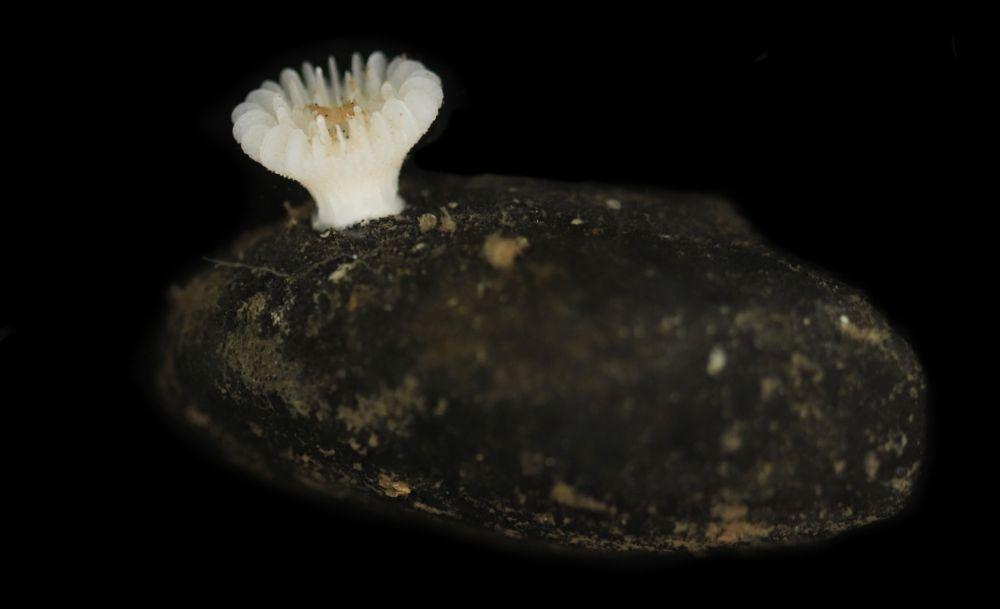
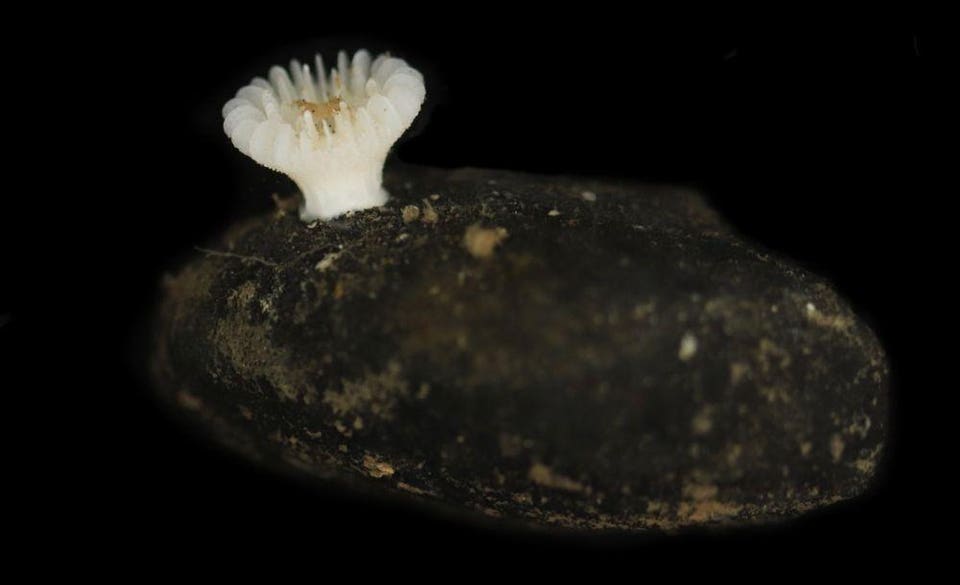
Deltocyathus zoemetallicus is the first stony coral known to live directly on mineral nodules found in the Pacific.
Bribiesca-Contreras et al, 2025/Zoological Journal
An international research team led by Senckenberg scientist Dr. Nadia Santodomingo and Dr. Guadalupe Bribiesca-Contreras from the U.K. National Oceanography Centre (NOC) have discovered a new species of deep-sea coral that lives attached to polymetallic nodules – the same mineral-rich rocks that are the focus of growing international interest for deep-sea mining.
Deltocyathus zoemetallicus was found more than 4,000 meters below the sea surface in the Clarion–Clipperton Zone (CCZ), an area of the eastern Pacific Ocean where the seafloor is covered by black, roughly fist-sized concretions known as polymetallic nodules. This is the first known Scleractinian coral to live directly attached to such nodules, as reflected in the species’ name meaning zoe = life and metallicus = metal.
Scleractinian corals, also known as stony corals, are marine animals that build hard skeletons made of calcium carbonate. While most people associate them with shallow tropical reefs, many species live isolated on the seafloor, survive in cold waters and even thrive in the deep sea.
Corals of the genus Deltocyathus are found in every ocean basin except the Arctic and around Antarctica. They typically inhabit depths between 200 and 1,000 meters, and most Deltocyathus species are free-living, meaning they sit atop the seafloor sediments.
The deepest specimens of Deltocyathus zoemetallicus were collected at a depth where the high pressure causes calcium carbonate to dissolve, a zone known as the carbonate compensation depth. This means that they have to have special adaptations, like enzymes constantly rebuilding the chalice-like hard skeleton, to be able to survive in water this deep.
View of the chalice-like hard skeleton of Deltocyathus zoemetallicus showing a radial pattern typical for stony corals.
Bribiesca-Contreras et al, 2025/Zoological Journal
Unlike shallow-water corals that often host symbiotic algae, who in return provide nutrients for the coral via sun-dependent photosynthesis, Deltocyathus zoemetallicus survives in total darkness. Instead it uses its tentacles to catch and feed on particles that are drifting through the water. The hard nodules offer an elevated and stable position on the muddy and soft seafloor. The species also seems to be unaffected by the potentially toxic metal levels of the nodules.
The Clarion–Clipperton Zone is of special interest to governments and mining companies. Here a seafloor area stretching from the island of Hawaiʻi to the coast of Mexico is dotted by billions of polymetallic nodules, rich in valuable metals like iron, manganese, copper, nickel and cobalt. The nodules form in areas of the ocean floor with low sediment input and where chemical precipitation prevails.
Although plans to mine the nodules date back to the mid-1970s, technological constraints, prohibitive costs, and the absence of a clear seafloor mining code have continued to hinder large-scale development. But as technology advances and demand for nickel and other metals continues to rise, deep-sea mining could become economically viable within a few years.
Because the nodules grow only a few millimeters every million years, removing them through mining would not only destroy the coral’s habitat but also eliminate the possibility of recolonization.
“This discovery underscores how little we know about life in the deep sea,” says Dr. Guadalupe Bribiesca-Contreras. “Every new species we find reminds us that the ocean floor is a living ecosystem and we still have so much research to do to explore and understand it fully.”
The full study, titled “Hidden gems of the abyss: first species of azooxanthellate scleractinian coral (Scleractinia: Deltocyathidae) attached to polymetallic nodules in the eastern Pacific Ocean,” was published in the Journal of the Linnean Society and is available online.
Additional material and interviews provided by the Senckenberg Institute.