
Breadcrumb Trail Links
New BrunswickThe IssuesFinance & Taxes
Economists, business leaders debate how to re-fire economic engine after data shows the province has the lowest GDP per person
Author of the article:
John Chilibeck • Local Journalism Initiative reporter
Published Dec 01, 2025 • Last updated 2 hours ago • 8 minute read
You can save this article by registering for free here. Or sign-in if you have an account.
 New Brunswick citizens have the lowest economic activity of any province or American state, according to the latest research. Photo by Brice McVicar/Brunswick NewsArticle content
Tongues are flapping over a chart that’s been circulating showing the weakness of New Brunswick’s economy.
Advertisement 2
This advertisement has not loaded yet, but your article continues below.

THIS CONTENT IS RESERVED FOR SUBSCRIBERS
Subscribe now to read the latest news in your city and across Canada.
Unlimited online access to articles from across Canada with one account.Get exclusive access to the e-Edition, an electronic replica of the print edition that you can share, download and comment on.Enjoy insights and behind-the-scenes analysis from our award-winning journalists.Support local journalism and the next generation of journalists.
SUBSCRIBE TO UNLOCK MORE ARTICLES
Subscribe now to read the latest news in your city and across Canada.
Unlimited online access to articles from across Canada with one account.Get exclusive access to the e-Edition, an electronic replica of the print edition that you can share, download and comment on.Enjoy insights and behind-the-scenes analysis from our award-winning journalists.Support local journalism and the next generation of journalists.
REGISTER / SIGN IN TO UNLOCK MORE ARTICLES
Create an account or sign in to keep reading.
Access articles from across Canada with one account.Enjoy additional articles per month.Get email updates from your favourite journalists.
THIS ARTICLE IS FREE TO READ REGISTER TO UNLOCK.
Create an account or sign in to continue with your reading experience.
Access articles from across Canada with one accountShare your thoughts and join the conversation in the commentsEnjoy additional articles per monthGet email updates from your favourite authors
Article content
Released last month, it ranked the gross domestic product, or GDP, per capita of all 10 Canadian provinces and 50 American states, 60 in total, for last year.
In other words, the chart established the level of economic activity, per person, in each place.
New Brunswick came dead last, 60th out of 60.
“It was simply a measure of the size of an economy, in this case that of the provinces and the states, per person,” said Trevor Tombe, an economics professor at the University of Calgary who comes up with the ranking every year.
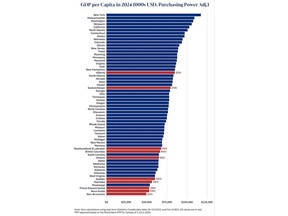 New Brunswick is dead last in a new chart that shows the purchasing power per person in all of Canada and the United States, research compiled by University of Calgary economist Trevor Tombe. SUBMITTED
“Big provinces and states obviously produce a lot more, but that doesn’t mean the average person is better off. So how big the economy is, how much stuff is produced in terms of good and services, per person, tracks very closely to things we do care about as individuals, such as the purchasing power of our labour compensation, our wages and salaries.
Advertisement 3
This advertisement has not loaded yet, but your article continues below.
Article content
“The GDP per capita is just a good summary measure of how strong an economy is for the average resident.”
Josh Purdy, a digital creator and comedian from Nova Scotia, has already posted on social media that Nova Scotia was worse in the rankings than West Virginia “they’ve got coal!”, Missouri “prison labour!,” and “even” Prince Edward Island “lots of potatoes!” before realizing that his province wasn’t dead last.
In the final frames, he strums on a guitar, singing: “Even when you think you suck, at least you’re not New Brunswick.”
Business leaders in the region have been muttering about the chart. Tombe said he appreciated some of the attention it’s been getting.
“It does mean that on average that the overall amount of income, expressed, not in dollars, but in terms of stuff you can buy with that, is on average lower than elsewhere. So, it suggests that living standards are, on average, lower.”

Morning Email Telegraph-Journal
Thanks for signing up!
Article content
Advertisement 4
This advertisement has not loaded yet, but your article continues below.
Article content
The professor, well aware his interview would be portrayed to a New Brunswick audience, took pains to say it was only one economic indicator.
“I don’t want to, I guess, overclaim here. This is really just a summary statistic saying everyone has a worse standard of living in New Brunswick or Nova Scotia compared to elsewhere. And there are also all sorts of non-economic factors too that might lead one to prefer living in New Brunswick or Nova Scotia than say, Alabama. Not to pick on Alabama.”
Alabama came in 52nd place. On top of the chart were New York, Massachusetts and Washington state.
The top Canadian provinces were Alberta (20th) and Saskatchewan (25th), a figure plugged by Saskatchewan Premier Brad Wall.
Tombe mentioned those two provinces had slipped a couple of rungs last year, mirroring a trend he’s noticed across Canada.
Advertisement 5
This advertisement has not loaded yet, but your article continues below.
Article content
He blamed a loss of productivity for a steadily growing gap between the size of the economies in the United States and Canada, a trend he’s noticed since 2015 onward, when the Liberals took power in Ottawa.
The GDP per capita numbers were determined by calculating the total value of all services and goods produced in each state and province divided by each jurisdiction’s population, then adjusted for purchasing power parity, including the exchange rate into U.S. dollars, cost of living, and pricing levels.
Newfoundland and Labrador came 45th, British Columbia 46th, Ontario 48th, Quebec 55th, Manitoba 56th and Prince Edward Island 58th. The territories weren’t ranked.
David Macdonald said the chart risked confusing people.
Advertisement 6
This advertisement has not loaded yet, but your article continues below.
Article content
The senior economist with the Canadian Centre for Policy Alternatives in Ottawa said it only looked at the economic activity per person, which could be a good or bad thing, depending on your perspective.
“Folks might interpret this as income, per capita, which it certainly isn’t,” he argued. “They might consider this wealth per person, which it is absolutely not.”
Macdonald zeroed in on the fact that in the United States, health care is largely privatized and generates big profits. This, he said, is part of the calculations for economic activity. By contrast, in Canada, most health care is publicly funded, with no profit generated.
“Everyone in the States is paying, you know, 20, 30, or 40 per cent more than they should be for health insurance. And as a result, it’s a big profit generator in the U.S., which drives GDP growth. Now, is that good for the average person? It’s terrible for the average person.”
Advertisement 7
This advertisement has not loaded yet, but your article continues below.
Article content
The economist said Canadians live longer and have much healthier lives while spending a lot less on health care than Americans do.
And he noted parallels in other important parts of the economy.
“It’s true for higher education and true for things like childcare, and so if you were to go back to a childcare system of $50 a day instead of $10 a day, like we have in Canada now, your GDP would go up. Or if you were to go to U.S.-style post-secondary education system or tuition, you know, $50,000 a year instead of $5,000, that’s good for GDP. But does the average person want to pay for all that?”
The economist noted that military and defence spending was much higher in the United States, a priority Canadians might not want.
“You know if you’re in a war, GDP goes through the roof. War is great for GDP, right? Is it good for the average New Brunswicker? I don’t think so.”
Advertisement 8
This advertisement has not loaded yet, but your article continues below.
Article content
Economists, he argued, should be equally concerned with other measures such as income inequality and personal bankruptcies, noting that there was a high number of people in the States who went bankrupt because of medical problems.
Others took the chart to pound the table on how the Maritimes needs to turn its economy around.
Don Mills, fresh from being appointed by the Carney government to a private-sector panel to help steer Atlantic Canada’s economic direction, told Brunswick News that Newfoundland had surged past New Brunswick because it was more willing to develop natural resources.
“Newfoundland is not getting federal transfer payments anymore because of the success of their own oil and mining industries,” said the co-founder of the Halifax polling firm Narrative Research and co-author of Toward Prosperity with New Brunswick economic thinker David Campbell.
Advertisement 9
This advertisement has not loaded yet, but your article continues below.
Article content
He noted those industries have created high-paying jobs and a lot of wealth for the Rock.
Mills laments that New Brunswick has a moratorium on developing natural gas, in place for a decade, because of environmental concerns.
New Brunswick’s natural gas reserves could be worth more than $200 billion based on current market prices, with an estimated 80 trillion cubic feet underground in the Frederick Brook shale formation in the southeast part of the province.
The former Liberal government of Brian Gallant imposed a moratorium because people were concerned about hydraulic fracking and the huge amounts of water and chemicals that would be pumped into the ground to release gas.
But Mills says the technology to extract the gas from shale beds has improved since that time, an idea he’s pushed on his Insights podcast with Campbell.
Advertisement 10
This advertisement has not loaded yet, but your article continues below.
Article content
“The question is, how can it be tapped into safely and with support from the Indigenous community and the general public?” Mills said. “If you took away the hydrofracking, how would that change the public’s acceptance of the drilling for natural gas? They wouldn’t have the fear factor. You know, we’re talking about leaving billions of dollars in the ground. It won’t change everything alone, obviously, but it would make a big difference.”
What sticks in his craw is what he calls an “attitudinal barrier” in the Maritimes.
“We are very comfortable saying no, when the rest of Canada is sending us transfer payments,” he said. “It’s hardly fair to ask other people to do what we should be doing, developing our natural resources. Those transfer payments help pay for our lifestyle. We need a ‘come to Jesus’ moment in our region to understand that we have to play our role and use our resources to help pay for our local public services, just like the rest of Canada does.”
Advertisement 11
This advertisement has not loaded yet, but your article continues below.
Article content
He also says eliminating provincial trade barriers and setting up a free trade zone in Atlantic Canada would go a long way in improving the regional economy.
Premier Susan Holt told business audiences in Moncton, Fredericton and Saint John last week that New Brunswick’s economic conditions have changed rapidly since she took office, through no fault of her own.
“All it took was a president to suggest that he was going to tear up our entire economy for investment to freeze up and for folks to reconsider a lot of business decisions,” she told the Moncton Chamber of Commerce on Wednesday, mentioning one of her favourite targets, U.S. President Donald Trump. “It’s not a pretty hand we’ve been dealt.”
New Brunswick is considered the most dependent on the United States of any province in Canada, with 92 per cent of its $17 billion in annual exports bound south of the border.
Advertisement 12
This advertisement has not loaded yet, but your article continues below.
Article content
That’s a lot of oil, lumber and lobster.
She said in the coming months, her Liberal government is going to launch a strategy that will lay out how to strengthen the economy, focusing on attracting investment, improving productivity, and diversifying business markets.
She also plugged a new growth office her government will create, though details are scarce.
“There’s a lot of pieces to co-ordinate,” she said in Moncton. “So, we are creating the New Brunswick Growth Office as a single place to drive major projects, strategic projects, across government departments to help us move with the speed of business and make sure investments are delivering the real results and measurable impact that New Brunswickers want.”
Advertisement 13
This advertisement has not loaded yet, but your article continues below.
Article content
Holt told reporters the bureaucracy works too slowly to ensure businesses get help quickly.
Within New Brunswick, she said, the Regional Development Corporation, Opportunities New Brunswick, the Department of Tourism, Heritage and Culture, and the Department of Agriculture, Aquaculture and Fisheries all work independently, with their own employees, who must vet business opportunities with senior staff and a deputy minister before it eventually filters to the provincial cabinet for possible approval.
The new office, she said, would speed up the cumbersome process by co-ordinating quickly between departments and Crown corporations.
She said the office was still in the development stage, but it would be staffed with civil servants who already have other duties.
Advertisement 14
This advertisement has not loaded yet, but your article continues below.
Article content
No details have been released about its budget or when it will start work. Questions to the premier’s office weren’t immediately answered Friday.
But she used her speeches to the businesses audiences to boost her message, including in Moncton.
“We’re taking the cards we’ve been dealt, and we are going to turn them into a winning hand, by retooling our economy, focusing on attracting investment, making ourselves more productive, finding new clients and new markets in other places, we’re going to leverage our capacity in natural resources and a knowledge economy, we’re going to make sure the infrastructure is there to support that growth and the energy systems are there to support that growth. And with that, we’re going to see the kind of economic prosperity that will help us deliver the health care, education and housing that every New Brunswicker wants.”
– with files from Brice McVicar and Alan Cochrane
Article content
Share this article in your social network