

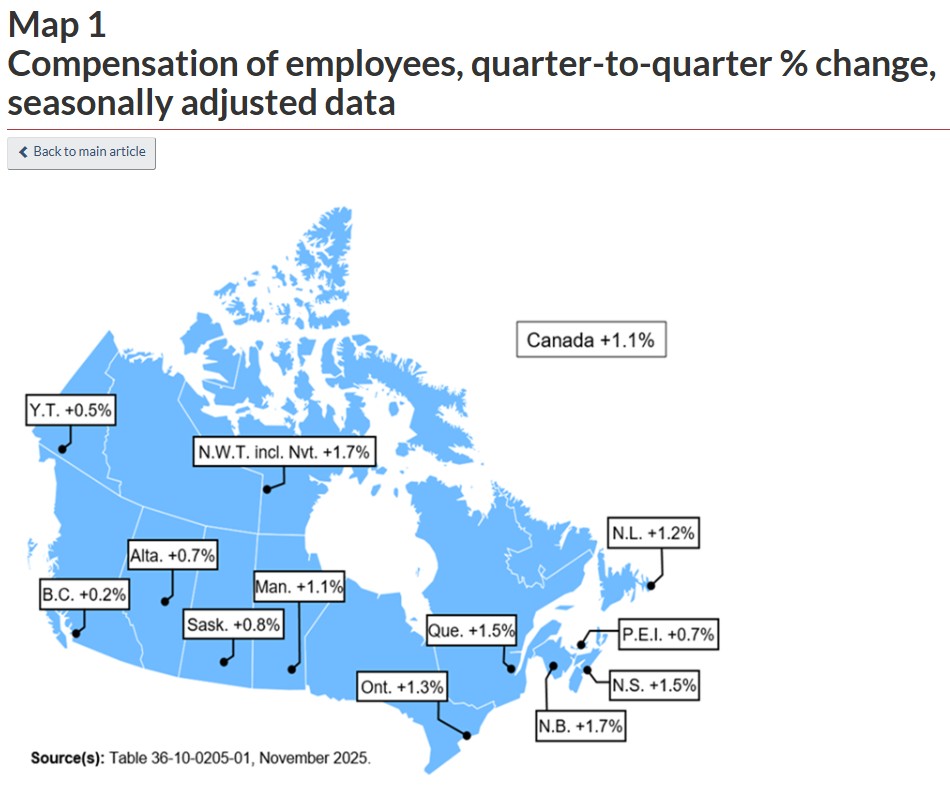
Employee compensation in Canada rose by 1.1% in the third quarter of 2025, accelerating from a 0.3% increase in the second quarter, according to new figures from Statistics Canada.
Wages increased across all industries in the third quarter, with one striking exception: federal government public administration excluding the military, where compensation fell by 4.2%.
By contrast, the private and broader public sectors recorded broad-based increases.
The strongest contributors to wage growth in the third quarter were service-based and knowledge-intensive industries. Statistics Canada highlights professional and personal services (+1.1%), finance, real estate and company management (+1.7%), and health care and social assistance (+1.2%) as key drivers of the overall rise in employee compensation.
On a geographic basis, compensation increased in every province and territory in the third quarter, according to Statistics Canada. New Brunswick recorded the strongest growth at 1.7%, while British Columbia saw the smallest increase at 0.2%.
At the same time, net savings declined for Canadian households across all income groups in the second quarter of 2025, marking the first time this has occurred since inflation peaked in 2022, according to new data from Statistics Canada.
This trend persisted even as inflation eased and the Bank of Canada’s policy rate fell to 2.75%.
The decreases in net saving were greater among the lower income brackets compared to the higher ones.
“Net saving worsened the least for higher income households despite weak wage gains, as their net investment earnings benefited from interest rate reductions,” said Statistics Canada. “Higher income households tend to hold balances on variable rate credit products such as lines of credit, rather than fixed rate products such as credit cards.”
Why compensation strategy matters for HR
Jay Williams, Compensation & HR Systems Manager at Austin Industries, notes that compensation is about more than just pay.
“From pay bands and market benchmarking to equity analysis and retention impact, effective compensation strategy requires a lot” of things, including:
deep market intelligence
rigorous analytical frameworks
strategic business alignment
“The organizations that understand the full depth of compensation don’t just pay competitively,” says Williams. “They use it as a strategic lever for talent attraction, retention, and business performance.”
More than half of Generation Z Canadians feel compelled to project an image of financial stability, despite facing rising living costs and low income, according to a previous report.