
Garmin seems to be playing with a few fresh hardware ideas that could show up in 2026. Recently filed patents give us some clues. Think a sealed rotating crown, a way to blend solar panels with AMOLED screens and a couple of other experiments that sit in the “maybe soon” category.
A patent is really just a way of staking a claim so it never guarantees the tech will ship. It still gives a clear window into what the company’s engineers are trying to solve right now. Nothing here counts as a production plan yet but some of it could land in real devices over the next year. Don’t be surprised if your next Garmin watch ends up carrying a few of these ideas.
Let’s get into it. All of these patents were filed in 2025.
Solar charging might finally work with AMOLED screens
Right now, it’s a trade-off. You either get a bright AMOLED screen or the longer battery life of a solar-charged MIP display. The reason for that split is pretty simple. Solar layers tend to block light, and AMOLED panels generate their own. Stack the two together and something suffers – usually screen clarity.
Garmin’s proposed fix uses fluid mechanics rather than traditional etching. The patent describes microscopic columns on the screen, coated with a hydrophobic layer. When a liquid solar material is applied, it flows around the columns and pools into defined channels, leaving open space for light to pass through.
This allows a grid of solar cells to form without disrupting the AMOLED below. Because there’s no laser carving involved, fragile materials like perovskites can be used. These materials are far better at collecting indoor or low-light energy than older silicon-based solar. That opens the door to watches that top up from office lighting or a grey afternoon rather than direct sun – solar AMOLED.
A magnetic rotating crown eliminates water risks
Water and dirt have always been the enemy of physical watch buttons. They need seals, shafts, and plenty of testing to survive daily abuse. Garmin is exploring a design that eliminates all of that.
The idea is a magnetic crown that never physically enters the case. Instead, a Hall effect sensor inside the watch detects how the knob moves using its magnetic field. That means no hole in the housing, no O-rings, and no risk of grime getting in.
To keep the tactile feel, the crown uses a snap dome system that clicks like a regular scroll wheel. It would give the same control for maps or menus, just without the risk of a leak or stuck button after a trail run or sea swim.
So far we have not seen a Garmin watch with a fully functional crown. That could, very likely, change in 2026.
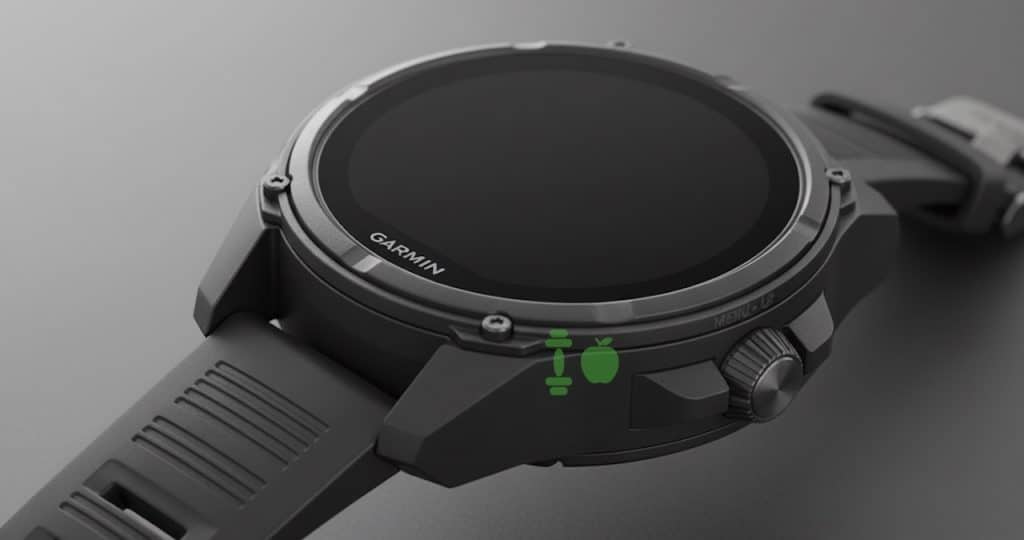 Concept image based on design specsHydration tracking could move beyond estimates
Most hydration features today are just dressed-up guesses. They estimate sweat loss from temperature and movement, or rely on manual inputs. Garmin’s proposed system uses pulse spectroscopy to go deeper – literally.
The watch would shine light at different wavelengths into your skin and measure how it scatters. By analysing how the signal interacts with tissue and adjusting for things like skin tone and wrist size, it can estimate fluid levels more directly.
The same method can also track hematocrit, which is the concentration of red blood cells. That’s especially useful for endurance athletes trying to avoid overtraining or spot early signs of iron depletion. The patent also references tissue oxygen saturation, a key performance metric during hard efforts.
It has been a while since we received a truly novel health metric on smartwatches. This could, very well, change soon.
Long-term glucose estimates from the wrist
One of the more ambitious ideas involves using pulse spectroscopy to estimate HbA1c. That’s not real-time glucose like the sensors diabetics use, but rather a monthly average that reflects your metabolic baseline.
The system would pull apart the photoplethysmographic signal into its AC and DC components and infer how much glycated hemoglobin is circulating. That’s the molecule that reflects how much sugar has stuck to your red blood cells over time.
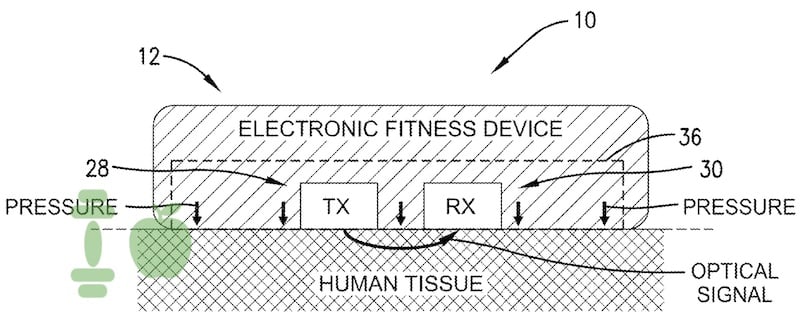 Source: USPTO
This makes a lot of sense for a wearable. It’s non-invasive and tracks slow trends rather than minute-by-minute changes. You wouldn’t need finger pricks or sensor patches – just a watch that quietly logs how your lifestyle choices play out over time.
Subscribe to our monthly newsletter! Check out our YouTube channel.
And of course, you can follow Gadgets & Wearables on Google News and add us as a preferred source to get our expert news, reviews, and opinion in your feeds.