
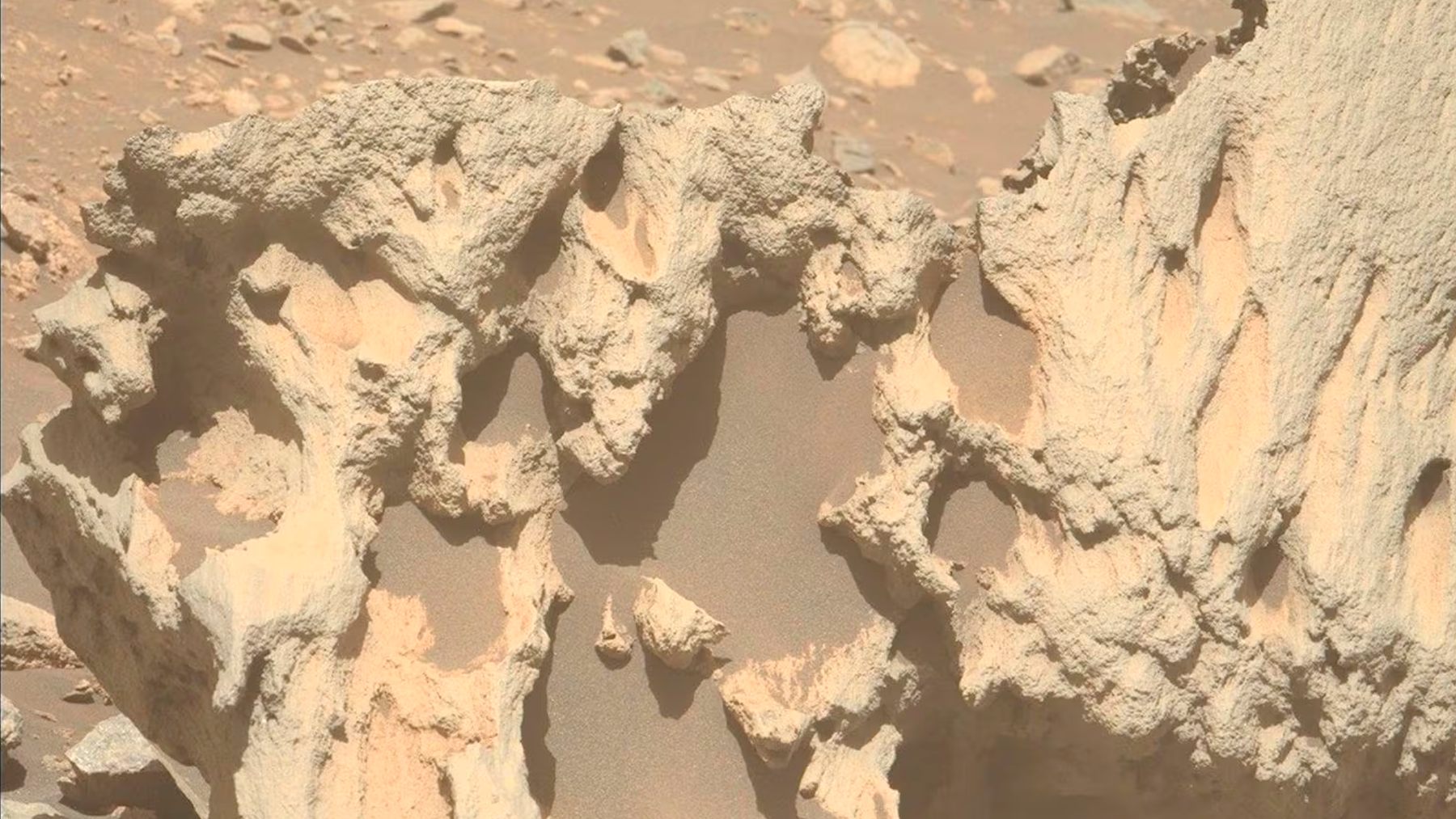
For many decades, Mars has been the subject of many space explorations. Its rocky surface and construction have made it the most documented landscape within our Solar system. Yet, in this confident familiarity, scientists have discovered something unusual on the planet, to start with. In this article, we discuss what scientists discovered this to be. Let’s dive in.
Scientists discover a new landscape on Mars
Given the extensive exploration that has taken place on Mars, scientists have long considered it a predictable setting. In the past half a century, we have labeled its craters, found its ancient riverbeds, and measured its frequent dust storms. All of these together define the Martian climate and have served as a framework for tracking Mars in its element.
There are hardly any fragments of Mars that aren’t known by NASA. From its oxidized rocks to volcanic sediments, this is due in large part to satellite imaging and sensors like the NASA Perseverance rover spacecraft. So, when scientists stumbled on something that seemed to be odd and foreign, one could easily reckon with their skepticism.
At first, NASA was unable to detect anything strange in plain sight. However, upon curious inspections, things begin to add up. Like any main character, the strange object stood out in the dusty red Martian atmosphere. Now, according to experts, this object looked nothing like the average meteorite nor a volcanic rock. No signatures on this object matched Martian geology.
Unraveling the alien rock on the Martian planet
Today, scientists from NASA have labeled this structure Phippsalsla. This was because its origin is from somewhere to way from the Martian environment. When scientists carried out a series of analyses with Perseverance SuperCam, they discovered a high mineral composition of iron and nickel. This gave scientists their first hint.
Only meteors at large asteroids had such a chemical composition. Although this isn’t the first time meteors have hit the red planet. Previous rovers, including Spirit and Curiosity, have reported their sights. However, this was the first time the Perseverance rover would pick it during its four-year mission on Mars, just like the strange black skull discovery, shocking scientists.
The rocky landscape stretches across 80 centimeters. Considering its unique texture and layering, scientists have attempted to locate its parent body within the solar system. Some researchers have argued that it may have been ejected from a distant volcanic site, while others say it may have launched from a massive impact across Mars.
Potential insight into Martian history
The timeframe in which the Phippsaksla had stayed on Mars remains a puzzle. But the Perseverance rover dates it to be millions of years ago. This means that studying the Phippsaksla rock form could reveal lost chapters in Mars’s evolution.
Importance of this discovery for Martian exploration
Following this discovery, scientists are becoming open to the idea that there may be more to the red planet. With the aid of the Perseverance rover, scientists from NASA have begun excavating the Martian soil for other foreign rock forms that have remained hidden in plain sight. Like Phippsaksla, if found, could reveal vital information about Mars
For upcoming missions on Mars, NASA plans to find and analyze more landscapes with unusual geology. However, they are choosing to pay more attention to regions known to previously occupied by glaciers or impacted by metros. Uncovering these strange visitors could reshape our overall perception of Mars.
For many years, scientists have stimulated various assumptions and theories about the Martian planet, but these assumptions are about to undergo vigorous fact analysis, and NASA is spearheading the truth hunt. The wake of Phippsaksla is setting the stage for something new and groundbreaking, leading to the Viking mission’s Martian discovery, dropping a bombshell. While we continue to theorize, astronomers and scientists are unveiling facts backed by scientific proof.