
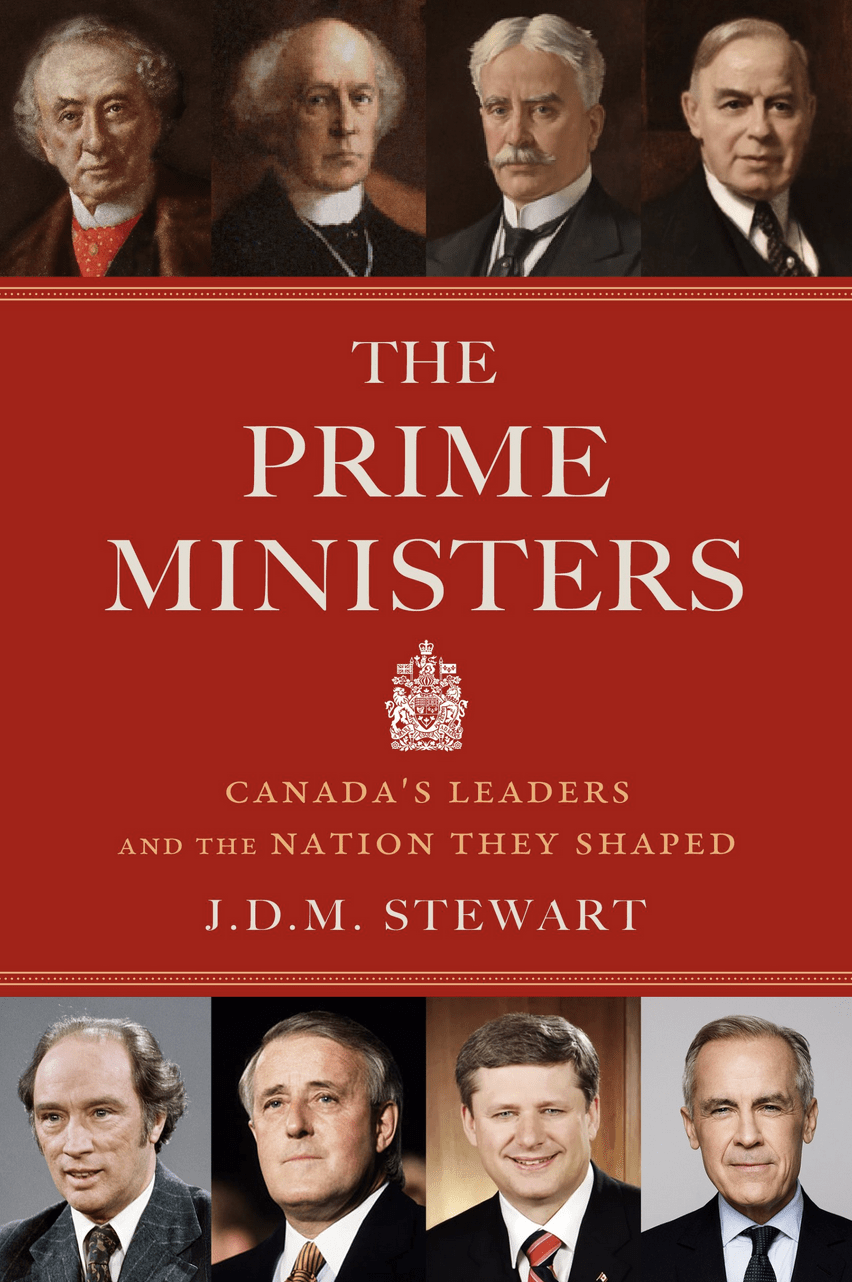
The Prime Ministers: Canada’s Leaders and the Nation They Shaped
Sutherland House Books, September 2025/386 pages
Reviewed by Thomas d’Aquino
December 1, 2025
J.D.M. Stewart’s book The Prime Ministers absorbed me from the start. Engaging and meticulously crafted, it offers a survey of the 23 men and one woman who have occupied the highest office in Canada.
Stewart, a former history teacher and now full-time prime ministerial historian, has long lamented that Canadians do not know their history as they should. Seminal to that knowledge, he believes, is an appreciation of Canada’s prime ministers — both as human beings with all their strengths, weaknesses and foibles and through their contributions to the shaping of the political and economic life of our country.
The Prime Ministers does this admirably. Stewart quotes the late author Peter C. Newman’s observation that “every hour a prime minister spends in that office is an hour in his country’s history”. As a series of profiles that include defining moments and key characteristics, the book does not provide exhaustive biographies.
Stewart encourages his readers to dig deeper into the lives of our prime ministers by offering “a list of a few of the best books on Canada’s prime ministers”. I am familiar with a good number of these works and stand by his recommendations.
Offering historical context is important to Stewart. He asks that we not judge the policies and actions of our past prime ministers by present-day standards and expectations. That said, he does not downplay instances where our leaders suffered lapses in judgment or character failures.
Overall, the reader is struck by the fact that Canada’s prime ministers, virtually without exception, have been driven by a desire to serve the public good. This is no small achievement as we take the measure of those who have occupied the highest office in the land.
Of the 24 prime ministers profiled by Stewart, I have had the privilege of knowing 12, starting with John Diefenbaker through to the current occupant of the office, Mark Carney. I served on the staff of Pierre Trudeau and had extensive interactions with Joe Clark, John Turner, Brian Mulroney, Jean Chrétien, Paul Martin, and Stephen Harper.
While my dealings with Prime Minister Carney since his election earlier this year have been limited, I have known him for some 25 years and we have shared experiences in the business, public policy and philanthropic domains.
In my recent memoir Private Power Public Purpose, I write about my interactions with Trudeau, Clark, Turner, Mulroney, Chrétien, Martin and Harper. I also mention my dealings with Carney prior to his entry into the political arena. I could not resist comparing notes about the leaders Stewart describes and my own experience with them. By and large, our views are aligned.
I found the organization of the book appealing. It moves from the fathers of confederation to contemporary leaders in a balanced way, free of partisan bias. Employing his skills as a teacher, Stewart’s talent for storytelling draws readers in. He treats the prime ministers who served in office for brief terms with respectful brevity.
By highlighting continuity as well as change, Stewart shows the office as a living institution rather than a sequence of isolated tenures.
Appropriately, he dwells at greater length on those whose time in office was longer and more consequential: Macdonald, despite his character flaws, as the father of the nation; Laurier, whose passion and hope for Canada burned bright; Borden, who carried the burden of the Great War; King, though uncharismatic, as the master at the political game; Pearson, the arch-diplomat and social reformer; Trudeau’s electrifying personality, patriation of the constitution and enactment of the Charter of Rights and Freedoms; Mulroney, who for a time restored the fortunes of the Progressive Conservative Party and courageously bet on free trade; Chrétien who reveled in his little-guy image and whose political instincts had few equals; Martin, who pursued lofty ideals but who will best be remembered for his major achievements as finance minister; Harper, who governed with a steely discipline. All are presented with carefully curated insights.
Of the postwar prime ministers whose tenures were brief, it is notable that only one went on to serve with distinction in a ministerial capacity. I am referring to my former law-school roommate, Joe Clark, who loyally served the Mulroney government in the constitutional and foreign policy domains.
As we travel through time from Macdonald to the contemporary world, Stewart enlightens us on the moments and events that shaped who we are as a nation — the early struggles leading to Confederation, the threats from a belligerent United States, the tragedy of two world wars and the Cold War, the ups and downs of the economy, federal-provincial tensions, constitutional struggles, and nation-building projects. Stewart points out how individual prime ministers were shaped by these events and how they, in turn, helped shaped history. He reminds us that to know our prime ministers is to know ourselves.
His description of how different prime ministers dealt with Canada’s Indigenous Peoples adds significantly to the understanding of our sometimes tortured history and paints a parallel timeline of our evolution as a nation.
My interest in Stewart’s book is tied as much to the policies of our prime ministers as to their character. In this, he does an admirable job. The lead-up to Confederation, waging war, building the postwar economy, stewarding constitutional reform, advancing major social legislation, shaping Canada’s foreign policy — all bear the imprint of prime ministerial leadership.
The Canada-United States relationship is a constant and dominant factor in the pages of Stewart’s book, as it has been as a defining element — for better or worse — of each PM’s tenure. Against the backdrop of World War II, King worked well with President Franklin Delano Roosevelt, and Chrétien and President Bill Clinton enjoyed positive chemistry.
It is safe to say, however, that no prime minister matched the success of Brian Mulroney in managing the bilateral relationship during the administrations of Presidents Ronald Reagan and George H.W. Bush. The two presidents became such close friends of their Canadian counterpart that he delivered the eulogies at both their funerals.
The author does an admirable job of plumbing the characters of our individual leaders with clarity and balance. Stewart writes engagingly, and his characters come to life in the pages of this book. A rich assortment of anecdotes helps keep our attention.
He demonstrates how each prime minister faced a Canada different from that of his predecessor and how each, in turn, shaped the nation for those who followed. By highlighting continuity as well as change, Stewart shows the office as a living institution rather than a sequence of isolated tenures.
One of the most important contributions of Stewart’s book is what it teaches about leadership — especially in a uniquely Canadian context. He invites us to reflect on the challenges of governing a vast, bilingual and multicultural federation and how success in nation-building rests on negotiation and political accommodation.
In a recent conversation with the author, he acknowledged that much more needs to be done to build understanding of the office of prime minister. He wonders whether a well-resourced centre for the study of Canadian prime ministers would make a difference. I believe it would and strongly endorse the idea.
For readers seeking an authoritative yet highly readable introduction to the leaders who have shaped Canada since Confederation, Stewart’s The Prime Ministers is an excellent choice.
Policy Contributing Writer Thomas d’Aquino is an entrepreneur, corporate director, author, philanthropist and a member of the Order of Canada. He is the Founding CEO of the Business Council of Canada, Chairman of Thomas d’Aquino Capital and author of the national best-selling Private Power Public Purpose: Adventures in Business, Politics and the Arts.