
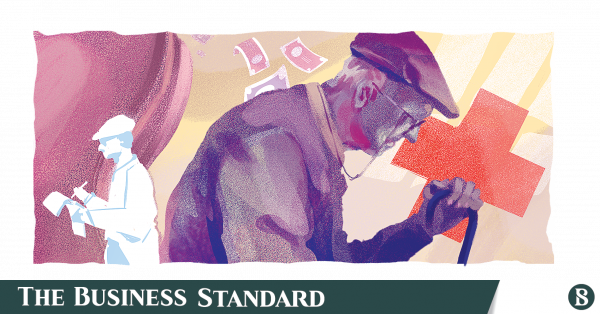
Rehman Aziz (pseudonym), a retired teacher in his late 60s, lost both his parents. His only child lives abroad. So when he returns home from the office, it’s just him.
“Sometimes it feels very lonely,” he said.
But statistically, by the number of people who feel the same, Rehman is not alone. According to the Population and Housing Census 2022, over 15.3 million people—or 9.28% of the country’s population—are aged 60 or above.

Keep updated, follow The Business Standard’s Google news channel
Life expectancy in Bangladesh stands at 74.06 years, according to the World Health Organization. So, life after 60 is like walking the last mile — but for most people, that walk is far from smooth.
As they enter the final decades of their lives, many face the realities of aging: declining health, memory loss, the emotional toll of isolation, and the fear of death.
The mental health struggle
Psychiatrist Jhunu Shamsun Nahar explained that mental health challenges, including depression and neurocognitive disorders like Alzheimer’s, are especially common among seniors.
“Depression manifests as persistent sadness, loss of interest, and low energy. In severe cases, it can lead to suicidal thoughts, with women being more vulnerable,” she said.
“Dementia, on the other hand, is characterised by progressive memory loss, often causing seniors to forget recent events while still vividly recalling the past. Among the elderly, the effects of mental health decline are compounded by other aspects of aging. The isolation many older adults experience, especially after losing loved ones, makes them more susceptible to depression. Physical illness only worsens the sense of helplessness.
“Religion can provide solace and structure,” Dr Nahar noted. “But when thoughts of death begin to dominate, fear and anxiety can become overwhelming. Therefore, addressing mental well-being is just as critical as managing physical health.”
“Families and caregivers should watch for signs of depression or cognitive decline in their elderly loved ones. Withdrawal, confusion, and loss of appetite are warning signs,” she added. Engaging seniors in activities that provide social and emotional stimulation, such as community work or spending time with grandchildren, can help restore a sense of purpose and improve overall well-being.
When financial stress never ends
Alongside mental health, financial planning is another pressing concern. With many elderly citizens lacking adequate savings or retirement benefits, financial insecurity often leads to a constant struggle for survival.
Mahtab Uddin, Assistant Professor of Economics at Dhaka University, paints a sobering picture of the realities awaiting most citizens after 60.
When asked whether Bangladeshis are financially prepared as they approach retirement, Mahtab Uddin said, “I don’t think we are prepared at all. Only around 7% of the population has any kind of financial security. Bangladesh also has one of the lowest shares of formal sector jobs, and even within that sector, not everyone receives retirement benefits.”
He added that most elderly Bangladeshis enter old age not only financially insecure but also physically unwell.
“Our elderly are not just old, they are old and sick. Years of polluted air, unsafe water, and unhealthy food mean they carry a heavier disease burden than elderly populations in developed countries. This alone demands far greater financial preparedness than most people possess.”
Is the economy kind to seniors?
Professor Mahtab believes that the current economic climate does not allow seniors to live comfortably.
“The old-age allowance of Tk600–700 is meaningless. It covers nothing. We need universal old-age coverage, with benefits meeting at least the international poverty line—around $90 a month. Support should go beyond money: Seniors need a holistic approach—quality healthcare, accessible transport, and dignified public services.”
Mahtab Uddin, Assistant Professor of Economics at Dhaka University
He identified three major barriers: “First, the cost-of-living crisis. Inflation has been consistently high, around 8–10% in recent years. Second, the quality of public services—from healthcare to transport—is poor and fraught with bureaucratic hurdles. Finally, security concerns and overall living standards make day-to-day life difficult, especially for the elderly.”
He further added that even basic mobility is a struggle: “Can a 75-year-old in a wheelchair board a Dhaka city bus? In many countries, public transport is designed to accommodate the elderly. We are far from that.”
Mahtab Uddin noted that medical expenses are the primary financial burden on seniors. “Our healthcare system operates on a two-tier basis. Seeing a doctor at a government hospital is free, but diagnostic tests and medicines are expensive and often unnecessary.”
He also warns of future risks: “Once we graduate from LDC status, many medicines will become costlier because we will lose TRIPS exemptions.”
Towards a holistic approach
For those already in their 60s, survival becomes the primary concern. Professor Mahtab explained, “Most seniors do not have savings or retirement benefits. Their spending is limited to essentials—food, medicine, and housing. Healthy food and regular check-ups should be priorities, but many cannot afford them.”
“Real financial planning must start decades earlier, through pension schemes, savings, and preventive healthcare,” he noted.
He suggested focusing on low-risk investment options. “Government savings instruments are the safest for the elderly. Share markets carry risks, even for relatively stable funds.”
However, there is a stark difference between public- and private-sector retirees. Government employees usually have pensions, while private-sector workers often do not.
Even with pensions providing some financial stability, many seniors still struggle with the cost of living and healthcare. Professor Mahtab criticizes the government’s limited support.
“The old-age allowance of Tk600–700 is meaningless. It covers nothing,” he said. “We need universal old-age coverage, with benefits meeting at least the international poverty line—around $90 a month.” He added that support should go beyond money: “Seniors need a holistic approach—quality healthcare, accessible transport, and dignified public services.”