
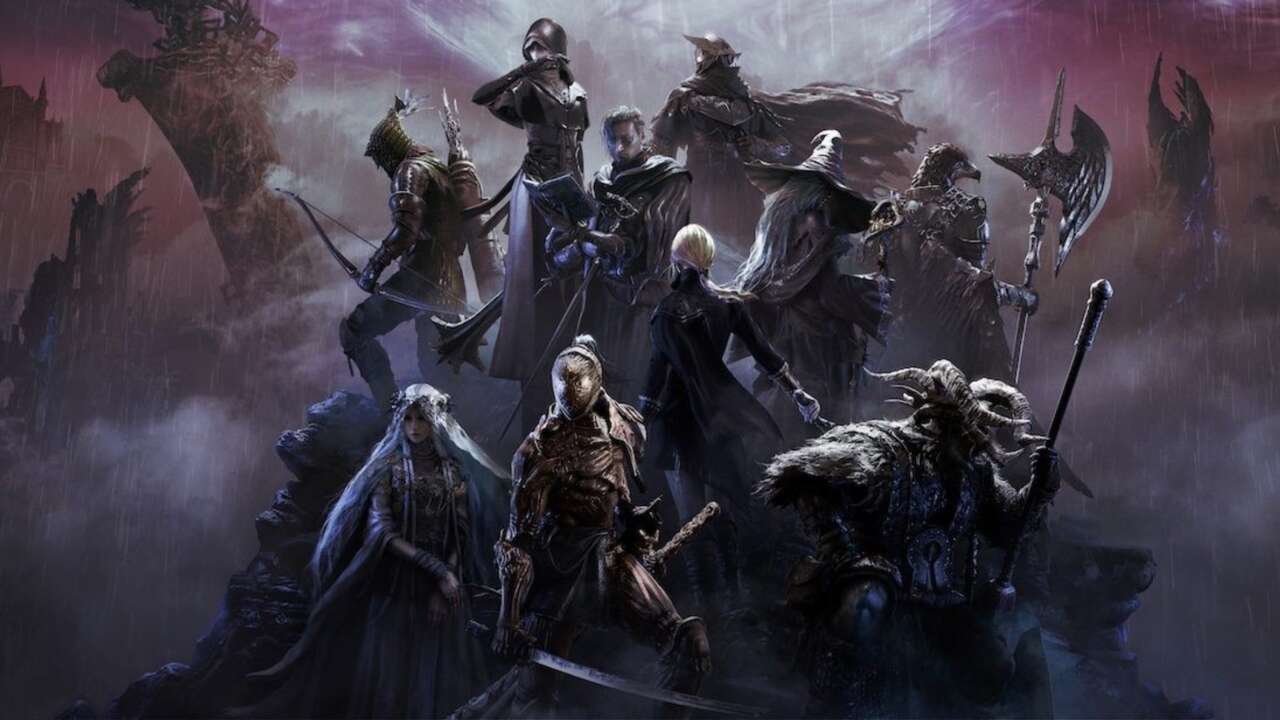
From Software is very careful about setting expectations when it comes to the DLC expansions for its games, favoring the underpromise and overdeliver approach. This much is reflected in the messaging around The Forsaken Hollows, Elden Ring Nightreign‘s first DLC expansion. When I pointed out a similarity I felt it had to Elden Ring‘s Shadow of the Erdtree DLC, the team made sure to clarify that the comparison was not quite apt and players shouldn’t expect something on that level.
The Forsaken Hollows is billed as a couple of new Nightfarers for players to pick between, along with new points of interest to give players a reason to jump back into Limveld and take on the Nightlords. That’s an accurate summation of it, but also somewhat undersells that the two new Nightfarers are very cool and create interesting new ways to think about and play the game; the new biomes come in the form of swamps (yes, they’re back) that make the threat of status effects more prominent; and there are multiple new mini-bosses and third-day bosses to take on.
But the real underselling pertains to the new Shifting Earth event, which is essentially a brand new map that’s distinct from Limveld, as opposed to a much smaller scale change in the environment that we’re used to expecting.
So, not expecting too much is indeed good advice. However, at the same time, what I thought The Forsaken Hollows is going to be and what it actually is caught me off guard in the same way the unexpectedly expansive nature of Shadow of the Erdtree did. And when I finished my hands-on time with it, I left with a reinvigorated interest in Nightreign.
Before delving into the nitty-gritty details with From Software, I wanted to understand what the studio thought of the reception to its first multiplayer-focused title. From has been very open that Nightreign was and is a game that was intentionally designed and developed under stringent conditions; namely time and money spent. That it has been so transparent about this has been interesting to me, particularly when it comes to whether the studio believes this was a successful endeavor.
We Played Elden Ring Nightreign’s New Characters For 6 Hours
Size:640 × 360480 × 270
Want us to remember this setting for all your devices?
Please use a html5 video capable browser to watch videos.
This video has an invalid file format.
Sorry, but you can’t access this content!
Please enter your date of birth to view this video
JanuaryFebruaryMarchAprilMayJuneJulyAugustSeptemberOctoberNovemberDecember12345678910111213141516171819202122232425262728293031Year202520242023202220212020201920182017201620152014201320122011201020092008200720062005200420032002200120001999199819971996199519941993199219911990198919881987198619851984198319821981198019791978197719761975197419731972197119701969196819671966196519641963196219611960195919581957195619551954195319521951195019491948194719461945194419431942194119401939193819371936193519341933193219311930192919281927192619251924192319221921192019191918191719161915191419131912191119101909190819071906190519041903190219011900
By clicking ‘enter’, you agree to GameSpot’s
Terms of Use and Privacy Policy
enter
“[It] more or less has sort of been in line with our expectations,” said director Junya Ishizaki. “I would say it’s definitely a success from that standpoint. I think that the overall gameplay has been well received as well, and we were kind of surprised to see the players’ interpretations of the relationship between the main characters and how they’re all friendly and nice with each other, which–when we were developing [the game]–we didn’t really consider. So it’s fun to see that the users have made their own version of it.”
The From Software community being able to connect dots in unexpected ways shouldn’t come as a surprise, as it’s very much par for the course for a group of fans that is always reading between the lines. What caught me off guard, however, was how there wasn’t a more pronounced backlash to what was in the game, given that, well, it’s a pretty obvious asset flip in so many ways. Despite this, the focus of discussion has been around how From’s considered mechanics and delicately paced and balanced design have been contorted into something that feels unnatural, but is compelling nonetheless.
With that in mind, it may not strike you as surprising that The Forsaken Hollows isn’t replete with brand new, unique to Nightreign content; it is very much taking what exists and finding different angles on them or delving into the studio’s history to pull from its larger catalog of games for some surprises.
Take the Scholar and the Undertaker, for example. These two new Nightfarers, on paper, don’t seem particularly exciting–not to me anyway. However, in both cases, just a few minutes of time with them quickly opened my eyes to the potential they have to drastically shift the dynamics of play between Nightfarers and also against the challenges Limveld presents.
Scholar, for example, feels like he’s a bit of a liability to begin with. His function in battle initially seems to be standing at a safe distance and applying buffs and/or debuffs that may contribute to giving the group an edge. And that much is true. His Character Skill is called Analyze, and lets him swap from wielding a weapon to surveying the battlefield using a large circle that can be aimed to try and capture multiple enemies within its scope of effect. The longer the Scholar can keep targets–both friendly and non-friendly–in his view, the more buffs and debuffs stack. And the closer he is to the target, the quicker the analysis will move up the three levels of potency. At level one, his buff increases his own stamina, but push through to level three, and he will create a barrier that activates a shockwave when hit. On the other hand, a level one debuff decreases an enemy’s attack power, but get to level three and the next hit they take will be more damaging.
His Passive Skill, meanwhile, is called Bagcraft, and it lets the Scholar pocket more items. If you’re a seasoned Nightreign player, you’ll know that most items outside of gear loot are usually not worth the time, effort, or potential danger they may leave you in when gathering supplies. Because of this, most players sprint past the vast majority of items in Limveld. The Scholar, however, is designed to encourage players to engage with this overlooked system by offering meaningful upgrades to items. Consumable stacks are increased thanks to Bagcraft and, by using items, the Scholar gains experience in that particular category of item. Over time, this levels up what they can do or how much impact they have. Usually, the first level up boosts an item’s strength or effectiveness, while the second can add a secondary effect.

The amount of uses it takes to level up an item category varies, but all items in that category will contribute to its growth. This means that you can lob any and all flavors of pots and they will all benefit from the levels you gain. Naturally, we didn’t have enough time to test all the items and how they change, but we were able to give darts secondary attributes, give pots a greater area of effect, and make healing items more potent. Couple this new system with relics that let the Scholar start a run with consumables in his pocket and you can quickly get the jumpstart on the leveling-up process.
What’s interesting from a gameplay dynamic perspective is that, in many ways, the team needs to accept that the Scholar may not be a very effective contributor in the early phases of a Nightreign run owing to its split focus. While the other members of the team may be focused on sprinting to points of interest to get more flasks, find gear, or gather experience, the Scholar needs to gather less-than-useful items and focus on spamming them at every opportunity which, often, isn’t exactly helpful. However, the flipside of that is that, if done smartly, the Scholar’s late-game contributions can be significant both in terms of offense and defense. In my experience, I found the team’s survivability was much better in fights on day three and against some Nightlords. The Tricephalos, for example, becomes far less frightening when it splits into three when you have the Scholar, who can, with good positioning and careful timing, analyze them simultaneously and debuff them.
The Scholar’s Ultimate Art is called Communion, and it links all nearby enemies and allies together, so damage dealt to one enemy will also transfer over to other enemies linked to it. Any healing items used in the area around the Scholar are also shared between all Nightfarers. Together, these skills make Communion a very powerful skill that, if used properly, can be used to manage multi-enemy bosses and mob groups of enemies.
That kind of sacrifice-now-and-benefit-later dynamic is really interesting and trades off trusting that your Scholar knows what they’re doing. It also demands patience and strategy from all members of the party, making it a quintessentially From Software design.
The Undertaker is a far more aggressive addition to the roster, feeling close to Wylder in terms of offensive potential and movement capabilities. The Undertaker is crucial to putting out big damage fast, and making the most of how and when fellow Nightfarers use their ultimates. On a basic level, she is most proficient in using hammers thanks to an A in scaling for faith and strength. She has a B in health scaling and a C in FP and stamina. The latter of those three attributes is what governs the push and pull between her offense and defense. She can get in and do a lot of damage, but without close regulation of what she’s doing, she could also find herself in danger without the ability to escape.
However, her character skill, Trance, is a tool in her arsenal that can provide some utility in situations just like that. “Bloodletting triggers the power of the loathsome hex,” reads its description. That basically means that, when she pops it, her running speed increases and she can move at the same speed as the sprint without consuming stamina. Additionally, her toughness and combo attack power both rise, while her dodge becomes a dodge step. If her ultimate art is ready to be used, she can instead opt to consume it, improving her attack power and movement speed, and also dodge one lethal blow, much like Wylder. The interesting twist is that when she uses this skill, it also instantly refills her stamina, so it can be used to apply a lot of pressure to enemies and potentially push them into a staggered state.
Her aforementioned ultimate is called Loathsome Hex and during it she slingshots herself towards whatever direction the player chooses–and towards an enemy if locked on–to attack with an uncanny bone she has pulled from her own body. It’s a very fast, flashy, and powerful attack that can turn the tide very quickly, either by doing good damage to an enemy, or if used on a downed ally, helping get them back in the fight quicker. It can also be executed in mid-air, giving it some versatility in timing and range, if combined with jumps. The one thing to be aware of, however, is that obstacles in its path can stop the Undertaker in her tracks, wasting the ultimate entirely. This means you have to be very careful and confident when initiating it.
The real fun, however, happens when you take into account Confluence, the Undertaker’s passive ability–undoubtedly the most fun, momentum-shifting ability in the game. Whenever any other Nightfarer activates their ultimate, the Undertaker has a very brief window to use Loathsome Hex for free, which means when it’s done, you’ll still have your own ultimate if it was charged or retain the progress towards getting it. With two other Nightfarers beside you and some good communication, you can unleash as many as five ultimates with the Undertaker on the team. And if you decided to run a team comp that has two Undertakers (which is very viable, based on my experience), the damage potential there is very exciting.
There’s a really satisfying synergy built into both of the new Nightfarers that, I think, isn’t present to the same extent in the original group. This means that my brief time with The Forsaken Hollows was filled with non-stop chatter as we tried to time our abilities together, and some thrilling sequences where we were able to bring once difficult mini-bosses to their knees with relative ease.
“That is definitely something that has been on the forefront of our minds from the very start of development; trying to figure out how we can get players not only to work together, but almost work on top of each other,” Ishizaki explained. “We’re not just necessarily going at it and seeing what characters can work well together, but what characters can work well by themselves, [and] also in combination with other characters.
“So there definitely is a sort of synergetic way of looking at it, and that’s where a lot of the ideas originally stemmed from–trying to figure out where they can fit into the ultimate equation with other characters.”
The big question, however, is how well this is all going to be balanced. And that’s something that, according to Ishizaki, was a challenge with the base game and continues to be a challenge as the team prepares to launch more content that will be enjoyed by casual players as well as a community that expects the difficulty to scale up to test their mastery.

“The main takeaway we had post-release was just there was a lot of trouble trying to get the balancing right,” Ishizaki said. “I think balancing is just so subjective, so a lot of our thoughts post-release working up to the DLC were how can we get the balancing in mind with what we were initially envisioning, and also with that balancing set, how can we take a different approach and devise new enemies, new characters, and stuff like that to play into that and utilize the new balancing that we are working with.
“Obviously, we don’t want it to be so hard that new players can’t get into it, but I think the original idea is that when the game initially had come out, there were even players who are veterans of some of the other games trying to figure out the new systems, trying to figure out how the game works. I think [we want our] ideas when we’re working on the DLC content to be a reflection of that. So whenever people who have played the main game extensively go into the DLC content, they’ll be able to have a bit of that feeling like they had when they first played Nightreign, where there’s still a bit that they’re trying to figure out. [The Forsaken Hollows is] definitely a little bit harder, but it’s not ridiculous or anything like that, but that’s still within what we would consider to be a fair challenge.”
While the big draw of The Forsaken Hollows is definitely the new characters and location, From has done some tweaking to the original Limveld map, most notably changing certain areas so they present more of a threat, while also feeding into the risk-versus-reward calculation. Longtime From Software fans will have to accept that the inevitable has happened and swamps have been introduced to achieve this. Now, areas of Limveld will have swamps that inflict poison, scarlet rot, frenzy, and other ailments if they’re not navigated properly. Staying true to classic Swamp Software design principles, wading into a swamp will slow walking speed down drastically and if you don’t get out of whatever horrible liquid you’re knee deep in, a bar builds up until that ailment is inflicted on the player.
Most of the time, however, pushing through will yield a weapon of that same attribute, which means they’re worth visiting if you have a strategy that involves exploiting boss weaknesses or inflicting certain attributes on them. Of course, I took the opportunity to ask Ishizaki about this obsession with swamps that has become a lighthearted meme in the From Software fan community, and clear up once and for all if Hidetaka Miyazaki has a swamp mandate for the studio’s games.
“We’re definitely aware of the [swamp] meme. It’s not like there’s a rule or any sort of policy here where it’s like we have to have a swamp in there, but it always seems to be [that before you realize] someone’s come up with the idea, it’s already sort of in there, and it’s just sort of taken a life of its own,” Ishizaki said.
“The main game for Nightreign did not have a swamp, so I do see what you mean now, having it added after the fact with the DLC. But yeah, it’s definitely one of those things that [it] always just seems like [our game] ends up with a swamp. Even if there’s not a specific rule like, ‘Oh yeah, we have to put that in there,’ [that’s] just always how it kind of ends up.”
Another new addition to the Limveld is the presence of forges that can be found in parts of the map and cleared of enemies, activating them. This item can then be used at a forge to re-roll an attribute on a weapon, so if you’ve got a weapon you like that doesn’t have much utility beyond smashing or slicing enemies with, you can head to a forge, try your luck, and hope you walk away with something you’re more excited about. Again, it’s not a major change, but it adds to the risk-versus-reward dynamic in a way that is just useful enough to entice some tense expeditions now and then.
The main event, as mentioned, is the Shifting Earth event. In The Forsaken Hollows, however, this involves gliding into a new location called The Great Hollows, where expansive fields, derelict shacks, and crumbled ruins are replaced by a landscape that is something closer to the Ashen Capital, but with the vibe and underground feel of Nokron, Eternal City or Ainsel River, with the Nightreign spin of the aesthetics. The area is covered with what looks like a thick layer of white ash, but large formations of crystals are also a regular sight. In some areas, you may encounter a Crystal Curse, requiring you to engage in a side-mission to acquire a status effect that makes you immune to this, while in others the biggest danger is an errant jump or poorly timed sprint. And you will be jumping more than you might think because a key design principle of The Great Hollows is verticality.
There are deep mines that you can fall into, but also precarious platforming demands that will have you walking along planks suspended above dilapidated cathedrals nestled in underground caverns. It has that strange kind of juxtaposition that the best areas of Elden Ring has. And while it didn’t have the knock-the-wind-out-of-you effect that taking an elevator down, down, down into Nokron to see there was and is an entire civilization there complete with its own night sky had, it still impressive to see the scale of it and soak in the weird collision of themes.
The verticality was another reason that The Forsaken Hollows reminded me of Shadow of the Erdtree, which opted to swap some of the breadth of The Lands Between for the height of the Land of Shadow. While Ishizaki didn’t attribute Shadow of the Erdtree as the inspiration for this verticality, the approach was intentional nevertheless.
“[The] idea behind that was that the original map was definitely very horizontally-focused, and when looking at that through the lens of working on DLC, we were thinking where else [was there] to go but up, right? We can add verticality to this and do it in a way that doesn’t detract from the horizontal aspect of the map. So that was where that came from; trying to figure out how we can add to it in such a way that it expands upon the verticality.
“It’s one of those things [where] a lot of our staff have also been playing Shadow of the Erdtree as the development for Nightreign has been going on. So there’s probably a little bit of influence there, but I don’t think [Erdtree’s influence is] necessarily intentional. It might even be almost like subconscious, but there’s definitely, I think, a bit of that for sure.”
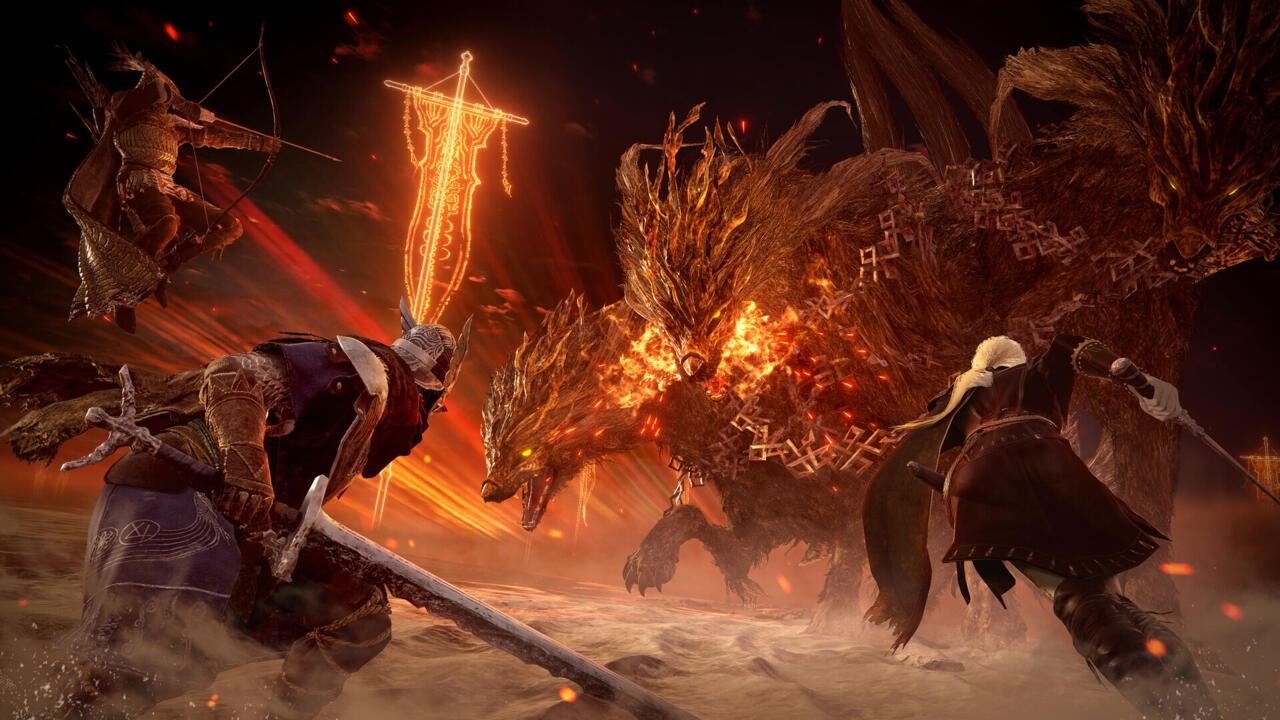
Since I know there are some From Software fans who like to go into the games with only the basic information, I will warn that from this point I will be very briefly discussing some of the noteworthy enemies that we faced–or didn’t in one case–so if you want to go in without knowing anything at all, be warned. For those that stick around, trust that I won’t reveal too much so as to preserve the experience.
The fact of the matter, honestly, is the new day three boss, which was the other big addition we got to check out, so thoroughly whooped us that it’s hard to say much about them anyway. With that in mind, what I’ll say is that the Nightlord we went up against was called Balancers and it pits Nightfarers up against multiple enemies, all of which are aggressive and demand a solid strategy built around movement that gives your comrades space but also communication that can enable you to shift priorities on a dime to help each other. Needless to say, our crew had a bit of a rough time beating the boss, even though we did make good progress towards it. Beyond that boss, there are a few other surprise appearances from the wider world of From Software games which I won’t spoil. Of course, Artorias from Dark Souls has been showcased, but we weren’t able to take him on, unfortunately.
Nightreign’s upcoming DLC, like Nightreign itself, feels like From Software trying to do a lot with a little. By Ishizaki’s own admission, The Forsaken Hollows was developed with stringent requirements, but that, he said, didn’t dull the team’s ambition.
“The schedule was always very tight and we had really limited resources, so it was always a battle of trying to do something that is doable within that limitation, but also doing it to the point where we feel like users are going to be satisfied. And I think all of the development staff, everyone really does want to make something that truly is special and that really does surprise users,” Ishizaki explained.
“Even if we want to do something doable, it’s like everyone wants to make something just a little bit better. So there’s always this sort of push from everyone to just do a little bit more and that sort of snowballs generally. Honestly, I think it comes just from our staff and their love for the craft, for the players, and really wanting to try to make something the best it can be.”
While Ishizaki is quick to bring in the Nightreign team and their contribution to the project, I wanted to take the opportunity to have him reflect on his experience as director. Although he has worked on multiple From Software titles, Nightreign was his first as director, making it a new experience for him. That alone would be daunting, but he also took on a project which, thanks to prior transparency, we know was developed under tricky conditions. As one of the key voices in From Software now and, given the success of Nightreign, someone who could likely become a bigger one in the future, I wanted to know if his experience as director is one he thinks of fondly and is keen to return to.
Elden Ring Nightreign DLC Scholar – Character Breakdown (Exclusive)
Size:640 × 360480 × 270
Want us to remember this setting for all your devices?
Please use a html5 video capable browser to watch videos.
This video has an invalid file format.
Sorry, but you can’t access this content!
Please enter your date of birth to view this video
JanuaryFebruaryMarchAprilMayJuneJulyAugustSeptemberOctoberNovemberDecember12345678910111213141516171819202122232425262728293031Year202520242023202220212020201920182017201620152014201320122011201020092008200720062005200420032002200120001999199819971996199519941993199219911990198919881987198619851984198319821981198019791978197719761975197419731972197119701969196819671966196519641963196219611960195919581957195619551954195319521951195019491948194719461945194419431942194119401939193819371936193519341933193219311930192919281927192619251924192319221921192019191918191719161915191419131912191119101909190819071906190519041903190219011900
By clicking ‘enter’, you agree to GameSpot’s
Terms of Use and Privacy Policy
enter
“We had a really good idea that just happened to sort of land right at that time, and that was pretty much the only way that we were able to do it; to use other assets and focus most of the budget on just really polishing it and making sure that the gameplay loop and experience is unique and fun.
“[In the future] it’s definitely not something that we would, from the outset, be like, ‘Okay, this is what we’re going to do [it], this is how we’re going to make [games].’ I think it really just is if we have a really good idea, someone comes up with something great at just the right time, and it feels like that’s the only way to do it, then it’s worth considering. I definitely wouldn’t put it in a sort of high-priority scenario for sure.
“I think it was a challenge for sure. Definitely the first time doing that; the first time being given that level of responsibility and definitely wanting the project to succeed. So I think given the result, it [has provided] a lot of confidence and reassured me as a creator that what I’m doing isn’t necessarily wrong, and I can trust my instincts. Although there are definitely points of reflection as well and I don’t really know what it’s going to be like going forward, but given the opportunity, I would definitely like to take my learnings from [developing Nightreign] and feed them into something new and something that I can be proud of.”
There’s plenty of reason to be excited to see and experience the full breadth of what The Forsaken Hollows offers, especially since we only experienced a small slice of it. Where the game goes from there, or if it even has a future beyond the DLC, remains unclear, but given what it already is and the impact it had on Ishizaki, I expect this won’t be the last time From Software leans into something unexpected and experimental.
And for those lore-obsessed fans that may be wondering: I didn’t see any references to Londor. But maybe we’ll find something when The Forsaken Hollows launches on December 4, 2025.