
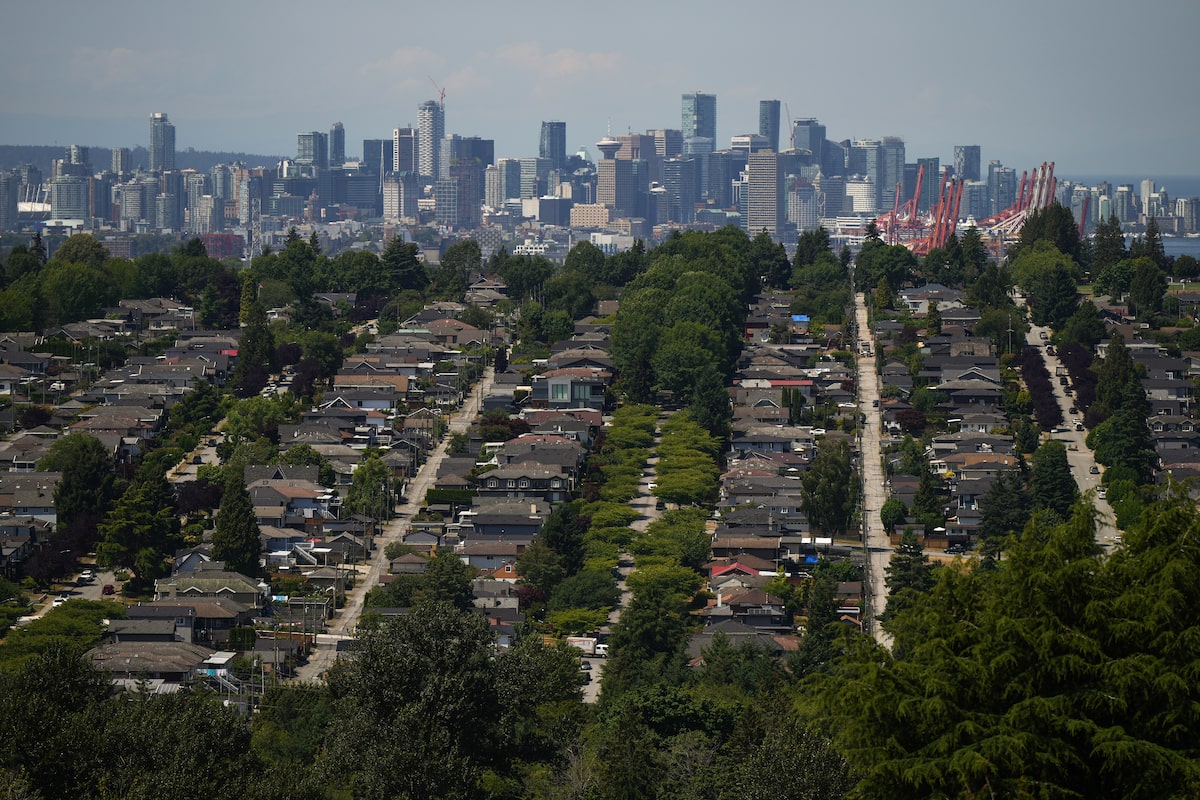
The downtown Vancouver skyline in the distance beyond houses in Burnaby, B.C., in July, 2023.DARRYL DYCK/The Canadian Press
Steven Globerman is a senior fellow at the Fraser Institute. Joel Emes and Austin Thompson are analysts at the Fraser Institute.
The dream of home ownership is alive, but not well. According to a recent Abacus poll, nearly nine in 10 young Canadians, those aged 18 to 29, aspire to own a home – but a similar share worry about the current state of housing in Canada.
Of course, those worries are justified. According to our new study, in 2023 (the latest year of comparable data), typical homes on the market were unaffordable for families earning the local median income in every major Canadian city. It’s not just Vancouver and Toronto – housing affordability has eroded nationwide.
Aspiring homeowners face two distinct challenges: saving enough for a down payment and keeping up with mortgage payments. Both have become harder in recent years.
For example, in 2014, across 36 of Canada’s largest cities, a 20-per-cent down payment for a typical home – detached house, townhouse or condo – cost the equivalent of 14.1 months, on average, of after-tax income for families earning the median income. By 2023, that figure had grown to 22 months – a 56-per-cent increase. During the same period, a mortgage payment for a typical home increased, as a share of median after-tax family income, from 29.9 per cent to 56.6 per cent.
Analysis: Have homes gotten pricier – or has money lost its value?
No major city has been spared. Between 2014 and 2023, the price of a typical home rose faster than the median after-tax family income in 32 out of 36 of Canada’s largest cities. And in all 36 cities, the monthly mortgage payment on a typical home grew when measured against that same income, reflecting rising house prices and higher mortgage rates.
While the housing affordability crisis is national in scope, the challenge differs between cities.
In 2023, a median-income-earning family in Fredericton, the most affordable large city for home ownership in Canada, had to save the equivalent of 10.6 months of after-tax income ($56,240) for a 20-per-cent down payment on a typical home. The monthly mortgage payment ($1,445) required 27.2 per cent of that family’s after-tax income.
Meanwhile, a median-income-earning family in Vancouver, Canada’s least affordable city, had to spend the equivalent of 43.7 months of after-tax income ($235,520) for a 20-per-cent down payment on a typical home with a monthly mortgage ($6,052) that required 112.3 per cent of its after-tax income. This would be a financial impossibility unless the family could rely on support from relatives or friends.
The financial barriers to home ownership are clearly greater in Vancouver. But, crucially, neither city is truly “affordable.” In Fredericton and Vancouver, as in every other major Canadian city, buying a typical home with the median income produces a debt burden beyond what’s advisable. Recent house-price declines in cities such as Vancouver and Toronto have provided some relief, but home ownership remains far beyond the reach of many families – and a sharp slowdown in home building threatens to limit further gains in affordability.
Federal budget falls short on housing affordability, experts say
For families priced out of home ownership, renting doesn’t offer much relief, as rent affordability has also declined in nearly every city. In 2014, rental rates for the median-priced rental unit required 19.8 per cent of median after-tax family income, on average across major cities. By 2023, that figure had risen to 23.5 per cent. And in the least affordable cities for renters, Toronto and Vancouver, a median-priced rental required more than 30 per cent of median after-tax family income. That’s a heavy burden for Canada’s renters, who typically earn less than homeowners. It’s also an added financial barrier to home ownership – many Canadian families rent for years before buying their first home, and higher rents make it harder to save for a down payment.
In light of these realities, Canadians should ask: Why have house prices and rental rates outpaced income growth?
Poor public policy has played a key role. Local regulations, lengthy municipal approval processes, and costly taxes and fees all combine to hinder housing development. And the federal government allowed a historic surge in immigration that greatly outpaced new home construction. It’s simple supply and demand: When more people chase a limited (and restricted) supply of homes, prices rise. Meanwhile, after-tax incomes aren’t keeping pace, as government policies that discourage investment and economic growth also discourage wage growth.
Canadians still want to own homes, but a decade of deteriorating affordability has made that a distant prospect for many families. Reversing the trend will require accelerated home building, better-paced immigration, and policies that grow wages while limiting tax bills for Canadians – changes governments routinely promise but rarely deliver.