
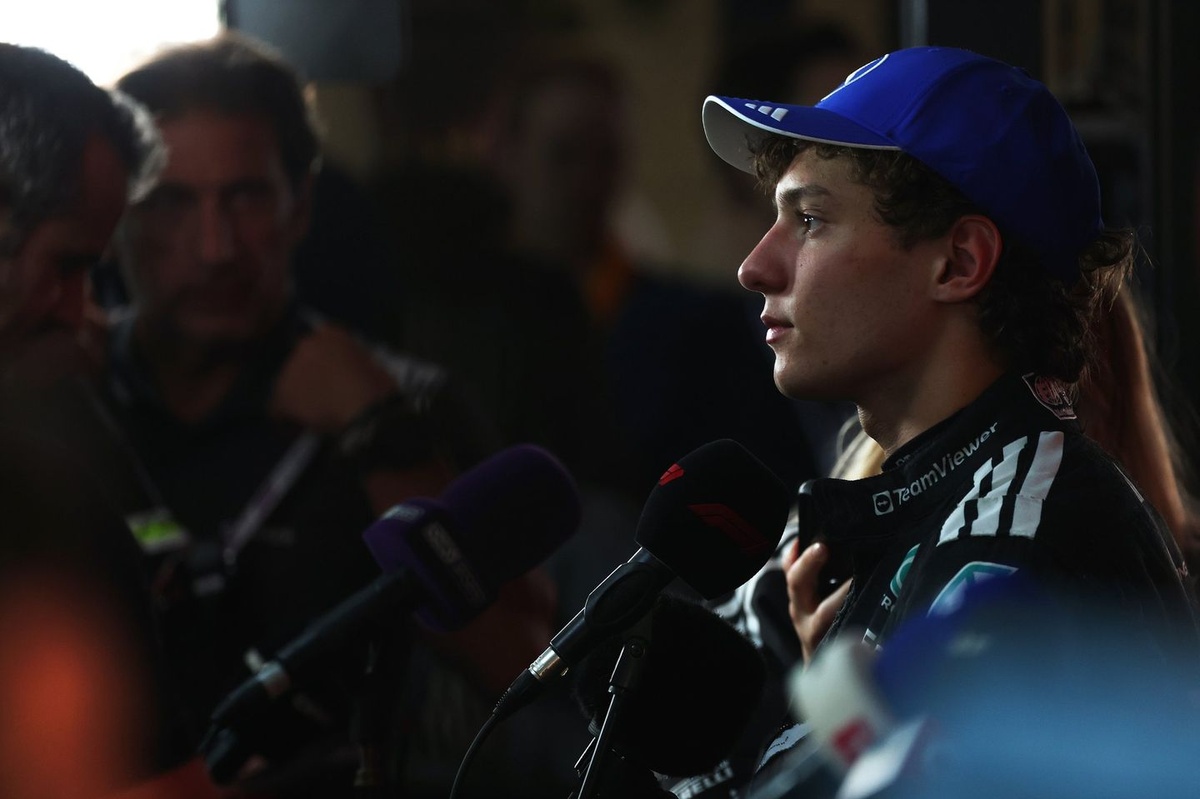
Let’s start with the clearest point: anyone who takes part in a harassment campaign is directly responsible for it. Whether it’s an anonymous, barely followed social media account or a public figure with thousands of readers, nobody is entitled to pour out crude, idiotic hatred at someone else. There is certainly no justification for such behaviour.
With that premise established, we can only regret how Helmut Marko – a long-time Red Bull figure, now 82 years old, an age that should by now bring a certain wisdom – threw Andrea Kimi Antonelli to the wolves at such a moment, when – at the end of the season – tension is running high. That outburst, even if some would argue it fits the Austrian’s unfiltered personality, was entirely avoidable.
Even if one may argue that Red Bull’s short statement and Marko’s subsequent comments rowing back were late – more than 12 hours after the end of the race – it’s still better late than never.
The role of the TV broadcast
There is, however, another party in this whole equation that contributed to the flare-up around what should have been treated simply as a racing incident – albeit one that could potentially become a decisive moment in the championship battle. That party is Formula 1 itself, via the international TV direction.
Watching laps 56 and 57 in full, plus the immediate post-race coverage, it’s hard not to see a textbook example of how poorly chosen or rushed use of available broadcast resources can inflame what otherwise could have gone down as a mere racing incident.
On lap 56, the TV broadcast logically decides to focus on the fight between Antonelli and Norris for fourth place. We follow them from the exit of Turn 15 on lap 55, with a few wide shots but mainly a camera fixed on Norris. Approaching the critical zone at Turn 10 on lap 56 – the moment the Mercedes driver makes his mistake – the camera is in fact pointed solely at the McLaren.
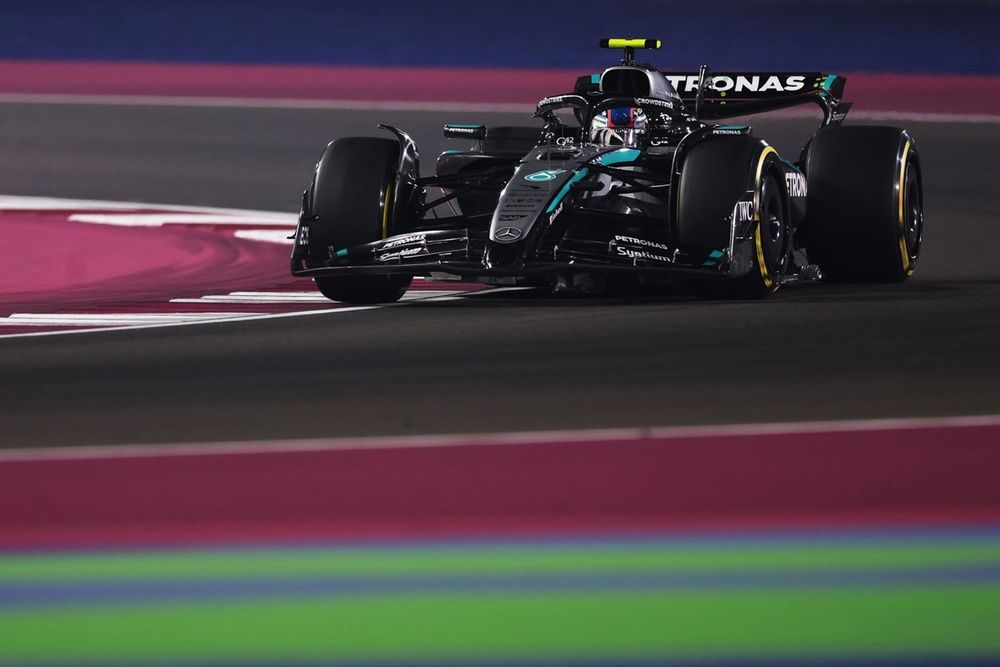
Kimi Antonelli, Mercedes
Photo by: Lars Baron / LAT Images via Getty Images
The TV broadcast therefore misses Antonelli’s error live. As the Briton prepares to pass the Mercedes, which has rejoined the track, the shot changes. We now get a helicopter view showing the McLaren blasting past with a huge speed difference. Meanwhile, the graphics indicate Verstappen is entering the final lap.
For another 30 seconds or so, the broadcast stays on Norris. It displays the updated live championship standings, then switches to Verstappen, keeping Norris’s onboard camera in a small window as he chases Sainz.
After about 40 more seconds following Verstappen, the broadcast triggers the animation introducing an upcoming radio message. Then we hear Gianpiero Lambiase – whose message certainly dates from moments after Norris’s overtake – say: “Not sure what happened to Antonelli, Max, looks like he just pulled over and let Norris through.”
At the exact moment the audio ends, Verstappen enters the final corner and wins the race. What follows is an extremely long sequence: the other cars finish, cool-down laps, a few radio messages, the top three arriving in parc ferme, and their first comments after stepping out of the car.
In short, only after all this – a period of roughly 10 minutes, during which a large part of the audience will already have switched off – does the TV broadcast finally provide the context for that now “famous” lap 56, showing the onboard replays from Antonelli and then from Norris, leaving little doubt about what actually happened.
A responsibility that must be acknowledged
We won’t reproach F1 for not showing those images between the moment of the incident and Verstappen’s finish; the window was likely too short and the priority of showing the Dutchman crossing the line, achieving his seventh win this year, too great.
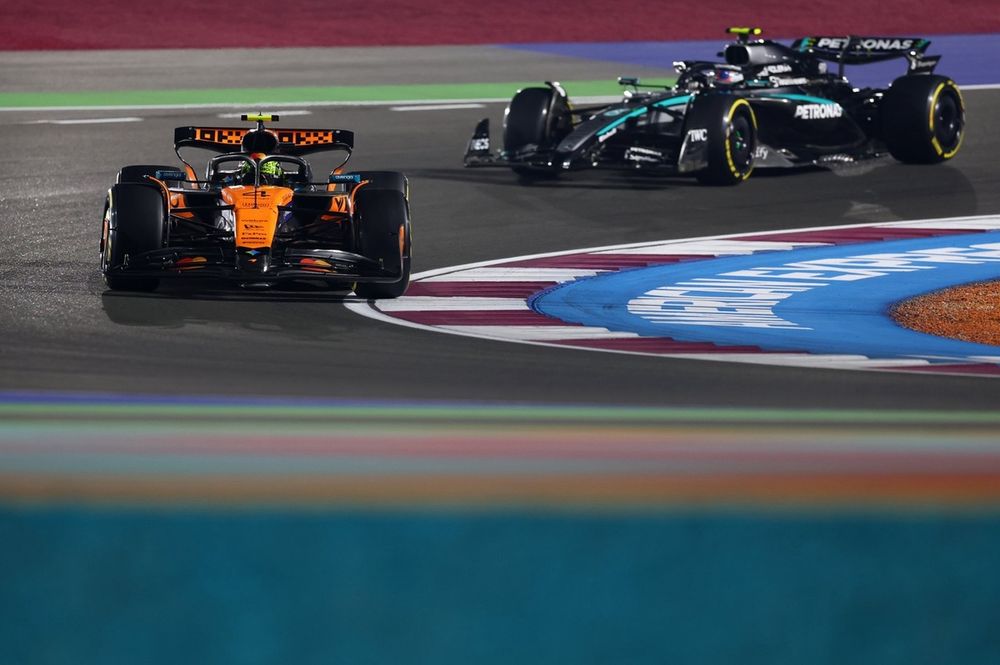
Lando Norris, McLaren, Andrea Kimi Antonelli, Mercedes
Photo by: Zak Mauger / LAT Images via Getty Images
What can be strongly regretted, however, is the haste with which the broadcast chose to air Lambiase’s radio message – entirely out of context – and the lack of similar urgency afterwards, once the finish was completed, to show the relevant replays of Norris’s overtake or even broadcast Antonelli’s radio messages in which he immediately admitted his mistake.
Faced with a situation that was unclear in the moment, because Antonelli’s error had not been seen live, the undiscerning use of the Red Bull radio message helped push the narrative down a very slippery slope. From there, of course, Marko took it upon himself to fuel the emerging fire, and things quickly spiralled out of control.
Read Also:
A few weeks ago, the F1 broadcast was under the spotlight for a different issue: prioritising shots of celebrities or drivers’ partners at the expense of the sporting action. It is a problem – and arguably a symbolic one, even if it predates the Liberty Media era – but the out-of-context use of broadcast resources is another problem entirely, with far more serious ramifications, as the Antonelli example unfortunately demonstrates.
F1 clearly wants to tell a spectacular story. But distorting that story, intentionally or not, especially in the context of a heated championship battle, risks consequences that far outweigh the brief shot of excitement for fans around the world hearing the “controversial” radio message.
No one should face such consequences and when we’re speaking about a 19-year-old, it should prompt urgent self-reflection and a greater awareness of the consequences of everyone’s actions, whether it’s Marko or the TV direction.
Read Also:
We want to hear from you!
Let us know what you would like to see from us in the future.
– The Autosport.com Team