
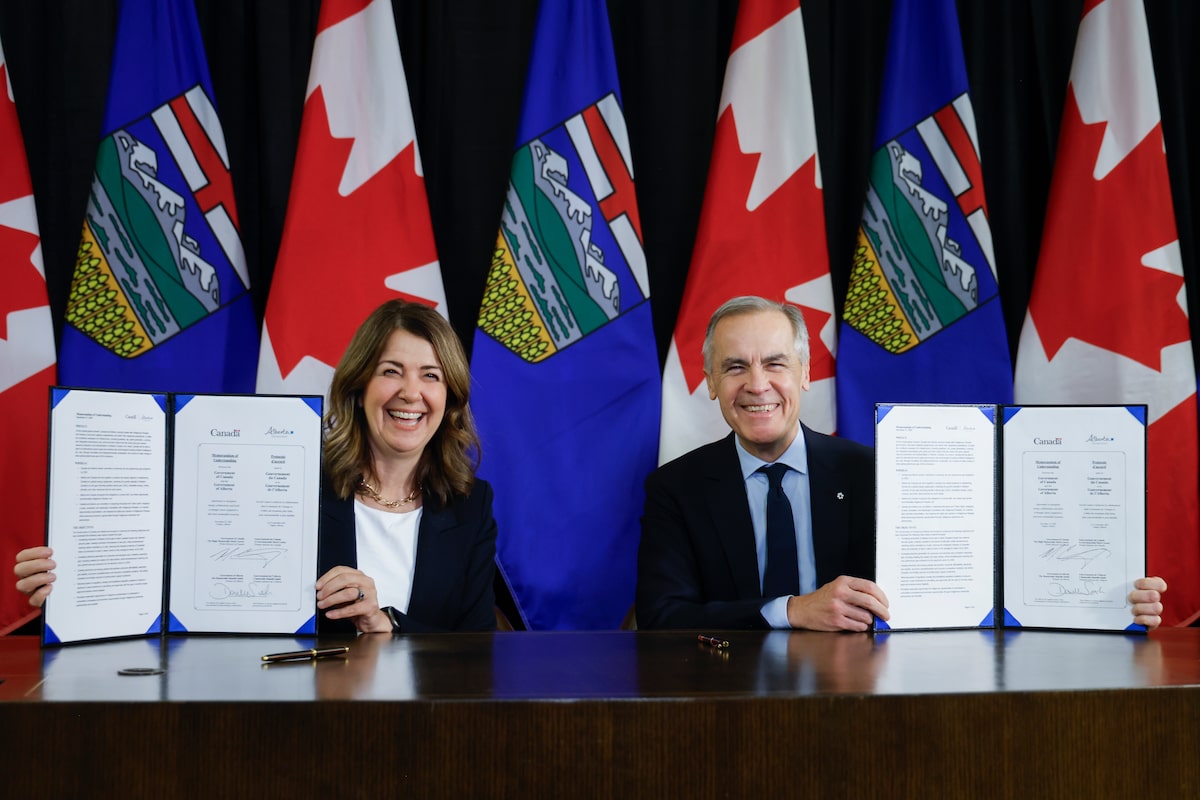
Prime Minister Mark Carney and Alberta Premier Danielle Smith are betting that there are more votes to be gained in the middle ground than there are to be lost on the fringes.Jeff McIntosh/The Canadian Press
Everyone could find something to hate about the energy agreement – technically, the Canada-Alberta Memorandum of Understanding – Mark Carney and Danielle Smith struck last week.
For the right, the conditions on federal support for a heavy oil pipeline from Alberta to the West Coast – notably, a tightened provincial carbon pricing regime – are too onerous, if not altogether unnecessary. For the left, it is the pipeline’s costs that are too great: not only in itself, but also in the form of federal emissions regulations that were traded away as part of the deal.
As for the scorekeepers in the pundit class, several were agreed that Mr. Carney and his closest advisers had been snookered, politically. All they would achieve by their concessions to Alberta is to run into a brick wall of opposition from British Columbia and Indigenous groups, divide the federal Liberals, and raise the federal NDP from the grave. Not to mention sink Liberal support in Quebec, especially after the resignation of former environment minister Steven Guilbeault from cabinet.
Whew. Apparently Mr. Carney, the former Goldman Sachs dealmaker, is a terrible negotiator, exceeded in incompetence only by Ms. Smith, who was roundly booed for her efforts at the United Conservative Party convention the next day. Each, it seems, gave away the store to the other.
Or perhaps they are not such simpletons as all that.
Carney to address AFN amid criticism over major projects, Indigenous consultation
Hodgson goes to B.C. to meet with Eby as fall-out from Alberta deal continues
What, first, is the nature of those concessions? The cap on emissions in the oil and gas sector the feds have agreed to scrap has been estimated to cost at least $800 per tonne of emissions averted, just in compliance costs, and as much as $2,887 per tonne when all economic losses are considered. Likewise, the federal clean electricity regulations from which Alberta would be spared imply compliance costs, even on the government’s own numbers, of more than $200 per tonne – much more, if economic losses are included.
By comparison, carbon pricing is a steal – even at the much-elevated price the two governments have agreed to. The $130 price mentioned in the agreement is a minimum price, not a ceiling; and it is the market price of a credit, not the “headline” or compliance price (the penalty a company would have to pay if it neither reduced its emissions nor bought credits on the market). Credits are currently trading at about $20 to $25 on Alberta’s Technology Innovation and Emissions Reduction market, so this represents about a sixfold increase.
But what’s to prevent Ms. Smith from agreeing to carbon pricing now, then scrapping it after the pipeline is built? Two things. One, the “financial mechanism” mentioned in the MOU is code for “carbon contracts for difference”: a kind of futures contract, protecting firms that invest in lower emissions from being left holding the bag should carbon pricing be scrapped or lowered at some future date (as the government would then have to pay the difference between the actual and projected price).
And two: the pipeline only proceeds if the Pathways carbon-capture-and-storage project does – the agreement is explicit on this. And Pathways is only feasible at a carbon price of at least $130 a tonne. No carbon pricing, no Pathways; no Pathways, no pipeline. Alberta hasn’t just given a political commitment to carbon pricing. It’s baked into the whole deal.
But what about the politics? Certainly it will not be easy to bring the government of B.C. on board, though Premier David Eby has already signalled his acquiescence (he cannot legally block it) so long as the tanker ban off B.C.’s north coast is maintained. That’s doable: the pipeline could take a different route, or regulations of equivalent effect could be implemented, much as Alaska did after the Exxon Valdez disaster.
Indigenous groups, likewise, can in principle be compensated (again, they have no veto in law) by being given a share of the equity in the project. Not every group will be mollified, but not every group has to be: only a politically critical mass.
Essentially, both Mr. Carney and Ms. Smith have, in their different ways, made the same bet: that there are more votes to be gained in the middle ground than there are to be lost on the fringes.
Whatever pains the deal may cause for Mr. Carney in B.C. (where a majority is in support of the project) or Quebec (where Mr. Guilbeault is half as popular as Mr. Carney), or with the still-leaderless NDP, these must be set against the opportunity to steal the centre-right vote from Conservative Leader Pierre Poilievre, and possibly reinvent the Liberals in Western Canada.
As for Ms. Smith, the deal offers a way out of the trap in which she is now caught, as the darling of a separatist movement that is widely rejected in the province. Those boos? I’m guessing they were music to her ears.