
In a couple of days, I’m starting my trip to the Benelux region to enjoy United XR Europe, which will take place on December 8-10 in Brussels, Belgium. The organizers were so kind to organize for me a preview of five super cool companies that will be there among the 150+ exhibitors, so I could give you a sneak peek of what you can expect from this event. And there are incredible things like a device that literally cancels motion sickness while you are in VR, smart contact lenses, AR navigation… keep reading to discover all of this with me!
Skyjet VR
I think Skyjet VR will be one of those attractions with a long line at the event. This is a VR simulator developed by IRALTA that lets you feel like you are flying on a Jetpack.
The trailer of the experience
The project is a combination of hardware and software. On the hardware side, you have a physical simulator you can stand in, and that is able to rotate around all three axes to increase the physical perception that you are flying. The rotation can span around 20 degrees. I’ve been told that theoretically the machine could even rotate more, but 20 degrees is the best compromise between realism and comfort. There is also air that blows on your face with a similar strength to the images you are seeing. On the software side, you have visuals that are a mix of 12K 360° drone footage and 3D environments generated in real time from hyper-realistic digital mapping and aerial scans using Unreal Engine 5.
Why do I think this is cool?
Well, as a nerd, I’ve always dreamt about flying on a jetpack… and I guess, you too… so the idea of trying a similar experience in VR excites me!
MPSkin
MPSkin is an AR wayfinding solution for mobile phones. Using the words of its PR, “It is like Google Maps for indoor places”. With MPSkin, you can have a space fully mapped so that you can add AR elements of different kinds (images, videos, 3D elements, texts, etc) in precise places. But even more than that, you can have the app give you AR instructions (with 3D arrows and such) to go from your position to the destination you want to go.
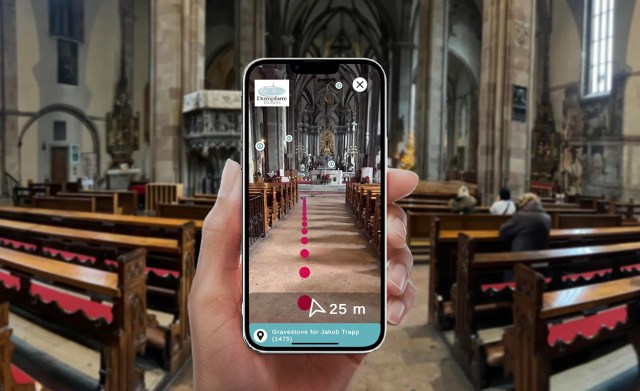 Indoor navigation in AR offered by MPSkin (Image by MPSkin)
MPSkin works mostly with Matterport scans: starting from a scan of the place, the company is able to enable AR mapping on it very easily. The full procedure for MPSkin, from mapping a place to delivering AR augmentations, takes between 2 and 24 hours, which is very fast. The use of Matterport scans offers a double advantage. The number one is that many places already have these scans, for instance, because they were scanned to make a virtual tour or a digital twin. MPSkin can exploit the data that many places already have, cutting the time and the cost necessary for the scan. The second advantage is that the accuracy of the 3D reconstruction of Matterport scans translates into a drift-free AR experience for the user.
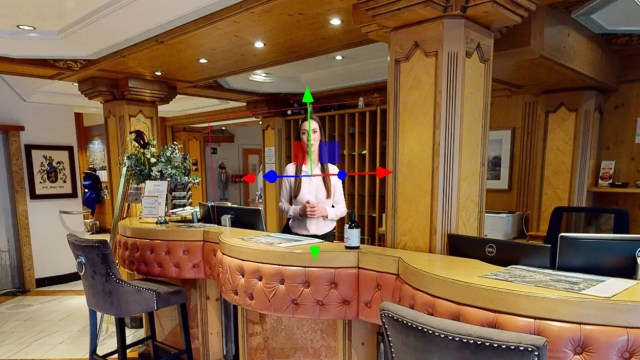 A green-screen video added to a specific place in AR (Image by MPSkin)
Why do I think it’s cool?
One thing that I haven’t told you is that they are going to demonstrate MPSkin directly at AWE! Every time I’m at AWE, I’m always getting lost in the Expo area, and finding the booth that I want to visit is always a mess. MPSkin is going to map the AWE venue, and so I guess they are offering us AR directions to go to every place we want to go. This is actually super useful. And it is also going to be for me a good way to test if this app actually works: if it delivers well in the AWE venue that is full of people, and with internet that is not always smooth, then the system is really solid. I can’t wait!
Hypervision
Hypervision is a company that I meet almost every year, and every year, it is able to show me intriguing solutions. It has a long experience in working on optical systems that can offer a high FOV to VR headsets. Yes, FOV, that feature that had a 0,1% increase in the last 10 years of VR…
Hypervision is going to show at the expo this prototype:
Pushing the limit in pancake optics is what’s needed for the next big leap in the XR industry.
▶️ True human-like 220° FOV in a compact design with huge sweet spot and higher brightness & clarity is the next big thing imho ◀️
Our portfolio company @HyperVisionXR is doing… pic.twitter.com/ifNNiwJ0A8
— Artur Sychov ᯅ (@ASychov) September 22, 2025
It is made by four 4K displays, two per eye. That weird system of lenses ensures that there is no visible seam when an eye transitions between one display and the other. In the past, when I’ve tried Hypervision technologies like this one, I’ve always found them amazing, but I could also perceive the seam between the two parts of the lens of every eye. This year, the company claims to have solved this issue, and I really can’t wait to verify this claim. If it is true, I could enjoy a headset with full human horizontal FOV!
They are also bringing to the event their standard optical system with “only” 160° FOV. They’re demoing it with the new TCL display that got the attention of many VR journalists because it can offer high-quality OLED visuals at an affordable price. It should have less brightness but more resolution than the BOE displays usually employed for this demo, so we are all curious about the results.
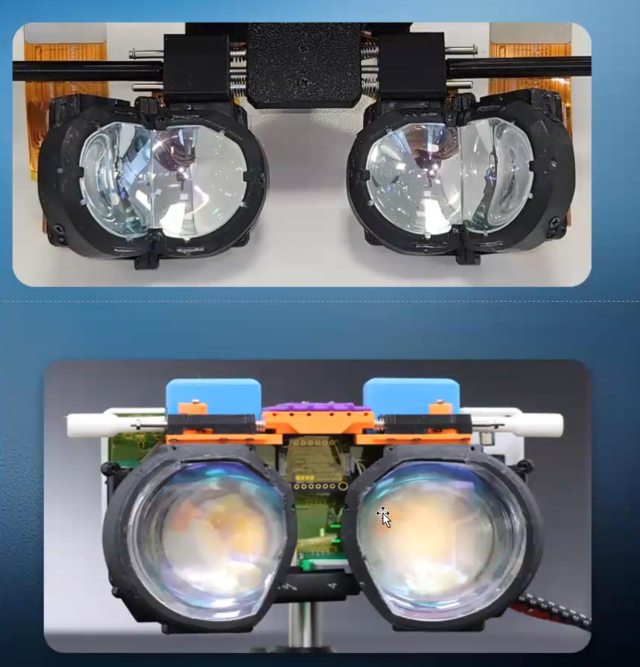 The two prototypes that Hypervision is going to show. On top, the new one; on the bottom, the traditional one (Image by Hypervision)
Artur from Hypervision mentioned that the traditional optical system could be in the hands of the developers in 2026. I asked him if this means that it will be mounted inside the Lynx headset, but he said no. He clarified that Lynx has a custom optical solution made by Hypervision: since it is a mixed reality device with an open periphery, it does not need such a huge FOV like a VR headset, so a more compact solution has been designed.
Why do I think this is cool?
Well, well, trying a headset with basically the same field of view as human vision is always exciting. And so is trying the new display from TCL, which can enable middle-range XR headsets in the future. And I’m happy to meet Artur every year, so… I’ll be here!
Neural Balance Innovation (NBI)
We now come to Neural Balance Innovation (NBI), which is offering something I’ve always wanted to try in my 11 years in VR: Galvanic Vestibular Stimulation (GVS).
One of the social media posts that made me the most excited about GVS in the past
NBI offers Stimbox, which is a little box with two little electrodes that you put behind the ears and have the purpose of “stabilizing the inner ear” to remove motion sickness. Remember that motion sickness happens because when you are in VR, your eyes see that you are moving, while the vestibular system in your ear perceives that you are static: the brain perceives this sensor mismatch, thinks that you have been poisoned, and makes you want to vomit to get rid of the poison.
Stimbox can solve this sensory mistmatch in two ways: it can either desensitize your ear, so that the brain ignores its signals; or, even better, sinchronize the perception of your inner ear with the movements that you see in VR: in this case, you really have the feeling that your body is moving while you’re moving in VR, for decreased nausea and added realism.
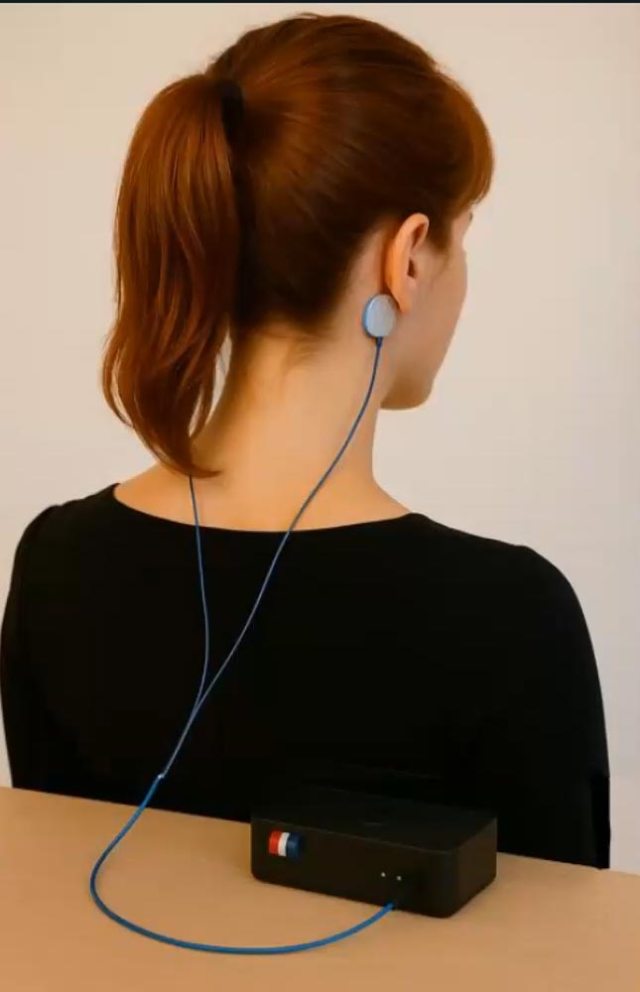 Example image of a person using the Stimbox device (Image by NBI)
I’ve asked Clarice, the PhD who is working on this project, if using GVS has some side effects on the users, and she said that some may happen if you don’t calibrate the system, that is, if you don’t customize it for you. She taught me that when you use GVS, there’s a threshold above which the system helps you in feeling better, and a second threshold, below which the nausea even gets worse (between the two thresholds, the effects are negligible). Calibration helps in ensuring that your experience is above the first threshold. She told me they are also starting to look at how this system can leave long-term positive effects on the users.
Currently, they are working with military, helicopter pilots, and drone pilots, but they want to expand their use cases.
Why do I think this is cool?
Nausea-free VR. Should I tell you something more? I’ve read about people having mind-blowing experiences with GVS. I’ll be in line to try this 100%. I want to try some rollercoasters while eating a hot dog, and I don’t feel any nausea!
XPANCEO
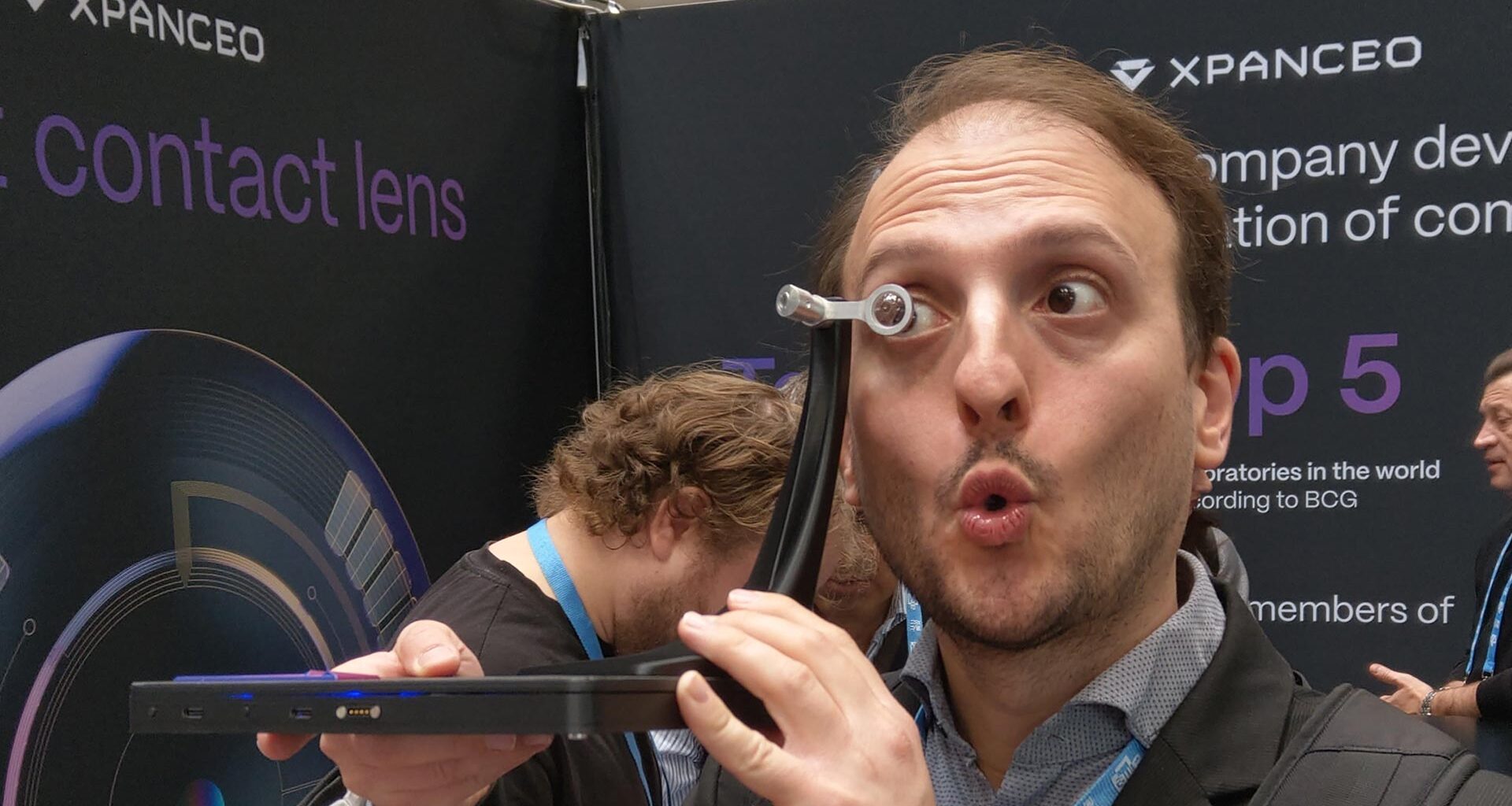
You know that I’m a super big fan of smart contact lenses, so I’m happy to know that XPANCEO will be again at UnitedXR!
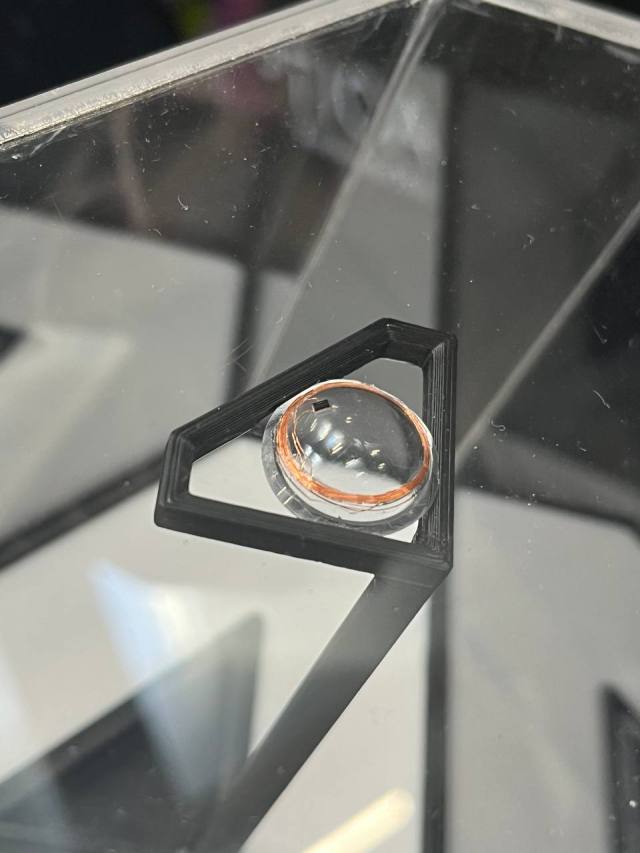 This contact lens can interact with your phone via NFC (Photo shot by Andrea Bravo)
This year, they are going to show a new cool use case for the lenses. Plus, they will have some prototypes on how they plan to power the contact lens: one is using a device that is close to the eye and that wirelessly shares power and data with the lens. Another one is a lens with an integrated microbattery. They will also have two different display types: one lens will feature a microdisplay and another a holographic display; the visitors will be able to put their eyes close to both of them.
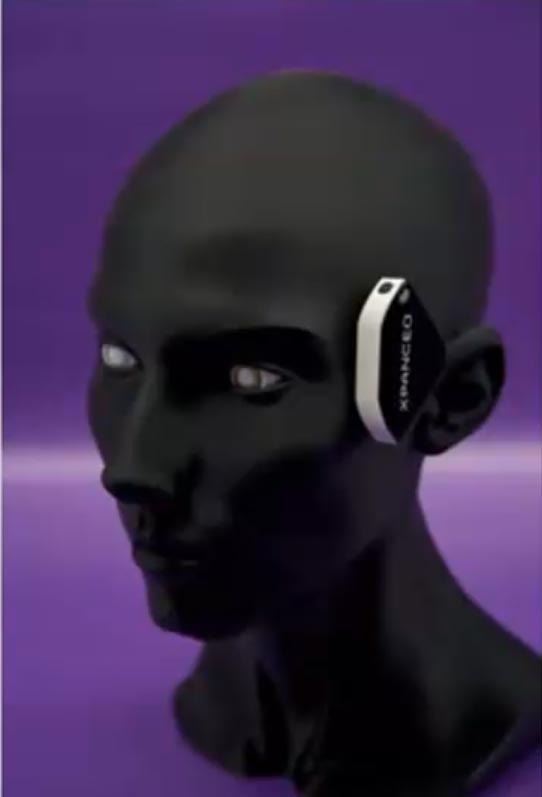 This Black-Mirror-like device is able to send power and data wirelessly to the contact lens in your eyes (Image by XPANCEO)
XPANCEO plans to have a first contact lens prototype with all the required features by the end of 2026, and then start doing medical trials of its gadgets. Hopefully, in a couple of years, someone will start putting these lenses in the eyes in some controlled environments!
Why do I think this is cool?
Smart contact lenses are the most cyberpunk technology I’ve ever tried in VR. I was a big fan of Mojo Vision back in the day, and now XPANCEO is giving us new hope in the sector. I literally can’t wait to try a lens in my eyes…
And that’s it for my preview of United XR Europe. I’ll be there next week, and I will try the products of all the companies mentioned here. What about you? Hopefully, see you there!
(Header image shot by Andrea Bravo)
Disclaimer: this blog contains advertisement and affiliate links to sustain itself. If you click on an affiliate link, I’ll be very happy because I’ll earn a small commission on your purchase. You can find my boring full disclosure here.
Share this with other innovators
Related