

Listen to this article
Estimated 3 minutes
The audio version of this article is generated by text-to-speech, a technology based on artificial intelligence.
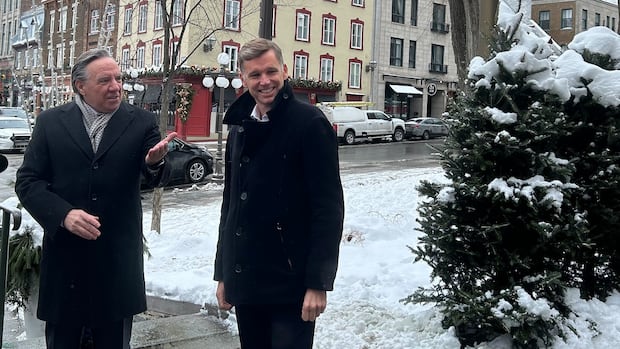
Quebec Premier François Legault made a stop at city hall in Quebec City Tuesday morning to meet with Mayor Bruno Marchand, who was re-elected for a second term in November.
During the official visit, the two discussed planned infrastructure projects, including TramCité — a 19-kilometre tramway venture — and also the controversial third link, a new span which will consist of a bridge and tunnel between Quebec City and Lévis on the South Shore.
Legault said Transport Minister Jonatan Julien was reviewing the route of the proposed third link.
“We hope to reach an agreement with Bruno, among other things, on the route,” Legault said.
When Legault’s Coalition Avenir Québec government announced this summer that a corridor had been chosen for the third link project, Marchand expressed some reservations.
He said he had questions regarding the impacts of the project on specific roads, highways, neighbourhoods, residents and the role of public transit.
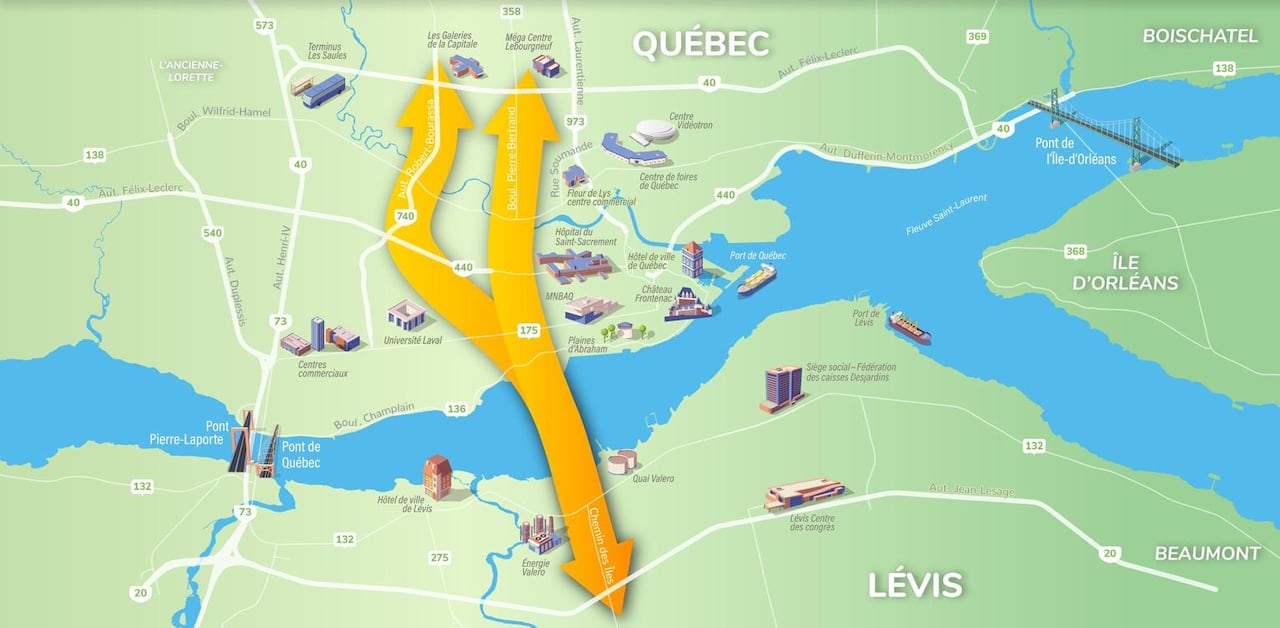 Earlier this year, the Legault government said two different locations were being considered for the access point in Quebec City. (Ministère des Transports et de la Mobilité durable)
He also made clear he was against a route that would “chop up” the city’s Vanier and St-Malo neighbourhoods, and reiterated that position on Tuesday.
Legault, for his part, didn’t mention any specific route changes, saying only the government was looking into the possibility of making adjustments, some of which were requested by Marchand. He added that costs had to be taken into account and should be minimized.
As for the city’s tramway project, both Legault and the mayor said it will boost the region’s economy.
“We expect a lot of jobs will be created with the construction of the tramway and residential construction near the tramway,” Legault said.
While financing for the project hasn’t been finalized, Legault said he’s confident the federal government will chip in and pay its share of the total costs.
“We will get 40 per cent,” Legault said.
Immigration challenges different in Quebec City
Legault took some by surprise after the meeting when he seemed to soften his stance on immigration — at least where Quebec City is concerned.
He said the stakes are different when it comes to welcoming newcomers in the city, compared to Montreal.
“On the island of Montreal, we have only 43 per cent of francophones,” he said, “so we don’t have this challenge of protecting French in Quebec [City] and the integration is a lot easier.”
And because of these different realities, Legault said it would make sense for the two cities to be treated differently.
“We recently announced that we will accept 45,000 permanent residents and we will prioritize those immigrants who are currently outside of Montreal and Laval,” Legault said.
The premier also pointed to ongoing discussions with Ottawa over the renewal of permits for temporary foreign workers outside of Montreal.
Marchand said he was happy the premier acknowledged, following their discussion, that the needs and realities in Quebec City are different than in Montreal.
He said that Legault already knew that 95 per cent of the population in Quebec City speak French, that integration is easier and that the region needs more workers.
“He sees that our economic boom will only intensify, particularly through various projects,” Marchand said of Legault.
He pointed to several job-creating initiatives, including the tramway, housing developments and Davie shipyard, which is expected to benefit from a boost in defense spending.