
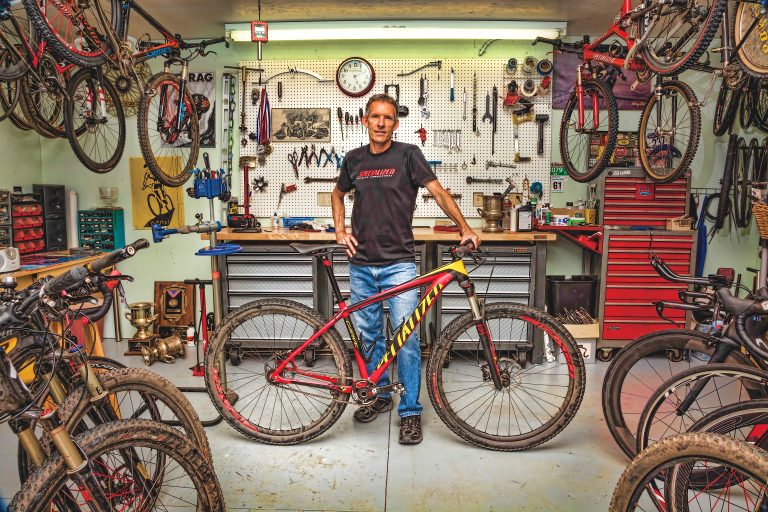
 “I think one of the reasons I have had longevity in bike racing is because I have embraced crosstraining and a variety of different cycling disciplines: mountain bike, fat bike on snow, cyclocross, gravel, road and triathlon.”—Ned Overend Photo by Dan Escobar
Ned Overend was the 1990 UCI Mountain Bike World Champion; a six-time National XC Champion; a two-time Xterra Triathlon World Champion; a Fat Bike National Champion; a Single-Speed National Champion; and a Winter Triathlon National Champ (run, mountain bike, ski). He’s also a member of the Mountain Bike Hall of Fame, the USA Bicycling Hall of Fame and the Xterra Triathlon Hall of Fame. Ned lives in Durango, Colorado, and works in product development and sports marketing for Specialized Bicycles.
My off-season training is about balance. In the winter, instead of focusing on peak fitness for a specific race event, I have more time to work on the muscle groups and skills I have neglected. It’s also a time to have fun with my training, which helps me stay positive and motivated when it comes time to increase my intensity and volume for the upcoming race season. I think one of the reasons I have had longevity in bike racing is because I have embraced cross-training and a variety of different cycling disciplines: mountain biking, fat biking on snow, cyclocross, gravel, road and triathlon. I love riding and geeking out on all types of bikes.
I do a variety of workouts in the offseason. A week in the winter might include a snow/fat bike ride, a day of cross-country skiing or a run with the dog on snow-packed trails. I have a Wahoo Kickr Smart Trainer that I use for a couple of Zwift sessions each week. I also try to strength train in the gym twice a week.
Riding on an indoor trainer is a great workout, and it’s more entertaining now with programs like Zwift, where you can ride and compete against others. I can concentrate on my pedal dynamics when I ride the trainer, and it has made me a more efficient cyclist. By watching the wattage output and experimenting with different muscle groups and where in the pedal circle I apply pressure, I found that I can maintain a consistently higher wattage with less effort. But, it’s important to get outside and work on things that benefit bike handling.
Fat biking in snow is great for developing mountain bike skills, because there is a lot of sliding and drifting, so you learn to balance on the bike as it’s sliding around. If you do fall, the snow is more forgiving than falling on dirt and rocks. Cross-country skiing is a great balance workout, and it’s one of the best for using all the major muscle groups. The variety of workouts makes me a more balanced athlete, and the break from my typical bike training gives me a mental break, which helps me approach the next race season with a positive attitude.
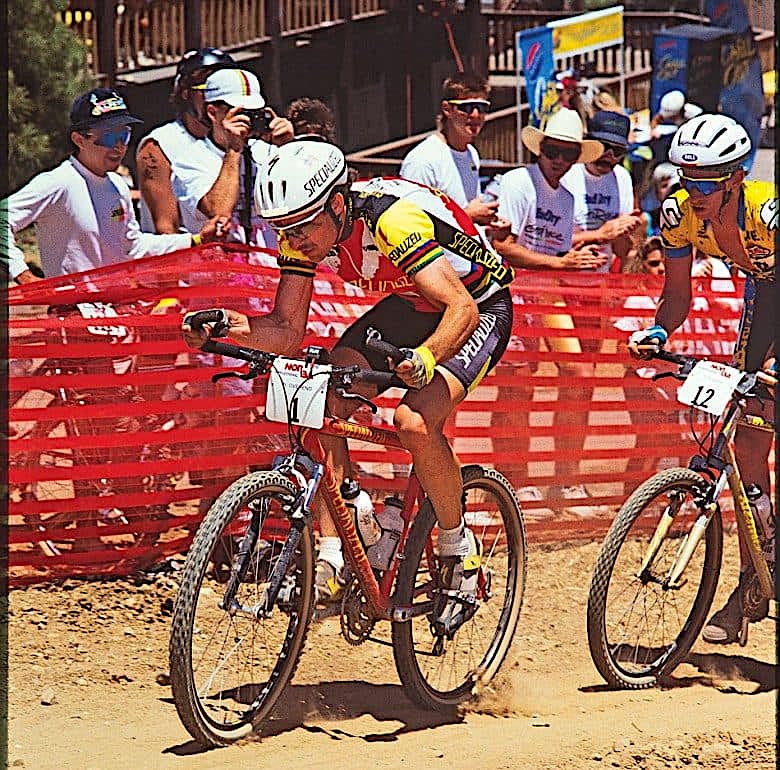 Photo-Pat Carrigan
Mountain Bike Action is a monthly magazine devoted to all things mountain biking (yes, that’s 12 times a year because we never take a month off of mountain biking). It has been around since 1986 and we’re still having fun.
Start a subscription by clicking below or calling (800) 767-0345.