

Listen to this article
Estimated 5 minutes
The audio version of this article is generated by text-to-speech, a technology based on artificial intelligence.
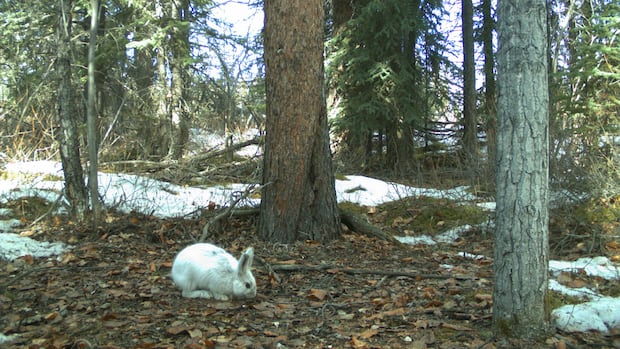
Snowshoe hares in the Yukon’s Kluane area are increasingly standing out from their surroundings, according to a study published earlier this month — and researchers are wondering whether that will make hare populations more vulnerable to predators over the long-term.
Snowshoe hares moult in the fall and spring to blend in with their environment and keep warm in winter, said Charles Krebs, a zoologist at the University of British Columbia and one of the authors of the paper published in the Royal Society Open Science journal.
With climate change affecting temperatures and snow cover, he and his team wanted to know if snowshoe hares in the Kluane region are changing the timing of their moults — when they change to either brown or white — and if there is a longer period of mismatch between snowshoe hares’ coats and their environments.
“There’s always going to be some mismatch because you know … it snows sometimes in the early autumn and then it all melts again for a while,” said Alice Kenney, a zoologist and another one of the paper‘s co-authors. “The question is whether it’s going to get worse with climate change — and that’s hard to get at.”
Contrary to their predictions, the researchers did not find a trend to suggest snowshoe hares are changing colour later in the fall or earlier in the spring in response to climate change.
“We can’t see any selection, if you like, for a shorter period of the hare being white,” said Krebs.
However, they did find that the mismatch between hares’ coats and their local environment is increasing. That means snowshoe hares are less camouflaged during the spring and fall.
Snowshoe hares play a vital role in the ecosystem, because of their 10-year population cycle. Hare populations gradually increase over the course of the cycle, before abruptly crashing. The population levels of their predators, including lynx, coyote and goshawks, also tend to follow this pattern, says Kenney, because they rely on hares as their primary food source. So, what happens to hares can have cascading effects in the boreal forest ecosystem.
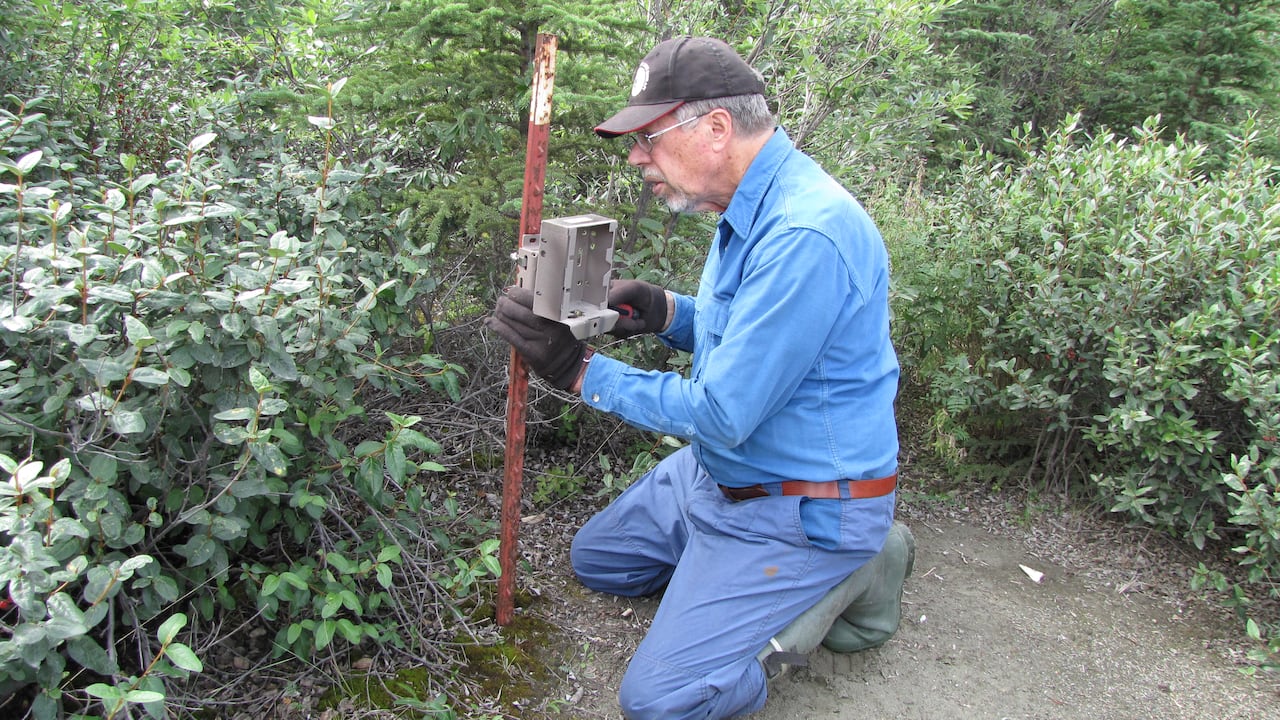 Charles Krebs sets up a lock box that will house a trail camera. This ‘camera trap’ captures time-lapse photos of wildlife in Kluane, Yukon. (Submitted by Alice Kenney)
Kenney has been studying hares and other species in the Kluane area since the 1980s, and about 10 years ago she began leading a “camera trap” project. The camera traps use trail cameras to take time-lapse photos every day, allowing researchers to study wildlife populations in a non-invasive way, said Kenney.
The hare study used camera trap data from 2016 to 2022 to compare the amount of snow cover on the ground to the whiteness of a snowshoe hare’s coat.
Nick Johnson, a Kluane First Nation citizen, has been involved in the project since its early days and was responsible for setting up the cameras in the forest and collecting the photos each summer. He says it was evident from the photos where the snowshoe hares were in their population cycle.
“When they’re high in their cycle, I remember seeing so many rabbits, like thousands of photos of rabbits … they were probably the number one animal we would get,” he said.
Easy targets for predators
Brian Melanson, a trapper in Haines Junction, Yukon, near Kluane, says he noticed many white hares this fall before the snow fell.
“We had pretty cool temperatures, but no snow. There were these white bunnies, you know, all over,” Melanson said. “I started to notice a lot more kill sites and started to notice a lot more hawks and eagles were hunting them along the highway and along the bush roads.”
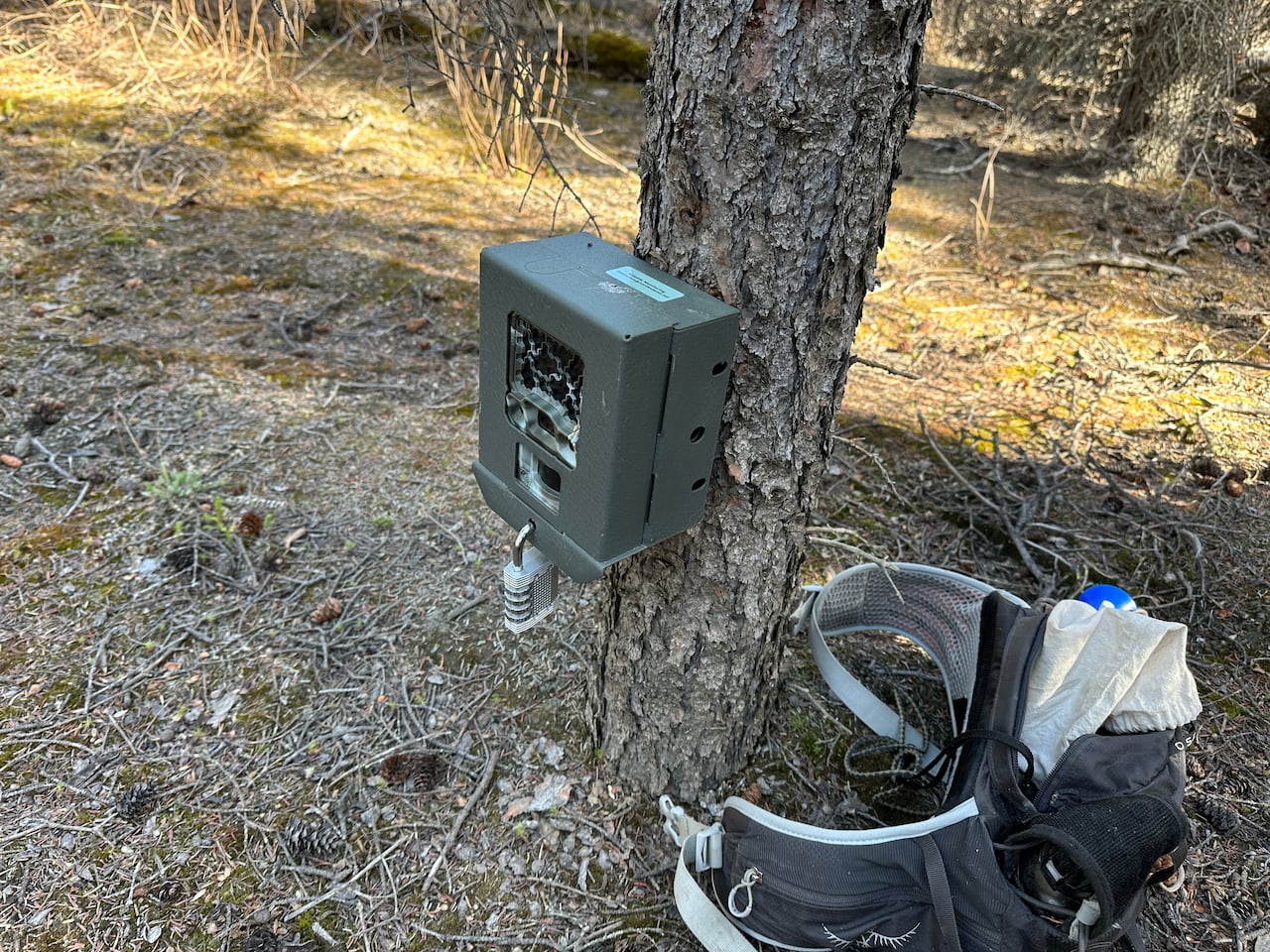 A ‘camera trap’ in Kluane that researchers used to compare the whiteness of snowshoe hares to the snow cover on the ground. These cameras allow researchers to continue studying snowshoe hare colouring and population density in a non-invasive way. (Alice Kenney)
Krebs says predators take advantage when hares are easy to spot. Previous research suggests that weekly survival rates decrease by up to 12 per cent when hares do not match their environment. However, Krebs notes that short bursts of high predation often don’t have a significant effect on snowshoe hare populations, so the long-term impacts of the coat-colour mismatch are still unclear.
“[Hares] can take a lot of damage from predators and … still carry on because they have a very high reproductive rate,” he said.
As climate change continues to create more variable temperature and snow conditions, Krebs says it’s possible that over time snowshoe hares will adapt their moulting cycle to better match their surroundings and avoid predation. However, that process could take longer than most studies last.
“Ecological events are taking place on timescales of tens of years, hundreds of years,” he said.
“Monitoring programs cannot simply stop at three or four or five, even seven years and say we have the answer — because you don’t have the answer until you can get a lot more years of data.”
Johnson says he plans to step away from the project next summer and train another member of his community to carry on his work. He says it’s important that the project continues.
“It is very useful information to have, especially in an abundant area like Kluane.”