
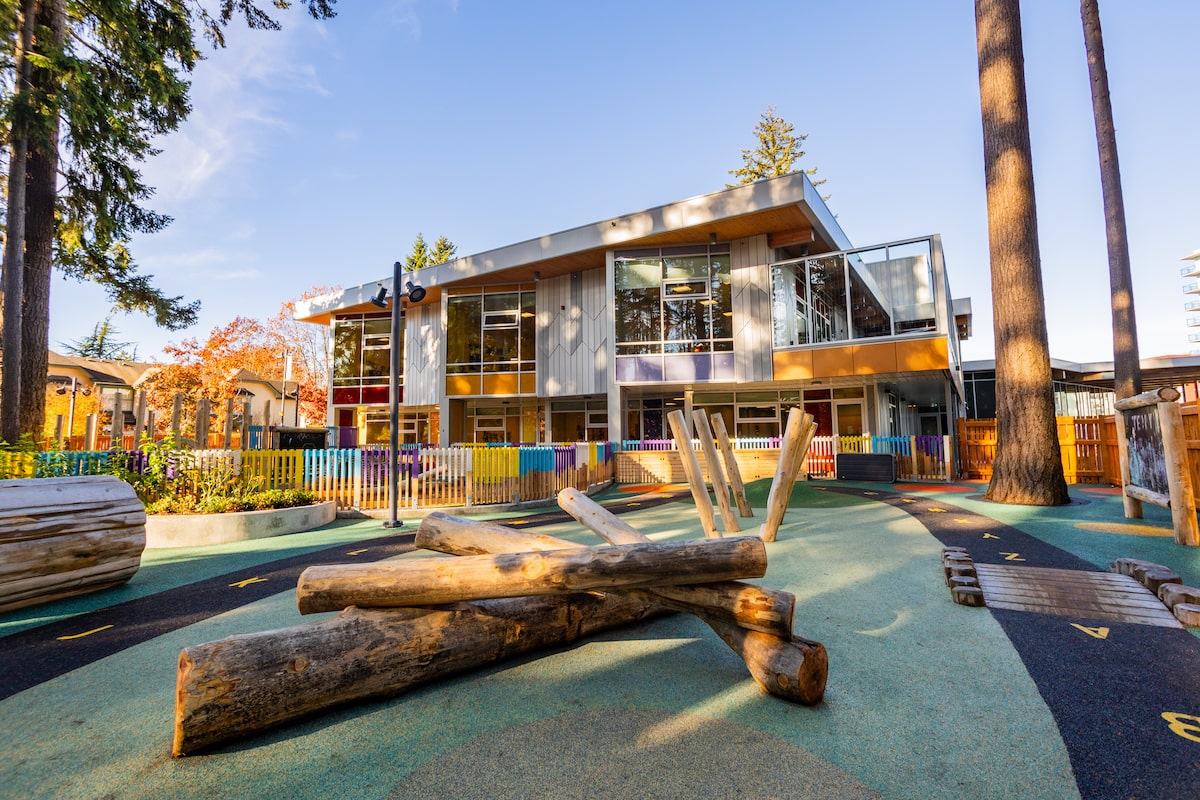
When we were small, we were so much closer to the ground. Remember studying granular anthills, veiny leaves and mottled pebbles? Or hugging the base of a tree, and how that rough bark felt under your soft, pudgy fingers? Those shiny, formative years, when absolutely everything was new, may be long gone for us, but there are ways we can enhance those years for the little ones in our lives now.
While the tall cedars and Douglas firs on Acadia Road near the University of British Columbia campus have likely stood for hundreds of years, two Douglas firs have become joyfully encircled by colourful, artificial surfacing. Less than two weeks ago, CEFA (Core Education and Fine Arts) Early Learning’s 50th school celebrated its grand opening in a bright 11,900-square-foot building while welcoming the two elderly trees into its adjoining 7,000-sq.-ft. playground.
The 7,000-square-foot playground is designed for safety.CEFA Early Learning
“Teaching your children to go outside and play is such a lost art,” begins CEFA CEO Arno Krug. “You notice the children find joy in playing with the simplest things … for example, keys, toothpicks, forks [and] matching them together, pine cones, it’s really triggering the imagination and spark in them.”
He’s right: on the drizzly, 8-degree day I visited, a trio of two-year-olds dressed in Muddy Buddies – Toronto children sport snowsuits, Vancouver children wear waterproof coveralls – were taxiing on the rubber runway, arms outstretched, trying to become airborne (the strategy seemed to be the louder and spittier the motor noise, the more likely one would take flight).
Share your children’s letters to Santa with our North Pole bureau
And if one of those little airplanes stumbles on the tarmac, there won’t be any scraped knees. “Our No. 1 focus is always safety, in the architecture and in the way we design things,” says Paul Dean, vice-president of real estate and business development. That means the 7,000 sq. ft. of squishy and wood-chippy playground is protected by locked gates and high fences. Climbing structures for the older children are at the next playground over. Inside the building, the locally made furniture has rounded corners.
“The kids have this amazing experience when they’re in the classrooms upstairs,” says Mr. Dean. “The windows come all the way down to the floor,” so instead of the children having to stand on their toes to see over a windowsill, “they’re on their bum, sitting on the ground at circle time … and they feel like they’re immersed in [the forest].”
The school has seven classrooms to accommodate 110 children.CEFA Early Learning
All of that nature, it should be noted, dovetails nicely with CEFA’s unique curriculum. While the wee ones are still allowed to get messy with finger painting or to build imaginary worlds with Legos, CEFA brings the scientific method, math and coding into classrooms – without the aid of screens – along with lessons in citizenship and cultural immersion. There’s even yoga.
“They learn without you teaching,” says Mr. Krug. “Without you telling them that you’re teaching them something. They absorb it with a smile.”
Originally, in 2020, there were to be 40 children smiling and absorbing in a one-storey, 4,500-sq.-ft. building when CEFA began talks with Musqueam Capital Corp., builders of a residential community called “Leləm̓” (the Musqueam word for home) on university endowment lands. But, soon after, all parties realized that, with an estimated 2,500 residents and the 50,000-plus students at the university campus just a short walk away, that “wouldn’t put a dent” in the need. So Francl Architecture added a second storey to the LEED-certified building. Now, 110 children in seven classrooms can better engage with coding or cultural immersion while sneaking glances at the forest outside.
The building itself is attractive, even playful. Sporting ziggy-zaggy cladding to mirror the community centre next door, the façade is punctuated by windows, some cantilevered. The structure is capped by a thick roof with an underbelly of warm wood. And while the south and east façades face the trees, there is still plenty of light penetration due to the zigging and zagging of the glazing, and the fact that much of the low-hanging branches had to be removed before occupancy for safety concerns. Whether on the first or second floor – and especially when on the second-storey outdoor play deck – the reassuring connection to the larger world outside is always there.
As our little tour group moved from classroom to classroom, it was interesting to witness the various levels of engagement: when we interrupted a group learning Jingle Bells, the song evaporated as all eyes locked on us (well, one little nervous guy looked out at the trees). But when we walked through a classroom of seated children engaged in pattern-recognition, we were all but invisible.
With lunchtime approaching, we popped into the kitchen. On the menu that day was pasta with a turkey bolognese and blueberry muffins. The menu, says Mr. Dean, can also be used as a casual learning tool: “They might be having broccoli for lunch: does broccoli grow on a tree on a bush? If they’re eating a curry, it might be about cultures.”
Sneaky? Sure, but aren’t the best conversations the ones where we learn something new? And the best architecture should inspire and open our minds in some places (usually with high ceilings and natural light) while also providing nooks and crannies to snuggle into (nap rooms). For CEFA, in existence for just 27 years, it’s a never-ending quest to get that balance right: “We’re constantly refining things, you don’t want to stay static in this space,” finishes Mr. Krug. “We built this facility, we love it today, but in three months we might [say] ‘If I could’ve done something different, I might’ve done this.’”
Except for the trees, that is: they’re perfect.
Reader’s note: Travel expenses for this article were paid for by National (Public Relations). The company did not review or approve the content.