
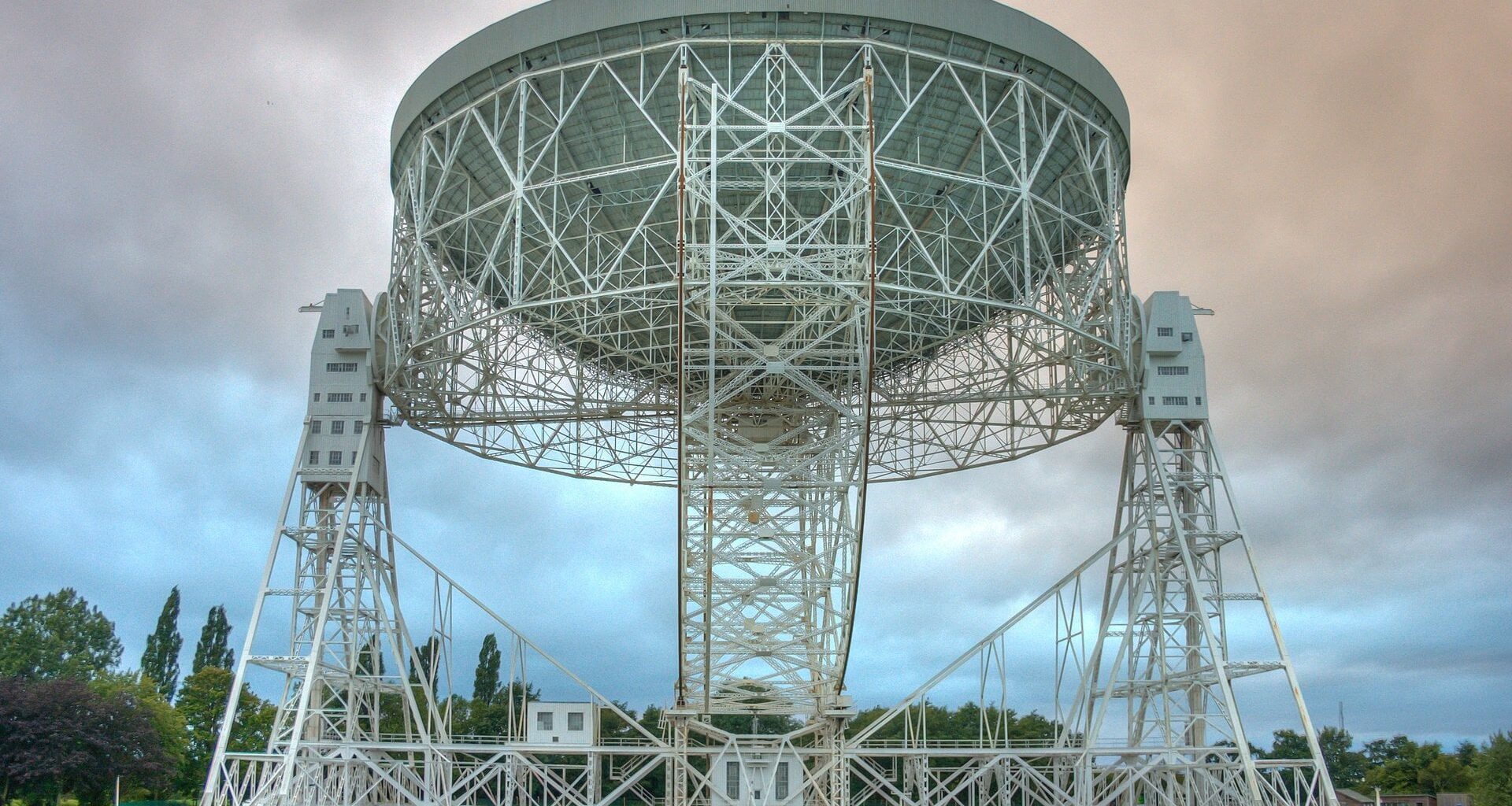
If you ever feel like you are constantly on the move, that’s because you are. And not only in your daily life. You spin around the world once a day, the Earth dances with the Moon around the Sun, and the Sun and everything else in the solar system bob around the Milky Way. Even our galaxy moves through the cosmos, and it might be moving faster than we thought.
The thing about motion is that it’s all relative. We can’t feel a constant motion in a straight line. So when we talk about motion, we always have to specify what the motion is relative to. For the Milky Way, we can measure our motion relative to nearby galaxies such as Andromeda, but on a cosmic scale we can measure our motion relative to the cosmic microwave background.
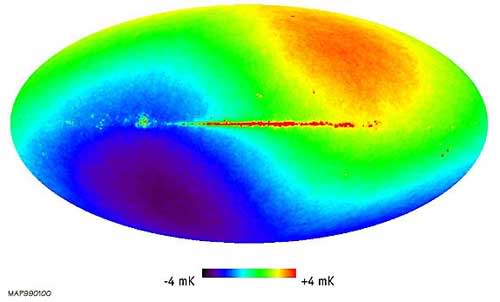 *The dipole in the raw cosmic background. Credit: Wilkinson Microwave Anisotropy Probe*
You’ve probably seen images of the cosmic microwave background from Planck or WMAP with their little fluctuations of color showing local variations in temperature. But that is a processed image that has corrected for our motion relative to the CMB. The raw data shows a clear dipole effect where the CMB in one direction appears hotter in one direction and cooler in the opposite direction. This is due to our relative motion to the CMB. Based on the data, we are moving through the cosmos at about 360 km/s, which is surprisingly fast.
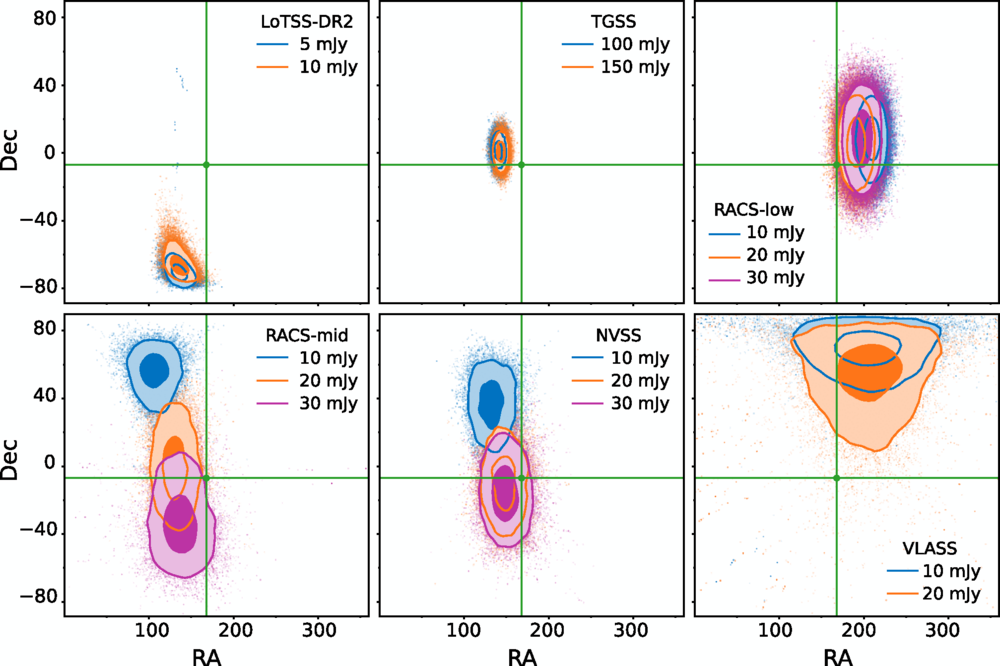 *The galaxy results vs. the CMB (green lines). Credit: Böhme, et al*
Here’s where it gets interesting. We should get about the same result if we take a statistical average of our speeds relative to the most distant galaxies. Cosmic expansion due to dark energy would average out to zero, which would leave an overall net motion. According to the standard model of cosmology, there might be a small difference between the two, but our relative motion should be about the same.
To verify this, the authors of this new work looked at sky survey data of radio galaxies. These are galaxies that are bright at radio frequencies, so we can measure their relative motion pretty easily. Many radio galaxies are so bright that we can see across billions of light-years, so there shouldn’t be a local bias. But their result skewed the dipole even further. Based on the radio galaxy observations, the Milky Way is moving through the Universe even faster than the CMB result.
The two results don’t entirely disagree. Both the radio galaxy and CMB measure have us moving in about the same direction, but the radio galaxy result is statistically faster by 5.4𝜎, which contradicts our expectation. This is similar to the Hubble tension issue with dark energy, where different results contradict. Further observations may resolve the issue, but this might another way in which our current standard model isn’t quite right. Clearly, our understanding of the cosmos is also on the move.
Reference: Böhme, Lukas, et al. “Overdispersed radio source counts and excess radio dipole detection.” *Physical Review Letters* 135.20 (2025): 201001.