
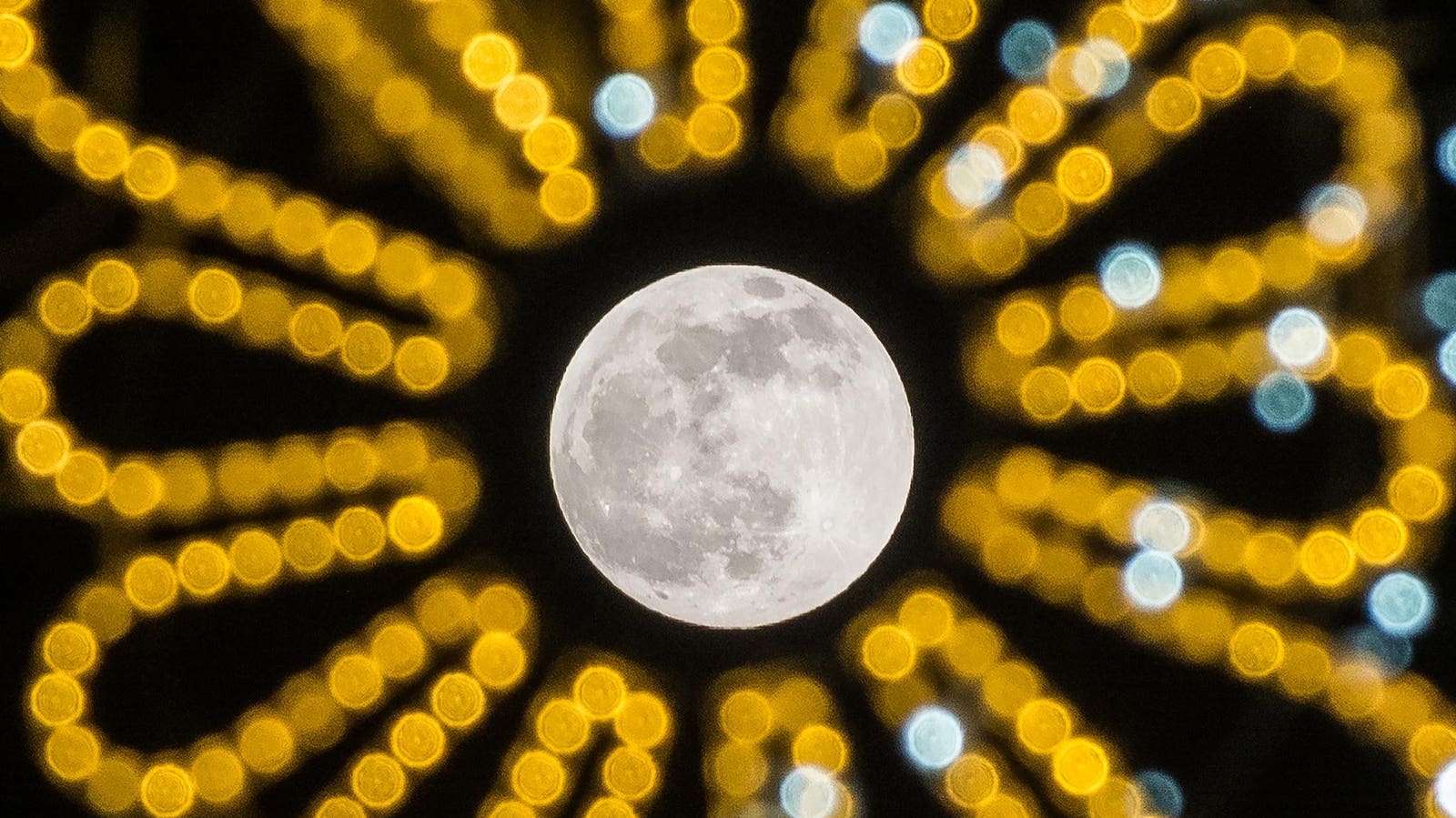
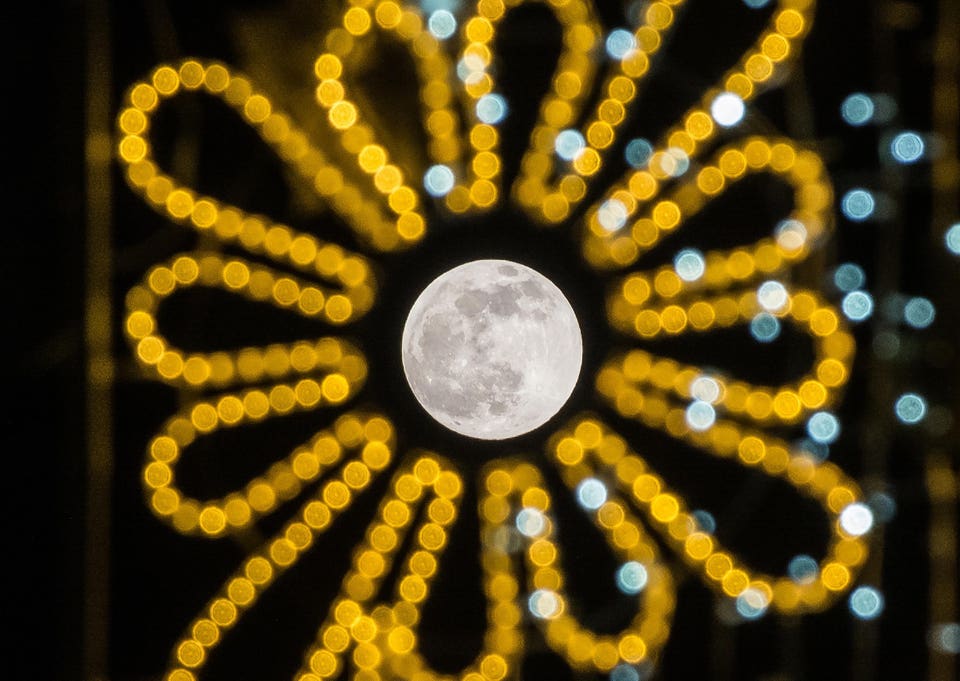
December’s full moon is seen through decorative Christmas lights.
SOPA Images/LightRocket via Getty Images
The final full moon of 2025, December’s cold moon — a supermoon — will become full on Thursday, Dec. 4, and you can watch it live online.
The Virtual Telescope Project will share views of the supermoon rising into Italian skies, with its live feed scheduled for 20:00 UTC (3:00 p.m. EST). It will also be shared live on YouTube.
When Is The Supermoon?
The last full moon of 2025 will turn full at 23:14 UTC (6:14 p.m. EST) on Thursday, Dec. 4, but the best time for most North Americans to see it with their own eyes will be moonrise on Friday, Dec. 5. That’s because from the contiguous U.S., the sky will still be bright when the moon rises on Thursday.
As the sun follows its lowest path of the year ahead of the Dec. 21 solstice, the Cold Moon will trace the highest arc of any full moon in 2025, dominating long winter nights.
What Is A Supermoon?
December’s Cold Moon is a supermoon, the second-biggest and second-brightest full moon of 2025. The moon orbits Earth on a slightly elliptical path, bringing it closest at perigee and farthest at apogee each month. A supermoon is when a full moon occurs while the moon is about 10% closer than its average distance from Earth. The Cold Supermoon will be about 30% brighter than the average full moon.
Near moonrise, the so-called “moon illusion” will enhance its apparent size as foreground buildings, trees and mountains trick the human brain into perceiving its disk as larger than it actually is. That’s the case for any moonrise.
ForbesWhy Today’s Full ‘Cold Supermoon’ Will Rise Higher Than Any OtherBy Jamie CarterSupermoons In 2026
The Cold Moon is the third of four consecutive supermoons that span late 2025 and early 2026. The sequence concludes with the Wolf Moon on Jan. 3, 2026, followed later that year by two more supermoons.
Wolf Moon on Jan. 3.Beaver Moon on Nov. 24.Cold Moon on Dec. 24.
The headline event will be the Cold Supermoon on Christmas Eve, when the moon comes to within about 221,668 miles (356,740 km) of Earth, making it the closest and biggest full moon between 2019 and the late 2020s.
Forbes‘Cold Supermoon’ Rises With A Bull’s Eye: The Night Sky This WeekBy Jamie CarterWhen Is The Next Total Lunar Eclipse?
The Cold Moon closes a year that featured two “blood moon” total lunar eclipses, in March and September 2025. The next total lunar eclipse will arrive with 2026’s Worm Moon. On the night of March 2-3, 2026, the Worm Moon will slide completely into Earth’s central shadow for 58 minutes, turning a rich reddish-orange as seen from western North America, the Pacific, East Asia, Australia and New Zealand. It will be the only total lunar eclipse of 2026 and the last such event until late 2028. Later that year, the Sturgeon Moon on Aug. 27-28 will undergo a deep partial eclipse, with over 96% of the lunar disk darkened.
ForbesSee A ‘Christmas Star,’ A Supermoon And Meteors: December’s Night SkyBy Jamie CarterWhen is The Next Full Moon?
After December’s Cold Moon, the next full moon will be the Wolf Moon on Jan. 3, 2026 — the fourth supermoon in a row and the first full moon of the year, and of winter in the Northern Hemisphere.
Wishing you clear skies and wide eyes.