
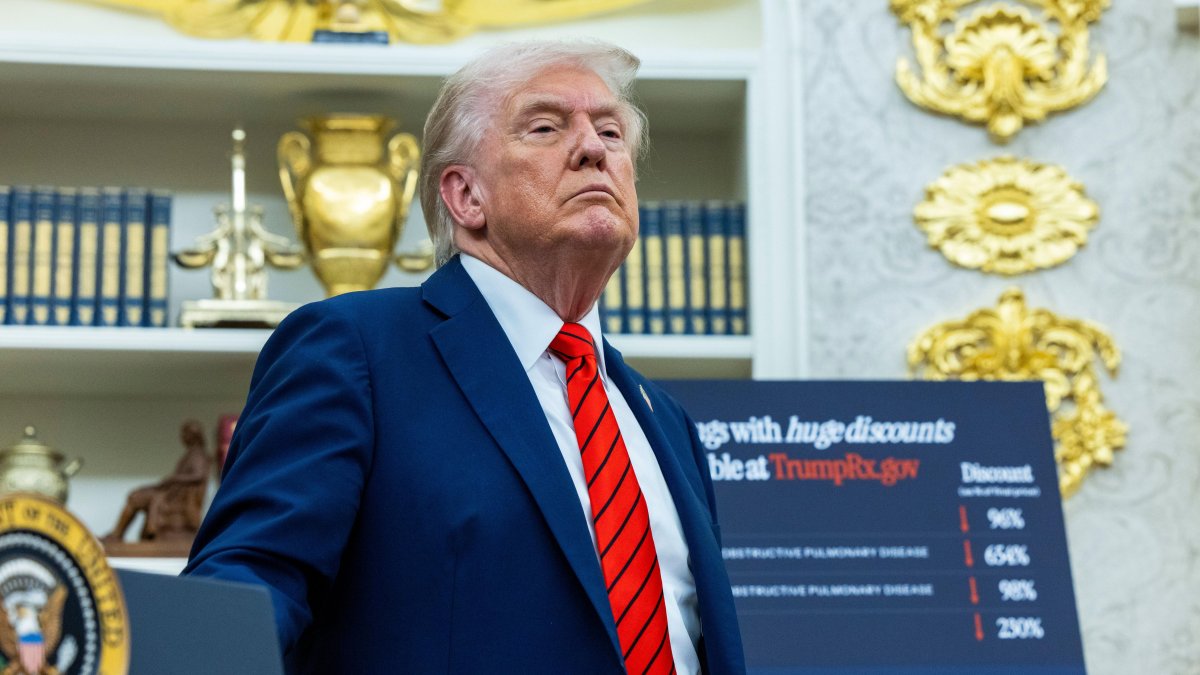

President Trump threatened tariffs on British drug exports to the US
SHAWN THEW/ALAMY
The pharmaceuticals industry has been one of the stars of the British economy over the past few decades. With its combination of cutting-edge innovation and high-end manufacturing, it is just the kind of business the government hopes to encourage. Yet in recent months it has faced an existential threat as a result of a pricing system holding down the prices of drugs, plus the threat of punitive tariffs from the United States.
In September Merck cancelled a £1 billion research centre in London and AstraZeneca paused a £200 million investment in Cambridge. There have been fears that more investment would evaporate if the government did not cut a deal with America. This week the government announced it had done just that. The NHS will in future pay more for its drugs, but British-made pharmaceuticals will face zero tariffs for three years when exported to America. The industry’s future isn’t guaranteed, but the business would certainly have withered without this new deal.
• Patients promised groundbreaking new drugs on NHS in deal with US
Under the old pricing system, Britain spent unusually little on drugs. The NHS received a rebate from pharmaceutical companies of 23.5 per cent of its spending on drugs purchases last year. Rebate deals are common, but they are lower for most countries — 7 per cent in Germany, for instance, and 9 per cent in Ireland. The National Institute for Health and Care Excellence (Nice), which decides what drugs are worth buying and for how much, set the upper limit on the amount that should be spent to extend somebody’s life by a year at £20,000-£30,000 in 1999. If the figure had risen in line with inflation it would be nearly twice that now. Britain’s spending on cutting-edge medicine is low: about 0.3 per cent of GDP, compared with 0.8 per cent in the US.
Since Americans were getting a worse deal from US pharmaceutical companies than Britons, President Trump weighed in. He threatened to put 100 per cent tariffs on the £6.6 billion of drugs which Britain exports to America if the government did not change its pricing system. His threats, along with those from the pharmaceutical companies, worked. Hence the new trade pact. Under it, the rebate will be capped at 15 per cent and Nice’s upper limit will rise to £25,000-£35,000 for every year of life. This will apply to new treatments, not to existing therapies or over-the-counter medicines.
The share of GDP that Britain spends on new drugs is likely to double to 0.6 per cent. Britons will, as a result, get access to new drugs that in the past they would have had to do without. Less happily, the NHS’s spending on pharmaceuticals will rise by £3 billion a year, from 9 per cent of its budget to 12.5 per cent. The government is not planning to increase spending on the health service to cope; the NHS will have to absorb the extra cost through efficiencies. That is as it should be. Spending on the NHS has risen from 5 to 8 per cent of GDP this century, and is projected to hit 9 per cent by 2030. It must be reined in.
Critics claim that in doing this deal Sir Keir Starmer has caved to President Trump and big business rather than standing up for British taxpayers. That is nonsense. The UK could not expect to retain this crucial industry while imposing on it a pricing system that discouraged innovation and investment. This deal is a good one for Britons. They, and the country’s pharmaceutical industry, will be healthier as a result.