
In December, the night sky is the place to focus your attention, as the annual Geminid meteor shower will be at its finest on the night of Dec.13, into the morning of Dec. 14.
According to the International Meteor Organization, the maximum peak of possibly seeing 120 meteors per hour is predicted to occur around 1 a.m., the morning of Dec. 14.
“A 23 per cent waning crescent Moon will rise late into the morning hours, so no big interference this year. This is a weekend event. If cloudy Saturday night, it’s still visible on Sunday night, but the numbers will be reduced,” says The Backyard Astronomer Gary Boyle.
“These are slow moving colourful meteors generated by the Asteroid (3200) Phaethon and will be memorable to witness, as they burn up in the atmosphere appearing in different directions of the sky. Some very bright fireballs could also be seen,” Boyle notes.
Boyle says to start looking around 7 p.m. local time. “But as the night moves on and the constellation Gemini rises higher over the next few hours, more meteors will be seen.”
“The brilliant planet Jupiter is up in the northeast around 7 p.m. and out all night long, along with the bright winter stars of Orion – the Hunter.”
The best way to witness this stellar spectacular is to travel out of town to a darker wide-open sky to fully enjoy the show.
Boyle is an astronomy educator and former columnist for the Royal Astronomical Society of Canada. He’s also been honoured with the naming of Asteroid (22406) Garyboyle.
According to Boyle, the Geminid meteor shower is one of the best meteor showers of the year.
Fireballs or brighter meteors, Boyle explains, are really coming from an asteroid. “An asteroid that’s pretty well a dead comet. It’s really a must-see event.”
There will be another meteor shower again Jan. 4, says Boyle. “Again, the numbers are pretty high, but the moon might be interfering with that meteor shower.”
The sky also features winter constellations, including Orion rising just after sunset. “While you’re watching the meteor shower, which is from the constellation Gemini, which is to the left, you’re going to see the planet Jupiter, which is very, very bright and near two stars.”
Stargazers can use any astronomy phone app to locate where any of the planets are.
“In the Western sky, once you’ve noticed where to look, you’ll see Saturn – but you’ll definitely need a telescope to see the rings and some of the moons,” Boyle notes.
Boyle says as of yet there’s nothing huge, in terms of any significance or highlights to come astronomically in 2026. “Of course, comets come and go. We’ve had a couple of bright comets over the past couple of months, but who knows what’s coming around.”
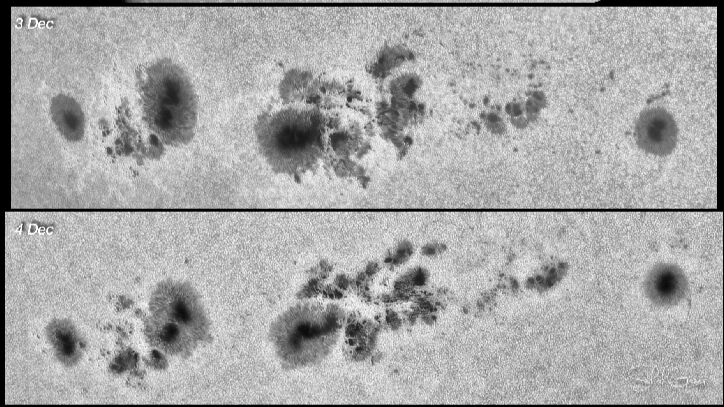
Right now, the sun is very active with large sunspots, which can be seen online at spaceweather.com.
“These sunspots are huge. They’re going to be producing a lot of northern lights. The sky will just be ablaze with greens and reds. Hopefully, we won’t get too many power outages because these huge storms do play with the power grid,” Boyle explains.
If you’re interested in exploring the night sky, Boyle says to stay away from big box stores when purchasing a telescope. “There are reputable telescope dealers across Canada and the U.S. that will sell you quality, solid equipment.”
If you have any questions about astronomy or telescopes, contact Boyle through his website at wondersofastronomy.com.