
CHARLOTTE, N.C. — It was a rollercoaster day for the defense side of the 23XI Racing / Front Row Motorsports vs. NASCAR trial on Thursday, Dec. 4. The day started with FRM owner Bob Jenkins delivering the end of his testimony to NASCAR’s attorneys and resulted in both high and low moments for the sanctioning body’s argument.
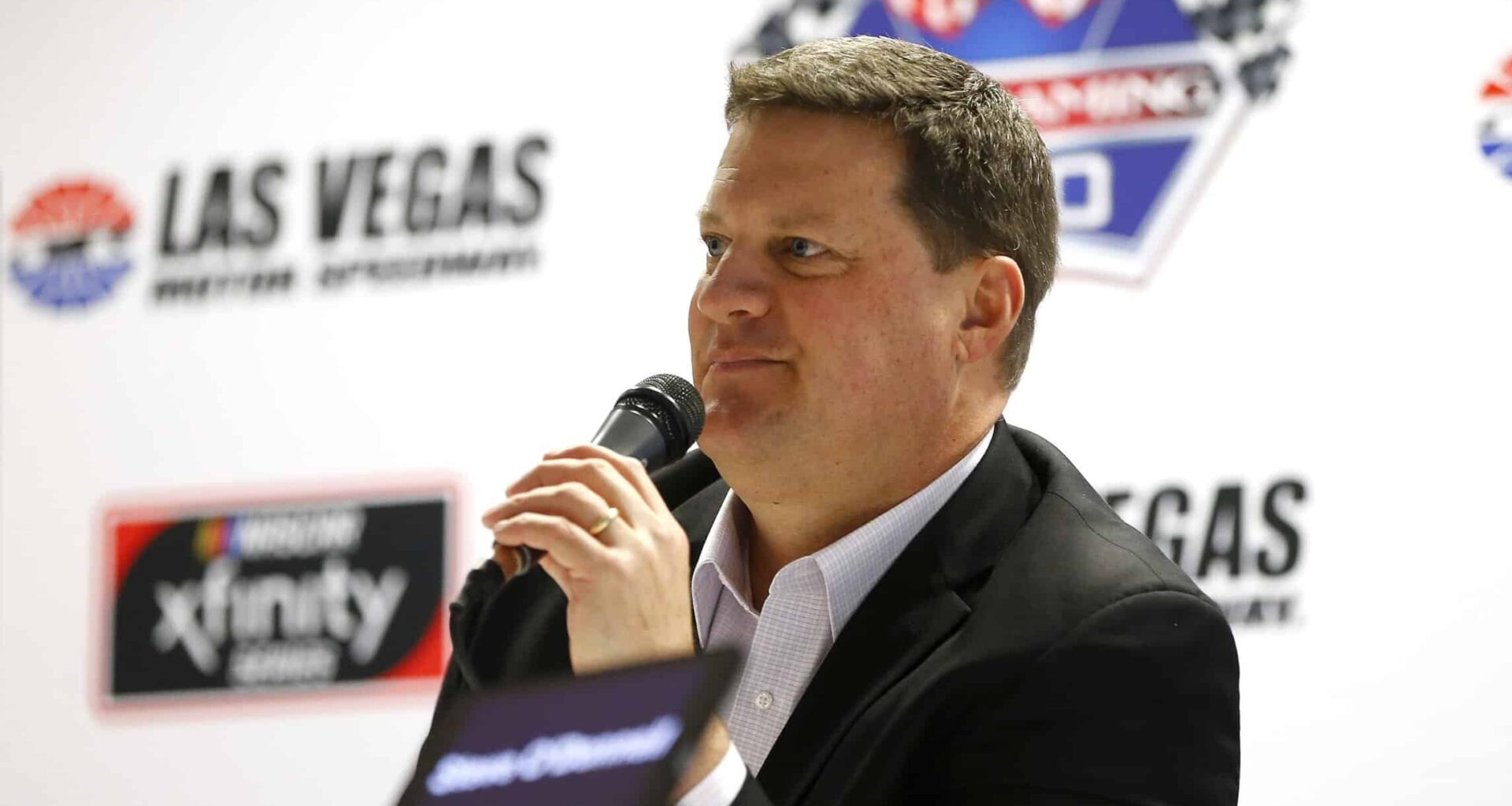
After Jenkins, NASCAR’s president Steve O’Donnell joined the courtroom for his testimony, which included a range of questions regarding both NASCAR’s track exclusivity provisions within its new charter agreement and O’Donnell text messages about NASCAR chairman and CEO Jim France.
On Thursday, Jenkins continued his testimony with defense attorney Lawrence Buterman that was paused from the previous day. The topic discussed was regarding Jenkins’ testimonies about the Next Gen NASCAR Cup Series car. In December 2019, Buterman provided evidence that Jenkins had actually endorsed the Next Gen car, a vehicle he had testified cost more money than what was promised when NASCAR first introduced the concept.
However, Jenkins doubled down on his original testimony by pointing out that he had endorsed only the “concept” of the Next Gen when it was, as he recalled, supposed to only cost $205,000. Today, Jenkins testified that the car costs almost double that amount, $350,000. Buterman pointed out that this was before the COVID-19 pandemic in 2020 and “costs go up.”
Afterward, a negative moment for the defense began when Buterman began speaking about the merger that was being discussed between 23XI and FRM in 2021 that included a sale of one of FRM’s charters to the Toyota team. Buterman, attempting to point out the similarities of anticompetition that the plaintiff is arguing of NASCAR, introduced a text message from Jenkins and FRM general manager Jerry Freeze from that year. Within it, Jenkins told Freeze he no longer wanted to sell one of his charters to Hamlin and told him to tell Rick Ware, owner of Rick Ware Racing and another person interested in selling his charter, to charge Hamlin “whatever he wants.”
Buterman asked if Jenkins was attempting to influence the deal’s price from Ware to Hamlin. Jenkins responded by telling him he never told Ware an exact amount to charge Hamlin. After Buterman asked Jenkins about the message several times, the plaintiff side finally objected for irrelevance. The judge answered by saying, “I’m starting to wonder myself. I think it’s best if you move on to another subject.” Buterman complied.
Buterman cross-examined Jenkins for a little over an hour afterward. At one point, the attorney provided evidence that NASCAR added $100 million to the new pool money per year under the new agreement and asked Jenkins if that sounded like, as the FRM owner testified on Wednesday (Dec. 3), “taxation without representation.” Jenkins stated that he still believed it was.
In perhaps NASCAR’s most positive moment of that day, Buterman began to question Jenkins about his financial evidence. Within it, the team owner displayed to the court the figure amount he had lost every year in the last three years. Buterman stated that those figures also included his NASCAR Craftsman Truck Series losses, as FRM has also fielded a Truck team since 2020. Jenkins stated he did not make the displays presented in court and agreed that it wasn’t relevant.
Buterman then recalled Jenkins’ testimony of his yearly Cup costs. Jenkins had testified in court that it costs $20 million a year to run a Cup car. However, Buterman then introduced FRM’s annual statements since 2021, and pointed out that, while entering two Cup cars and even a Truck team, FRM has never spent more than $28 million in one year. The attorney said that Jenkins was requesting $140 million from NASCAR in the lawsuit and questioned if that was an accurate number of damages.
Jenkins stated the $20 million number was a “median cost” of all Cup teams, after which Buterman reminded Jenkins that he had testified under oath the amount was $20 million. Jenkins could only respond by saying he didn’t actually know the amount when he testified.
In response, during secondary questioning from the plaintiff attorney, Jenkins was asked if FRM is an efficient team and if it “does the most with the least.” Of course, the team owner agreed. The plaintiff rested soon after and requested that O’Donnell join the witness stand.
Over the course of the questioning by the plaintiff’s lead attorney Jeffrey Kessler, the two main points appeared to be NASCAR’s exclusivity deal with its Cup tracks and Jim France’s influence in the charter negotiations.
Afterward, Kessler began to start mentioning NASCAR tracks. The attorney pointed out in notes written by O’Donnell that NASCAR would need to partner with tracks even outside of Speedway Motorsports would need to become exclusive under the charter agreement.
Under the 2024 agreement, Kessler pointed out with evidence, independent tracks such as Indianapolis Motor Speedway, Road America and Bowman Gray Stadium all were under the sanction provision and could not host races for any other racing series with some exceptions. Kessler pointed out that the Camping World SRX Series was not among these exceptions. However, O’Donnell quickly replied that the zMAX CARS Tour, a stock-car racing series on short tracks, was listed as an exception and actually shares a racing venue with NASCAR in North Wilkesboro Speedway.
Kessler’s argument, which was the same as yesterday, was that NASCAR was attempting to prevent teams from breaking away and starting their own series and competing on the same tracks as NASCAR. The lawyer asked O’Donnell what superspeedways and intermediate tracks would be available to compete at with a stock-car series outside of NASCAR. O’Donnell replied that he didn’t know any outside of the ones they already compete at.
It wasn’t long after that the topic of the France family came up again when Kessler presented handwritten notes written by O’Donnell as evidence. The NASCAR president had written notes regarding the new charter agreements where Kessler pointed out the lines, “What are we? … One NASCAR from [Steve] Phelps down … Try to be a step ahead … Difficult with existing board … Legacy mindset hinders growth.”
Afterward, Kessler displayed texts from O’Donnell to other members of NASCAR leadership regarding a meeting between O’Donnell and the France family. In it, O’Donnell said, “We just need to keep trying to move the needle. Teams won’t get everything they want, and hopefully we can just meet in the middle. I just listened as she didn’t want to hear any opinions, but I of course didn’t hold back.”
Kessler attempted to provide context asking O’Donnell if these were messages regarding the France family and bringing up the teams’ demands during charter negotiations.
Following this, Kessler displayed texts from O’Donnell to NASCAR Executive Vice President and France’s nephew Ben Kennedy. O’Donnell stated, “Jim [France] is now reading Heather [Gibbs’] letter out loud and swearing every other sentence.” The letter in the text was regarding charter demands.
In response, O’Donnell testified that France wasn’t actually swearing. When Kessler asked what he was doing that made him mad enough for O’Donnell to send the text, the NASCAR president said he didn’t remember. Kessler, in response, asked how he could have known if he wasn’t swearing if he didn’t remember.
After a 15-minute recess, Kessler asked some more questions to O’Donnell before handing him over to the defense for cross-examination. It appeared the defense was attempting to explain NASCAR’s relationships with its tracks.
At one point, the defense attorney asked O’Donnell about Daytona International Speedway, Talladega Superspeedway and Phoenix Raceway. He asked him how much money has gone into upgrading Daytona since its construction, to which O’Donnell testified, nearly $1 billion worth, which illustrated NASCAR’s argument of needing money to continue to develop its tracks in both quality and safety.
Earlier in the day, O’Donnell was asked by Kessler how much money was lost by NASCAR when going to new markets such as Mexico City this year and the Los Angeles Memorial Coliseum from 2022 to 2024. O’Donnell testified the company had lost $10-12 million over the course of three years in Los Angeles and $6 million in 2025 at Mexico alone.
NASCAR’s defense followed up on this, asking why the company went ahead with these events when it knew it was going to lose money. O’Donnell replied for each event it was to “grow the sport” by reaching new potential fans. He testified that it was successful in doing so.
Before releasing the court for the day, the judge pointed out that the trial was “not on the pace we’re hoping for” and urged both sides to consider cutting some of its witnesses to which both sides agreed.
The judge also stated that “some of the examinations are beating a dead horse” and “some witnesses aren’t answering even the most harmless of questions.” He followed this by asking the counselors on both sides to tell their witnesses to answer the questions and that “we wouldn’t be at trial if there weren’t some bad facts for both sides.”
The trial is set to resume for its fifth day on Friday, Dec. 5 at 9 a.m. ET.

NASCAR At Track Coordinator at Frontstretch
Dalton Hopkins began writing for Frontstretch in April 2021. Currently, he is the lead writer for the weekly Thinkin’ Out Loud column, co-host of the Frontstretch Happy Hour podcast, and one of our lead reporters. Beforehand, he wrote for IMSA shortly after graduating from Embry-Riddle Aeronautical University in 2019. Simultaneously, he also serves as a Captain in the US Army.
Follow Dalton on Twitter @PitLaneCPT