
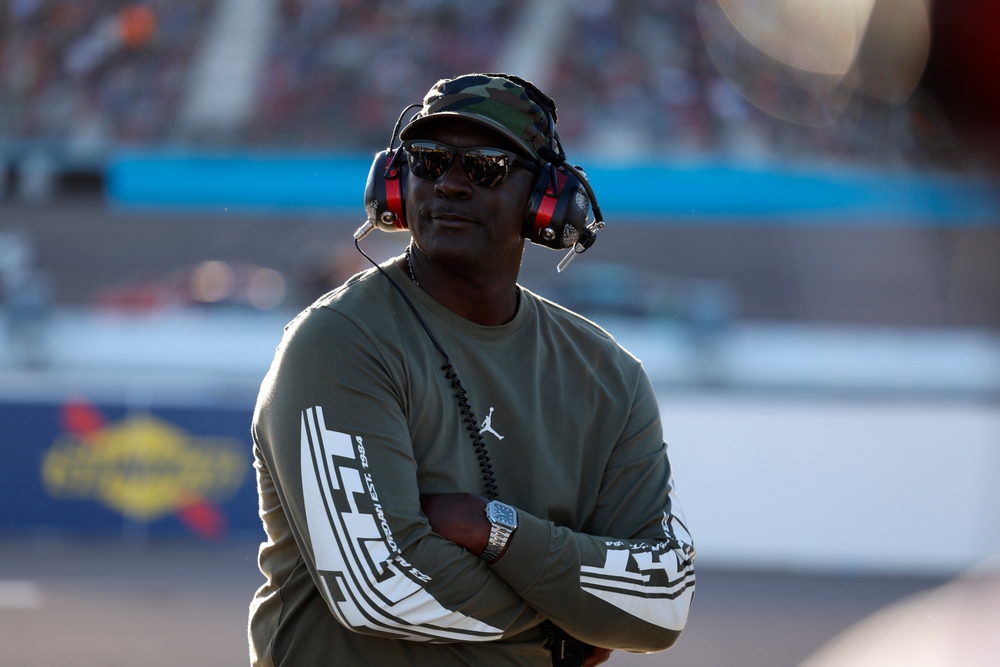
The Basketball Hall of Famer and Joe Gibbs Racing COO Heather Gibbs were expected to testify Friday on the fifth day of the federal antitrust case over NASCAR’s charter system
Michael Jordan and Joe Gibbs’ daughter in law were expected to testify Friday on the fifth day of the federal antitrust case the Basketball Hall of Famer filed against NASCAR over claims the series has acted as monopolistic bullies. The testimony comes as the trial reveals deep frustrations between team owners and NASCAR leadership over the charter system.
Heather Gibbs, the chief operating officer of Joe Gibbs Racing, wrote an impassioned letter to NASCAR chairman Jim France in May 2024 imploring him to make charters permanent for the sake of strengthening the family business. The emotional appeal highlighted the stakes involved for racing families who have invested decades building their operations.
Charters are the equivalent of the franchise model used in other sports and in NASCAR it guarantees every chartered car a spot in all 38 races, plus a defined payout from NASCAR. The system was created in 2016 and during the two plus years of bitter negotiations on an extension teams begged for the renewable charters to become permanent.
The Michael Jordan lawsuit origins
When NASCAR refused to make them permanent and gave the teams six hours in September 2024 to sign the 112 page extension, 23XI and Front Row Motorsports were the only two organizations out of 15 to refuse and instead filed an antitrust suit. 23XI is owned by Jordan and three time Daytona 500 winner Denny Hamlin, and Front Row is owned by fast food franchiser Bob Jenkins.
The discovery phase of the trial revealed Heather Gibbs sent a letter to France, who is now chairman of the series his father founded 76 years ago. She wrote that they put 32 years into investing and building a dream, building careers, building families and building NASCAR. If the financial model made sense, they would not have had to work with an outside investor. If their teams were financially healthy and did not solely rely on sponsorship, she would sleep better at night.
The letter continued that they have invested not only time but family in this sport. They have raised champions and buried their leaders, all while continuing to embrace the historical roots of NASCAR. With all due respect, when NASCAR tells them it does not make sense to partner with them after seven years is dejecting and truly disappointing.
Internal NASCAR tensions emerge
The letter came up Thursday in testimony by NASCAR President Steve O’Donnell, who was called as an adverse witness. O’Donnell in a text message told Ben Kennedy, nephew of Jim France, that the chairman was reading Heather’s letter out loud and swearing every other sentence.
Pressed by plaintiffs attorney Jeffrey Kessler as to what France was saying as he read the letter, O’Donnell said the chairman never swore. Kessler tried to force O’Donnell to reconcile what he wrote to Kennedy, but O’Donnell maintained that his boss was not cursing. O’Donnell testified they were all taken aback by the letter and France was frustrated, as they all were.
Joe Gibbs ultimately signed the charter agreement, but Jenkins testified his rival team owner apologized for doing so. On Thursday, Kessler attempted to portray France as a brick wall in negotiations. The teams had made specific requests in an attempt to improve their financial position, but the deal ultimately given to them on the eve of the start of the 2024 playoffs lacked most of their asks.
Fighting for financial survival
Earlier Thursday, O’Donnell testified that teams approached the sanctioning body in early 2022 asking for an improved revenue model, arguing the system was unsustainable. Teams asked that the negotiating window on a new charter agreement open early because they were fighting for their financial survival.
O’Donnell testified that in that first meeting, four time series champion Jeff Gordon, now vice chair of Hendrick Motorsports, asked specifically if the France family was open to a new model. Kennedy, great grandson of NASCAR’s founder, told Gordon yes. But O’Donnell testified that chairman France was opposed to a new revenue model.
The extensions that began this year upped the guaranteed money for every chartered car to $12.5 million in annual revenue, from $9 million. Hamlin and Jenkins have both testified it costs $20 million to bring a single car to the track for all 38 races. That figure does not include any overhead, operating costs or a driver’s salary.
Judge Kenneth Bell admonished both sides over the slow pace of the trial, which was initially expected to take two weeks. The judge said stretching the trial to three weeks is not acceptable and urged both sides to counsel their witnesses to stop being reluctant to answer even the most harmless questions.