
When President Donald Trump introduced his “Liberation Day” tariffs in April, many economists predicted Americans would soon experience massive price increases. While inflation has ticked up in the eight months that passed, it’s been nowhere near levels initially projected.
A big reason for that: Nearly everything from cars to toilet paper produced by America’s top two trading partners, Mexico and Canada, has been exempt from duties if goods comply with the terms of a trilateral free-trade agreement known as the United States-Mexico-Canada Agreement (USMCA), which Trump inked during his first term.
But the deal, which replaced the North American Free Trade Agreement, is scheduled to undergo a review in July, and already Trump is signaling he wants out. If that happens, it likely would usher in a floodgate of higher prices from which Americans have so far been shielded.
“We’ll either let it expire or we’ll maybe work out another deal with Mexico and Canada,” Trump said Wednesday. US Trade Representative Jamieson Greer also said in a Politico interview, “the reason why we built a review period into USMCA was in case we needed to revise it, review it or exit it.”
The president’s stance could change between now and July, and the White House told CNN that. “Discussion about what hypothetical trade deals that have not yet been negotiated could look like is meaningless speculation,” spokesman Kush Desai said.
Prior to Trump’s second term, goods from Mexico and Canada essentially entered the US duty-free even if they weren’t USMCA compliant because there weren’t tariffs in place. But Trump introduced tariffs of 25% on non-USMCA-compliant products from Mexico and 35% from Canada.
Unlike those two countries, every other nation’s exports to the United States have been subject to higher tariffs over the past year, barring exemptions for certain goods. Those rates at one point went as high as 145% in the case of China.
Prior to Trump’s second term, goods from Mexico and Canada essentially entered the US duty-free even if they weren’t USMCA compliant because there weren’t tariffs in place. That helps explain why 38% of imports from Canada and 49% of imports from Mexico were USMCA compliant last year, according to US Commerce Department data. But as of August this year, those shares rose to nearly 86% of imports from Canada and 87% of imports from Mexico.
“Increased compliance with USMCA has shielded billions of dollars’ worth of imports from the new tariffs,” said Erica York, vice president of federal tax policy at the conservative-leaning Tax Foundation.
If USMCA exemptions weren’t in place, “Americans would face significantly higher prices,” she said. “That would make American workers poorer and American businesses less competitive, and for no good reason.”
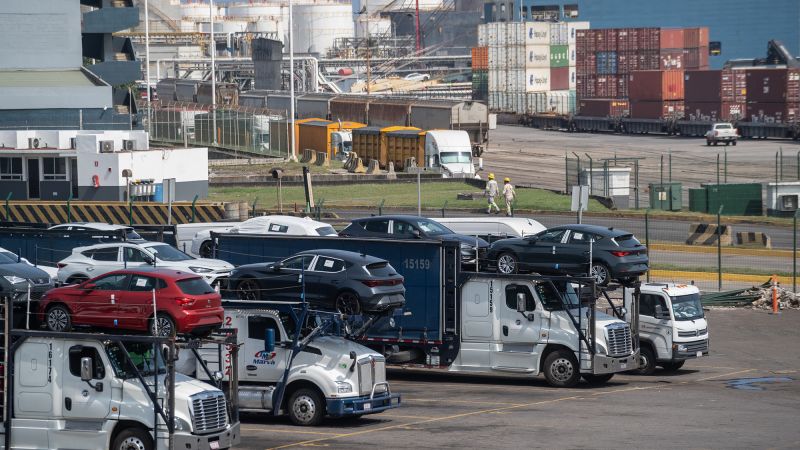
Consumer electronics and cars are among the goods that could be most vulnerable to price increases, given that the United States has become more reliant on its neighbors for such items.
Additionally, supply chains across all three countries have grown more intertwined, with components often crossing the American border multiple times during the assembly process. That means that even cars and electronics, as well as other domestically produced goods, could be impacted by potentially higher tariffs on Canadian and Mexican goods and get passed on to consumers.
“USMCA is a cornerstone of North America’s electronics manufacturing ecosystem. Terminating it would disrupt the production system that US manufacturers rely on, leading to longer lead times and higher input costs,” said Chris Mitchell, vice president for global government relations at the Global Electronics Association. “Those pressures would ultimately translate into higher prices for automotive, consumer, and medical electronics.”