
It has been 13 long years since Aaron Foster last spoke to The Verge. Back then, Foster’s tiny, three-person studio Lunar Software was touting sci-fi horror game Routine with a striking vision: Foster hoped to suck players into the desolate eeriness of its moon base setting, which was equal parts immersive and grounded. Foster ended that interview by swerving a release date question. With 13 years of hindsight, it reads like an all-timer understatement. “Making a good game is more important than a hard-set deadline,” he said. “So we will keep it loose for now.”
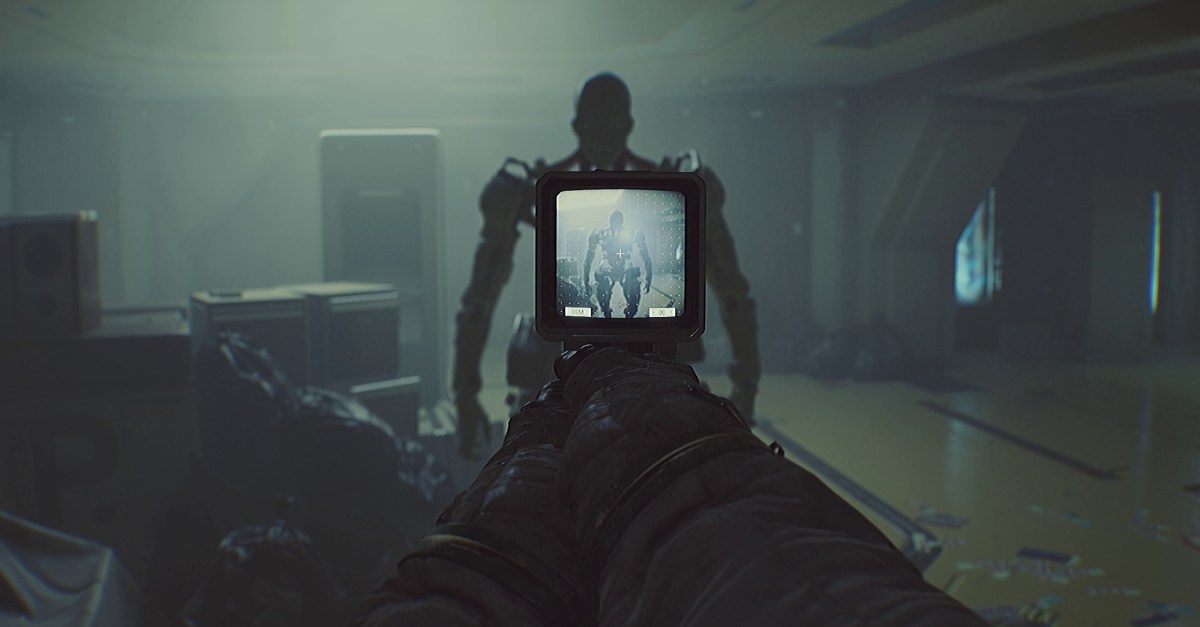
Now, nearly a decade and a half on, Routine has been released on Steam and Xbox. Better yet — miraculously, even — the game appears to bear little trace of its turbulent and protracted development. This is visually ravishing hard sci-fi with some of the most committed diegetic design I’ve ever seen in a video game. There is no heads-up display and no health gauge, nor is there any omniscient text directing you where to go. Instead, you must pay close attention to everything. Such is the concentration the game demands, likely causing you to literally lean into the screen; it can feel as if you are actually there, inhabiting the physical space of this magnificently believable lunar base.
Foster has made the game for a very specific type of video game aficionado, himself included. “I just appreciate it when I’m playing a game that I forget that I’m actually playing a game,” he says in a new interview with The Verge. “Often UI brings you out of the experience.”
Foster, who serves as art and design lead on the game, says that he and his partner, assistant lead artist and designer Jemma Hughes, go to great lengths to foster this kind of experience in games not expressly designed for them. The pair played online multiplayer survival game Conan Exiles with a self-imposed modifier: Neither person is allowed to look at the map. “We could only navigate the world through memory,” says Foster, “and that changes how you interact with the spaces.”
Your Cosmonaut Assistance Tool — or CAT — is the best example of how hard Lunar Software has pushed this diegetic approach in Routine. CAT is an ungainly multifunctional electronic device with a chunky, 1980s-inspired look. You can hold it like a firearm, aiming the reticule through a small, low-res screen, pinging off bolts of electricity at the imposing robots that stalk the station. You can also hold CAT up, revealing buttons on its side and a bar showing how much battery life remains. Press one button and, if you’re standing next to a terminal with a projector, the in-game menu (tracking objectives and other useful information) appears. There is no way to access this menu by conventionally pressing Start or Esc; the menu must be accessed through the game world.
CAT, and the overall sinister atmosphere, is visible in the very first 2012 trailer. Not long before, Foster had quit his job as a 3D environment artist at Eurocom, a large UK-based studio that specialized in licensed games. He was feeling burned out and creatively unfulfilled, working on personal projects in the evening. This grueling double life caused him to overdose on caffeine. He wasn’t able to focus on any of his work, and he suffered from nosebleeds.
At first, Foster saw Routine as a Dear Esther-esque walking simulator. “I thought I could make something visually distinct, if not with the great writing of Dan Pinchbeck,” he says. Soon after, programmer Pete Dissler came on board, which meant more involved systems could be implemented. In 2011, Foster, Dissler, and Hughes formed Lunar Software, moving into an apartment together in Preston, an industrial town in the north of England. They became like a tightly knit three-piece band. Foster and Hughes still live in the same flat; they became a couple in the early stages of production.
For a time, Routine’s production went smoothly. The team built environments and mechanics, while Mick Gordon, composer and audio designer on titles like Prey and Doom, joined the trio, designing its intricately machinic soundscape (listen closely for the ambient whirs and clicks of the door’s internal mechanisms). Yet slowly, the game began to lose focus. “We tried to solve problems with design by just throwing more things at it, more environments to navigate, more this, more that. None of it added anything to the experience,” says Foster. “It felt like a very shallow experience that we weren’t creatively in a good spot to fix.”
A release date trailer arrived in 2016; the team missed that deadline. Health issues struck various team members; what savings they had ran out. Foster and Hughes were reliant on Hughes’ parents for financial support. “We didn’t pay ourselves a wage,” says Hughes. “We were running on fumes.” Some of the team took on contract work; others did odd jobs. In effect, development shut down.

Image: Lunar Software
Then, in 2020, flickers of life. Lunar had pitched a prototype for a different game about a bounty-hunting frog, which they’d been working on as a means to keep their spirits up, to Raw Fury. The publisher was more interested in revisiting Lunar’s shelved project. “They’re like, ‘Aren’t you the folks that are working on Routine? What’s your feelings on returning to that project?’” recalls Foster. “‘Very, very fucking positive,’” he told them.
Many developers spend years toiling on their passion projects: Acclaimed autobiographical life simulator Consume Me took 10 years to make; lauded Metroidvanias Ultros and Animal Well, and gorgeous soccer adventure Despelote, all took approximately seven years. There are many tales of blockbuster development hell: Duke Nukem Forever and the ongoing Beyond Good and Evil 2. But Routine is unique. Early into this second iteration of the project, Foster and his colleagues had a realization. “We were essentially doing a remake of our own game,” he says. “But without the game having ever been released. It was very strange.”
“We were essentially doing a remake of our own game.”
Chief among Lunar’s initial tasks on the second run was creating practically every asset from scratch as they shifted production from the relatively humdrum Unreal Engine 3 to its successor. The team borrowed a texturing technique from Star Citizen (another game languishing in its own development hell), and the lighting looks so ravishing because it has been baked into the levels, diffusing naturally through every ominously long corridor.
During Routine’s most stressful moments, lumbering foes, likely having spotted your helmet poking out from behind a counter, click into thundering gear. There are doors that you can close to halt them momentarily, except — oh no! — you may fumble closing one because you must aim your cursor at the terminal screen itself rather than locking on to it automatically. It’s an interface style that was cribbed from Doom 3, and is representative of Routine as a whole: It riffs on the familiar yet manages to feel fresh.
Given all of that work, how did the team maintain motivation on the project for all that time? “We just couldn’t live in a world where Routine didn’t release,” says Hughes. Foster, 26 when the project started and now 40, cites devotion as the primary reason behind how they kept going. “If we didn’t love Routine as much as we do, it wouldn’t have gotten us through the hard times.”
Follow topics and authors from this story to see more like this in your personalized homepage feed and to receive email updates.Lewis GordonCloseLewis Gordon
Posts from this author will be added to your daily email digest and your homepage feed.
FollowFollow
EntertainmentCloseEntertainment
Posts from this topic will be added to your daily email digest and your homepage feed.
FollowFollow
GamingCloseGaming
Posts from this topic will be added to your daily email digest and your homepage feed.
FollowFollow
ReportCloseReport
Posts from this topic will be added to your daily email digest and your homepage feed.
FollowFollow