
For nine straight months, air travel from Canada to the United States has been down, and for 10 straight months, cross-border trips have declined as more and more people sidestep travelling stateside.
The decline comes amid icy tensions between Canada and the U.S. as turbulent trade talks stall and the president continues to threaten to annex Canada, calling it the “51st State.”
But as British Columbians look to spend their money anywhere but America, businesses south of the line are hurting.
Bellingham Regional Chamber of Commerce President and CEO Guy Occhiogrosso tells 1130 NewsRadio, he gets it. He understands the hurt, frustration and why people are not visiting. He admits local businesses are desperate to get British Columbians, and their money, back.
“I think as we’re all feeling economic pressures and inflation on both sides of the border. Things are just getting more expensive, so it’s a little bit of this double hit for our business community, not having the Canadians come down. And also our local domestic spending is a bit at pressure, let’s say.”
He says some communities are at a loss.
“The border communities, there’s nothing really that they can do, so they are in panic mode,” said Occhiogrosso, referring to Blaine, Point Roberts and Sumas.
“This has been a chaotic normal for about six years now, because of the pandemic and, of course, Canadian sentiment.”
Occhiogrosso has been speaking to local businesses and admits they’re concerned.
“I think everyone’s feeling it. The word that keeps coming to my mind and I’m hearing in various forms is ‘hesitant.’ There’s a hesitancy for businesses to hire. There’s a hesitancy for businesses to expand. Again, really thinking about those entities that are right on the border, some of them are in crisis.”
He hasn’t heard of any layoffs as a result of a drop-off in Canadian tourism, but points out that staffing levels aren’t exactly growing at an ideal pace.
“It’s hard to plan. If tariffs were to go away, I’m not certain the sentiment would change. In fact, I would go on record to say I know it wouldn’t change overnight. I’m not certain an immediate change in the politics will have an immediate change in the habits. I think we’re going to be here for a long time.”
Looking ahead to 2026, Occhiogrosso says there are no marketing ploys to target and recruit British Columbians, that he feels would be genuine.
“The only strategy that we can do locally, from a transactional perspective, is doing our best to still be a safe place as much as we can for those who are continuing to come down and those who may feel like they want to. Locally, there’s so little that we and our business community can do. There’s not a lot our businesses can do other than continuing to communicate with our neighbours and our friends and families who live on that side of the border.”
Occhiogrosso, who has visited B.C. a handful of times despite travel slowing the other way, shared a message to anyone who may consider crossing the border for leisure.
“Truly, we’re ready. We value you being here and spending your hard-earned dollars — spending your investments in our community. It’s important to this community, and it’s not just a short-term, recent thing. This has been part of our history for generations.”
Earlier this week, Statistics Canada released new data that showed passenger traffic through major airports in this country, including Vancouver International Airport (YVR), to American destinations had decreased for the ninth month in a row in October.
In contrast, the federal agency pointed out that over 5 million people were recorded checking in at Canada’s eight largest airports in October, which is an increase of 4.5 per cent year over year. YVR saw more over 900,000 people in that time, leading to an increase of nearly 6.6 per cent compared to the previous year.
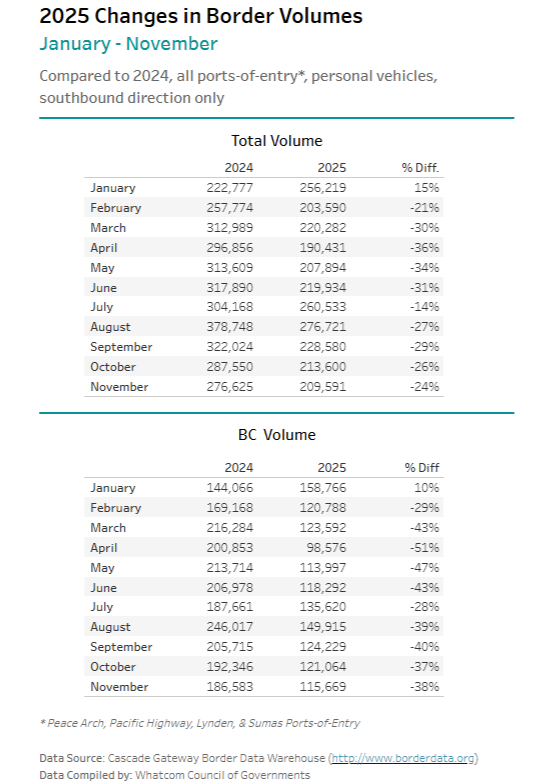
(Courtesy Whatcom County, Wash.)
On Tuesday, the Whatcom Council of Governments released its latest data, collected at four land border crossings, showing British Columbians continue to avoid travelling to the U.S. for the 10th month in a row. It says, in November alone, there was a decline of 38 per cent.