
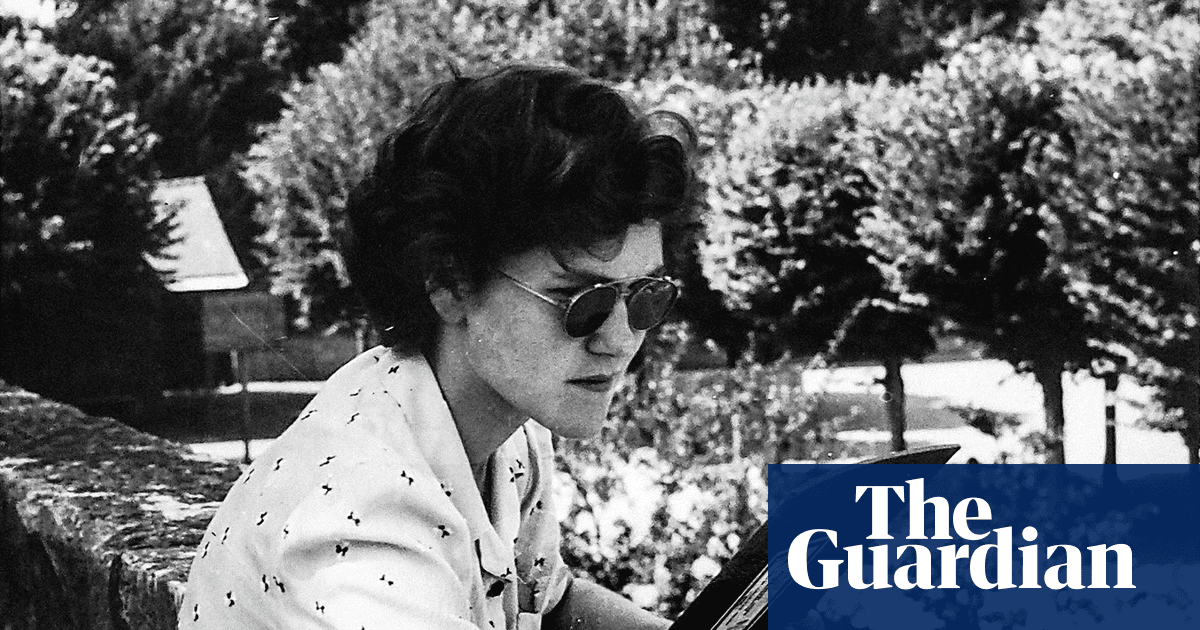
The architect Gillian Hopwood, who has died aged 98, only recently found recognition in her home country, England, after a career spent since 1954 in Nigeria. As Godwin and Hopwood, she and her husband, John Godwin, worked together as equals in a partnership that long outlasted the larger London-based practices that briefly flourished there in the years leading up to independence in 1960.
Jill and John met while studying at the Architectural Association (AA) in London in the postwar period. On the teaching staff there were members of Architects’ Co-Partnership (ACP), a firm founded by prewar AA students, and after graduation Jill and John joined a newly established ACP branch office in Lagos, Nigeria’s capital city at the time. After 18 months they decided to remain, but as an independent practice. The combined home and office they built at 27 Boyle Street on Lagos Island, a “tropical modernist” design with innovative passive cooling, showed their commitment. Keeping government hours of 8am to 2pm with their staff, they took the afternoon off, but worked again after dinner from 9pm to midnight, and produced around 1,000 buildings during their time in practice.
The Christ Church Cathedral school, Lagos, one of Jill’s projects.
Projects were collaborative but also involved the two principals in separate design and supervision. Nigerian independence was set for 1960, and a rapid school-building programme began. Jill’s contribution included Christ Church Cathedral school, Surulere School for the Blind and Yaba Model school, all in Lagos. Before the couple’s children, Tony and Carey, went to school, Jill was less free than John to travel long distances to supervise building sites. However, as she said, “I always had a job on my board,” exercising her talent for meticulously organising drawings and papers at the office, and taking photographs of a professional standard of old Lagos and new buildings.
Other jobs included flats for employees of the Metal Box Company, in 1961, and Bookshop House, Lagos, in 1973, or “my big building”, as she called it. It was there that a “bumptious electrician” questioned her authority and was told by the contractor: “She puts it in a site meeting note – you treat it like the Bible, you do it!” This 16-storey cubic office with deep shading fins and aluminium louvres stands obliquely on a three-storey podium to get optimum sun orientation. By the 1980s, there were fewer commissions and Jill retired from working in practice in 1997.
On arrival in Lagos, some months ahead of Jill, John had joined the multinational Island Club, marking his commitment to integration – shared equally with Jill – in the still-colonial country. Travelling out after John by ship, Jill made important friendships that led to her joining the Business and Professional Women’s Association organisation. In 1963, she was deputed to ask the prime minister, Tafawa Balewa, for funds to convert empty houses near the yacht club into a children’s home – and completed the conversion with nine shillings left in the budget. She also became the first non-government and non-commercial member, and vice-president, of the Ladies’ Dining Club. Later, she worked her way up to become president of the Soroptimist International (SI) women’s network in Nigeria in 1990-91.
The construction of flats for workers at the Metal Box Company, 1963
Gillian was born in Rochdale. Her mother, Hilda (nee Kershaw), was an academically trained electrical engineer but did not work after she married. Her father, Edward Hopwood, also an electrical engineer, was a designer for the Queensway tunnel under the River Mersey and later for Philips at Eindhoven. In 1935, the family moved from Lancashire to Woodford, Essex, where Gillian attended Loughton high school and the co-educational Friends’ school in Saffron Walden during the second world war years.
On her first day at the AA in 1945, she set up her drawing board one row ahead of Godwin. When he asked her to marry him in 1951, she replied: “I suppose so.” After enjoying their adventurous life together and weathering the political upheavals in Nigeria, they retired in 2017 to a terrace house in Cheltenham with their complete archive, later given to the Canadian Centre for Architecture in Montreal. The practice continues in Lagos as Godwin Hopwood Kuye.
They were individually recorded for the National Life Stories project’s Architects’ Lives in 2020, and in 2024 Ben Tosland’s study of their work, Who Are Godwin and Hopwood? Exploring Tropical Architecture in the Age of the Climate Crisis, based on documents and further interviews, brought them the recognition they had long deserved.
John died in 2023. Jill is survived by Tony and Carey.
Margaret Gillian Hopwood, born 27 June 1927; died 6 November 2025