
A group of geologists has identified thousands of fossil footprints on a wall of Monte Conero, in the Marche region: they may have been left by a herd of prehistoric turtles as they fled a violent earthquake that occurred 80 million years ago in an ancient ocean.
The exceptional discovery, described in an article published in the scientific journal “Cretaceous Research“, is a unique case in the world: they are the only footprints of prehistoric marine reptiles left imprinted on an ancient ocean floor.
The discovery, reported by geologists from the universities of Urbino, Trondheim (Norway) and the Geological Observatory of Coldigioco, occurred by chance. In 2019, a group of free climbers obtained authorization from the Conero Park to climb a rock face – usually closed to the public due to the risk of landslides – which overlooks the Adriatic Sea, along the north-eastern coast known as Spiaggia della Vela.
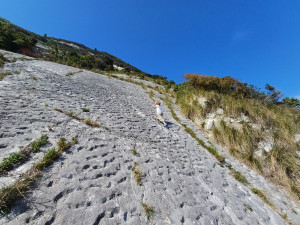

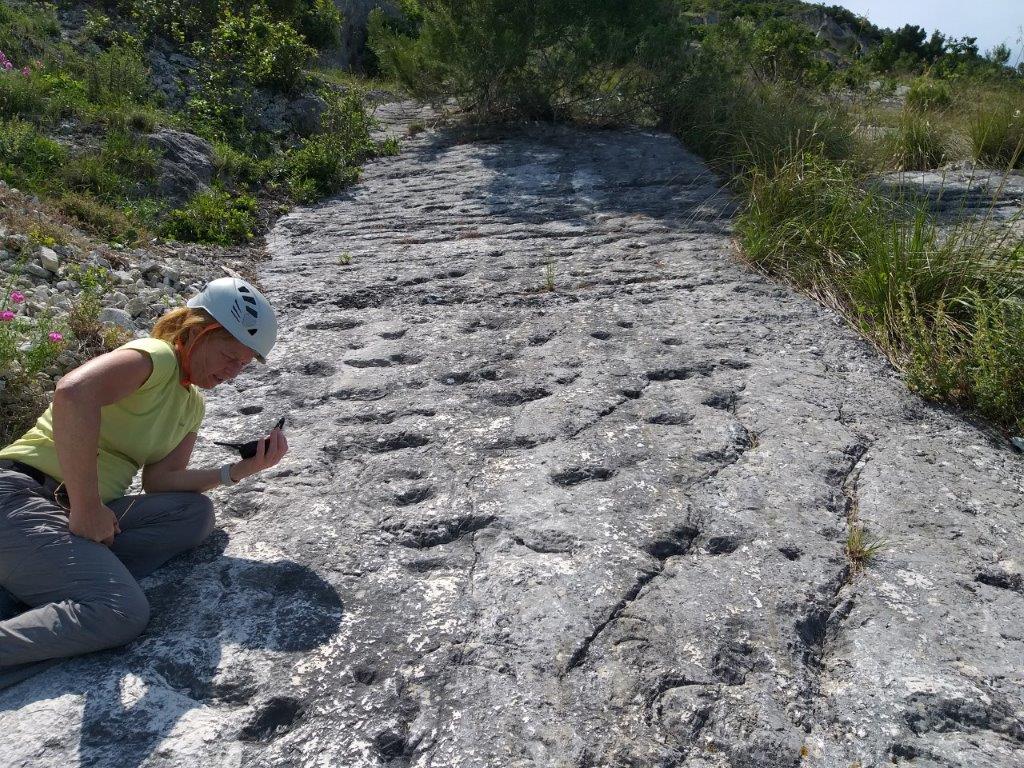
A MYSTERY. When they reached it by rope they noticed thousands of arched footprints, 20 cm wide and up to 10 cm deep, over an area 200 m wide2like a volleyball court. What could they have been produced from? The climbers took several photos and showed them to Alessandro Montanari, director of the Geological Observatory of Coldigioco, who has been studying the Scaglia Rossa for 50 years, the geological formation of the central Apennines which in the Cretaceous period constituted the bottom of an ancient ocean. It was precisely in these rocks that Walter Alvarez, a geologist from the University of Berkeley, found traces of the asteroid impact that caused the mass extinction of the dinosaurs.
What story did those footprints tell? It was a mystery, which geologists patiently tried to decipher.
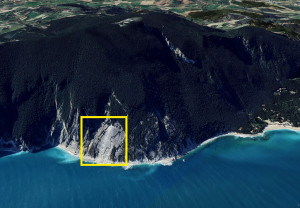

LAGOON. The climbers returned to the rock face with a drone, taking aerial photos and taking rock samples. Analyzes of the sections under the microscope began to reveal what had happened.
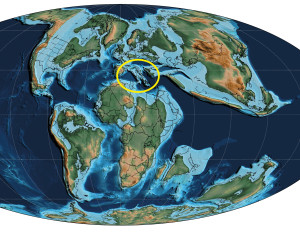
«That Conero wall is a vast slab of pelagic limestone», explains Montanari. «It was formed, that is, by the slow accumulation, on a seabed, of calcareous skeletons of tiny planktonic organisms. Upon microscopic analysis, the samples were found to be pelagic biomicrite, that is, a deep sea mud (let’s assume 600 meters) made of coccoliths, pieces of plankton calcareous algae, and plankton residues with calcareous shells.” The rock sample, based on its chemical-physical characteristics, was dated to around 80 million years ago: at that time the Italian peninsula did not yet exist. In its place was the Tethys ocean, which separated Eurasia and Africa.
The area now occupied by the Adriatic Sea was a vast carbonate platform, with shallow sea, lagoons and coral reefs: a landscape similar to that of the Maldives, so to speak.
SEALED. So, if the current Conero wall was an ocean floor, what produced those traces? And how did they manage to survive for millions of years? «The upper layer of the rocks was a turbidite, or rather an underwater avalanche of sand, fine mud and sediment» replies Montanari. «This avalanche covered the footprints, and over time transformed into limestone, sealing these tracks to this day. And from dating we know that that avalanche was not produced by a storm but by an earthquake.”
The rocks, in fact, date back to an age, the Campanian, which was characterized by a sudden climate change, due to a global drop in temperatures. «The planet cooled because not enough solar radiation passed into the atmosphere, which was darkened not by massive volcanic eruptions, but by the dust produced by the explosion of a meteor shower in the atmosphere. We know this thanks to the presence, in rocks, of a chemical element, helium-3, which forms in deep space”, says Montanari. So, the Earth cooled, and the seas lowered following the glaciation. This reduced the pressure on the earth’s crust, which however began to rise again when the atmosphere freed itself from the dust and the ice melted, causing sea levels to rise: the change in pressure on the crust triggered great seismic activity in the area.

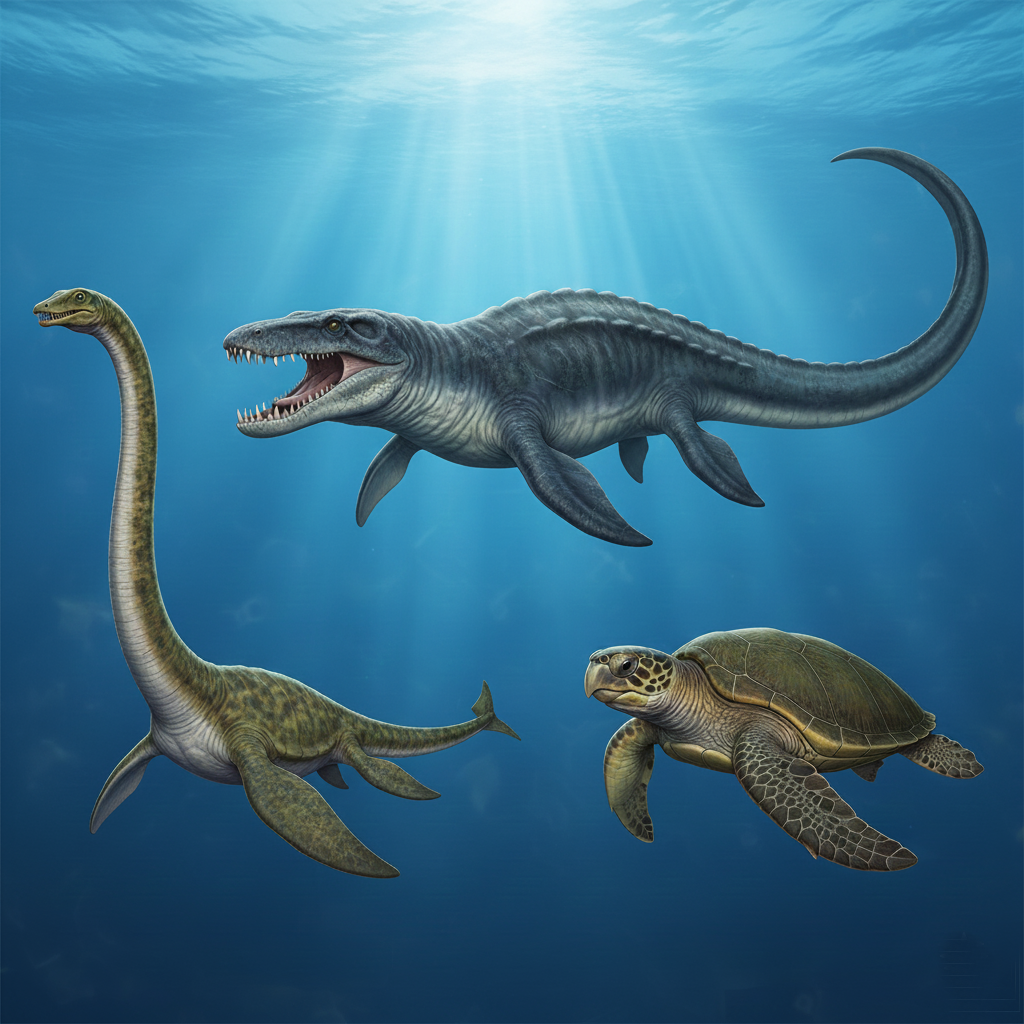
REPTILES. But what could have produced those tracks? In that ancient ocean, the only vertebrates that roamed the deep sea were fish and reptiles. Only the latter could have left imprints on the seabed with their fins. And at the time there were only three species of large marine reptiles, now extinct: plesiosaurs, mosasaurs and sea turtles. Which of them could it have been?
«We had an important piece of evidence that spoke in favor of the turtles: the number of footprints. There were about a thousand of them, and only turtles move en masse: today several species arrive on tropical beaches to lay their eggs. And some species that feed on sponges and other invertebrates colonize lagoon-type environments en masse because they find there food in abundance and shelter from the predators that infest the open seas” explains Montanari.
However, it remained to be ascertained whether the traces found on the Conero were compatible with the underwater movements of a turtle.
The scientists ascertained this by observing YouTube videos of Hawaiian sea turtles swimming near the seabed: «These reptiles skim, and sometimes immerse the tips of their front fins and tail in the soft sediment, leaving parallel arcuate marks similar to those found on the Conero», he adds.
ON THE RUN. Here is the reconstruction of what happened 80 million years ago in those waters: «The traces represent the mass movement of a large number of turtles of the protostegid family, now extinct» says Montanari. Some species reached 4 meters in length. «A sudden earthquake caused a hasty escape towards the open sea, in the direction opposite to the epicentre. Some of them, in a panic, swam close to the seabed leaving their footprints on the soft carbonate sediment, which were immediately covered by an underwater avalanche triggered by that earthquake. Something similar happened 600 million years ago in the Burgess Shale (Canada), where many fossils have been preserved thanks to the underwater collapse of large limestone platforms.”
OTHER FOOTPRINTS. Those on the Conero are not the only fossil traces of prehistoric vertebrates discovered in Italy. The most famous and numerous were found in Pontrelli Quarry of Altamura, in Puglia: there are around 4 thousand of them, they date back to the Upper Cretaceous (around 70 million years ago) and belong to at least five different species, including herbivorous dinosaurs such as sauropods, ceratopsids and ankylosaurs, and carnivores such as theropods. Around 70 footprints of sauropods, theropods and iguanodonts were also found in Puglia in a quarry in Borgo Celano. On the Monte Cagnoin Abruzzo, the footprint of the largest bipedal carnivorous dinosaur (a theropod) ever found in Italy was discovered: it is approximately 135 cm long and dates back to the Lower Cretaceous (125-113 million years ago). An animal about 8 meters long left it.