
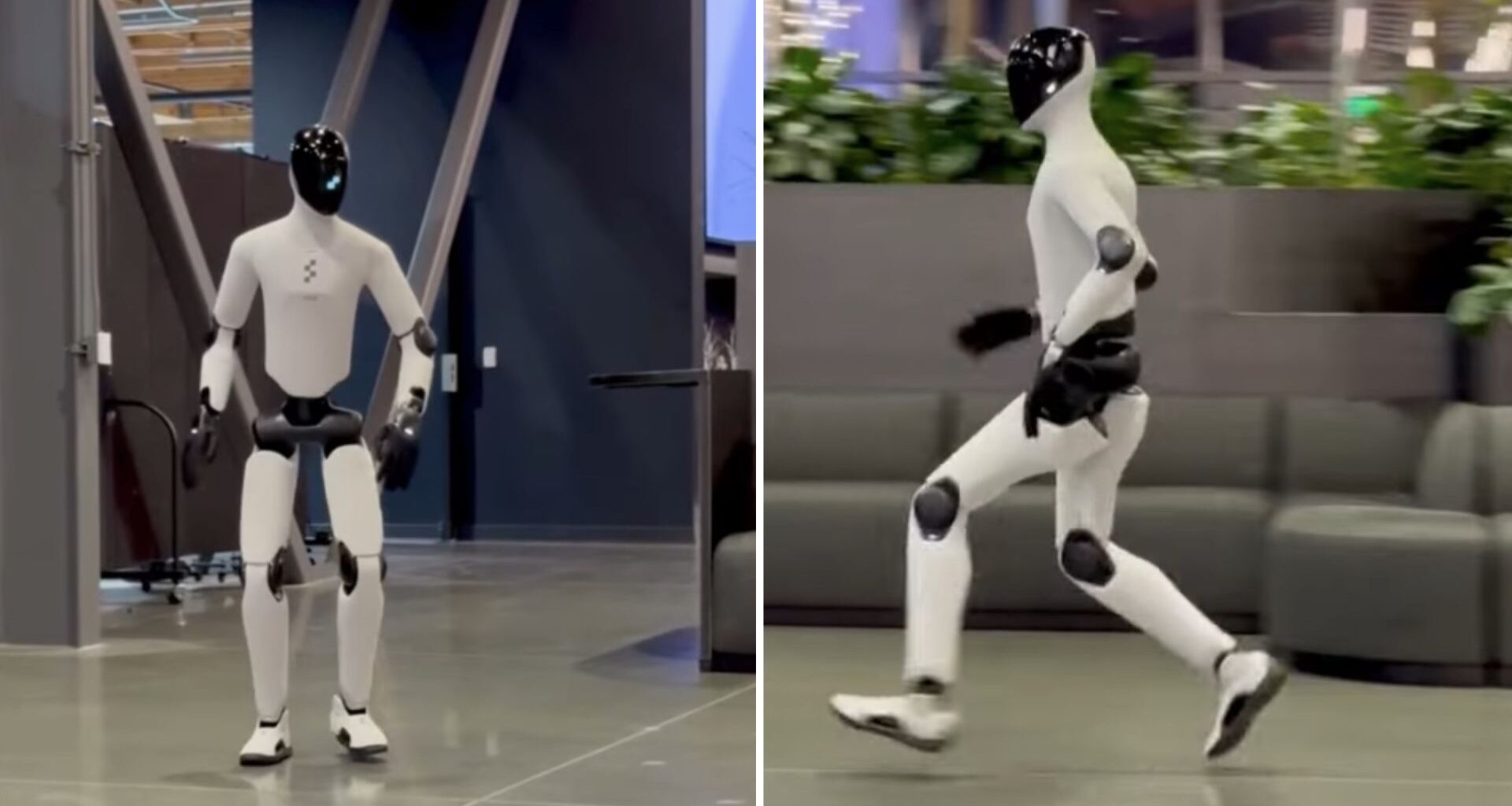
The future of factory floors and domestic help just got a lot faster.
Recently, Figure AI CEO Brett Adcock dropped a short video on social media, teasing the extraordinary speed and agility of the Figure 03 humanoid robot.
The clip clearly shows the robot’s quick start, smooth directional changes, and sharp braking while running inside a complex. These movements defy the widely held notion that today’s humanoids are slow and lumbering.
“This F.03 robot controller is being run by an onboard neural network built by the Helix team,” Adcock wrote in the Instagram caption.
Breaking the speed barrier
For years, the Achilles’ heel of general-purpose humanoid robots has been their inability to move quickly.
Companies that build humanoid robots often withhold their maximum walking speeds because the figures are typically not impressive.
Competitors like Agility Robotics’ Digit and Sanctuary AI’s Phoenix have generally published maximum walking speeds in the conservative 3 to 4 miles per hour range.
California-based Figure AI reported its own number for Figure 03 as a seemingly modest 1.3 meters/second, or 2.7 mph.
But this new footage shows otherwise. Forbes reported that the robot appears to be operating at the upper end of human jogging speed—4 to 6 mph.
Interestingly, the robot is shown with both feet off the ground simultaneously, a motion that technically defines running and requires complex dynamic stability control. This is a massive engineering hurdle that has been overcome.
This rapid, smooth movement — particularly its ability to quickly slow down and execute a turn — indicates a major advancement in Figure’s control system and high-torque actuation.
The Helix team’s neural network provides the sophisticated intelligence required for the Figure 03 to execute complex, agile movements, such as running and quick turns. Notably, the development moves it from a stiff automaton toward a more capable machine.
“Figure 03 is well-suited for commercial applications for several reasons. The actuators can operate 2x faster while maintaining improved torque density (nm/kg). The most significant result of this is our ability to pick and place items at faster speeds,” the website noted.
This breakthrough appears to be a direct response to, or a new benchmark against, the recent speed improvements demonstrated by rival robots like Tesla’s Optimus.
It looks like the race for dynamic, real-world utility is on.
Figure 03 is equipped with advanced sensors
The third-generation robot is a production-ready machine for both home and industry use.
Standing at five feet eight inches, Figure 03 represents an upgrade over its predecessor, Figure 02, featuring a sharper sensory system, a softer aesthetic, and enhanced coordination.
With nine percent less mass and a significantly reduced volume compared to the Figure 02 robot, the Figure 03 robot is much easier to maneuver, particularly in household environments.
Interesting Engineering previously reported that the robot’s design features an advanced setup that allows it to grasp objects and continuously adjust its grip.
A key component of this capability is its softer, more flexible hands, which are equipped with fingertip sensors that detect extremely light pressure—down to 3 grams (about the weight of a paperclip). This high level of sensitivity enables the robot to handle delicate items, such as glassware, safely, and prevents tools or objects from slipping.
The combination of high-speed locomotion and production viability makes Figure 03 a fierce contender in the ever-growing humanoid market.