
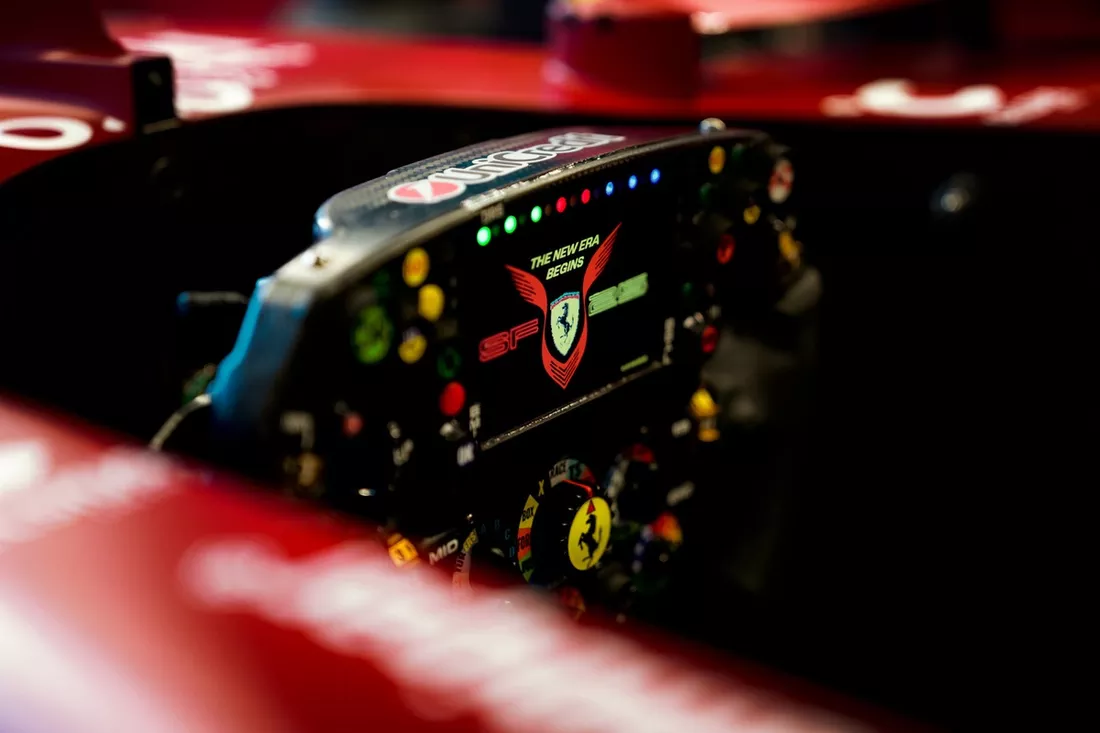
Ferrari took advantage of the Abu Dhabi free practice sessions to test a prototype 2026 steering wheel, which appears slimmer and lighter. While it may seem like a minor detail, the Scuderia seems to have completely reshaped its design philosophy, making a clear break from the past in both size and the layout of the rotary switches. Let’s explore the details.
Often, the final Grand Prix of the year in Abu Dhabi provides teams with the opportunity to turn Friday practice into an open-air laboratory, beginning to test solutions for the next season. This year, however, with a major technical revolution looming that will have little in common with the current cars, only a few teams chose to use the sessions in this way.
Among them was Ferrari, which, without resorting to the flashy rake systems for data collection or other unusual solutions, still offered a first glimpse of the future: a prototype of the 2026 steering wheel was tested on track with Arthur Leclerc. It might seem a minor detail, but it contains very interesting elements.
Slimmer and “sculpted” on the top
The new Ferrari steering wheel is not directly inspired by the 499P used in the WEC. Although the upper shape may seem similar at first glance, the reference remains the F1 steering wheel used until this season, reinterpreted for weight reduction. The characteristic “horns” shape follows a precise design logic.
The sculpted areas help save a few grams, while the raised outer sections house the front differential adjustment wheel and a secondary button at the rear of the wheel. This combination gives it an unusual wavy shape, which is fully functional. Another notable detail is the slimmer profile compared to the previous wheel, which featured a less pronounced rear bulge. This suggests Ferrari has revised the internal electronics, connected to the standard board provided by Motion Applied.
On the rear, the wheel’s core remains largely unchanged: the side paddles still allow rapid adjustments of multiple parameters simultaneously, while the clutch and gearbox paddles received only minor updates, retaining already proven solutions.
Almost all buttons reorganized
The most significant changes are on the front, signaling a genuine revolution compared to Ferrari wheels of the last decade. The rotary switches for brake balance and differential remain unchanged, with six in total for quick adjustments. However, the rest of the wheel has seen deep modifications.

The layout of buttons and lights on the upper part has been completely redesigned: some are now positioned closer to the screen, and the configuration can vary depending on the driver’s preferences. Even more radical are the changes on the lower section.
Until this season, Ferrari’s philosophy was not to combine multiple functions in a single rotary switch. For example, one switch was dedicated to strategy, allowing the driver to communicate tyre status directly from the wheel, avoiding verbal transmission and keeping valuable information away from rivals. Other switches managed engine settings, quick presets, or secondary power unit parameters. This design was carefully considered to maximize driver comfort, inspired by Sebastian Vettel, who over the years requested more functions within immediate reach to control every parameter without delving into submenus, which could distract and cost precious seconds.
Fewer rotaries and a clean lower cut
For 2026, Ferrari appears to be charting a new course, partially aligning with the philosophy Lewis Hamilton used at Mercedes. On the wheel tested by Arthur Leclerc in FP1, the lower rotary switches were halved: from six to three, the same number Hamilton used at Brackley.
This suggests that secondary functions have been consolidated into submenus, but the most interesting aspect is that the reduction allowed the wheel to be significantly resized, now featuring a clean lower cut. This design recalls Mercedes or Sauber styling (requested by Valtteri Bottas, who had previously drawn inspiration from the “Star”).
The change reduces weight further, a factor that will become crucial in the next technical cycle, as cars will initially struggle to meet the FIA’s minimum weight limit, while also freeing up more space for the driver’s legs. Small details, certainly, but they mark the beginning of Ferrari’s 2026 revolution.
Dec 8, 2025Scuderia Fans
Let other Scuderia Fans know about us


