
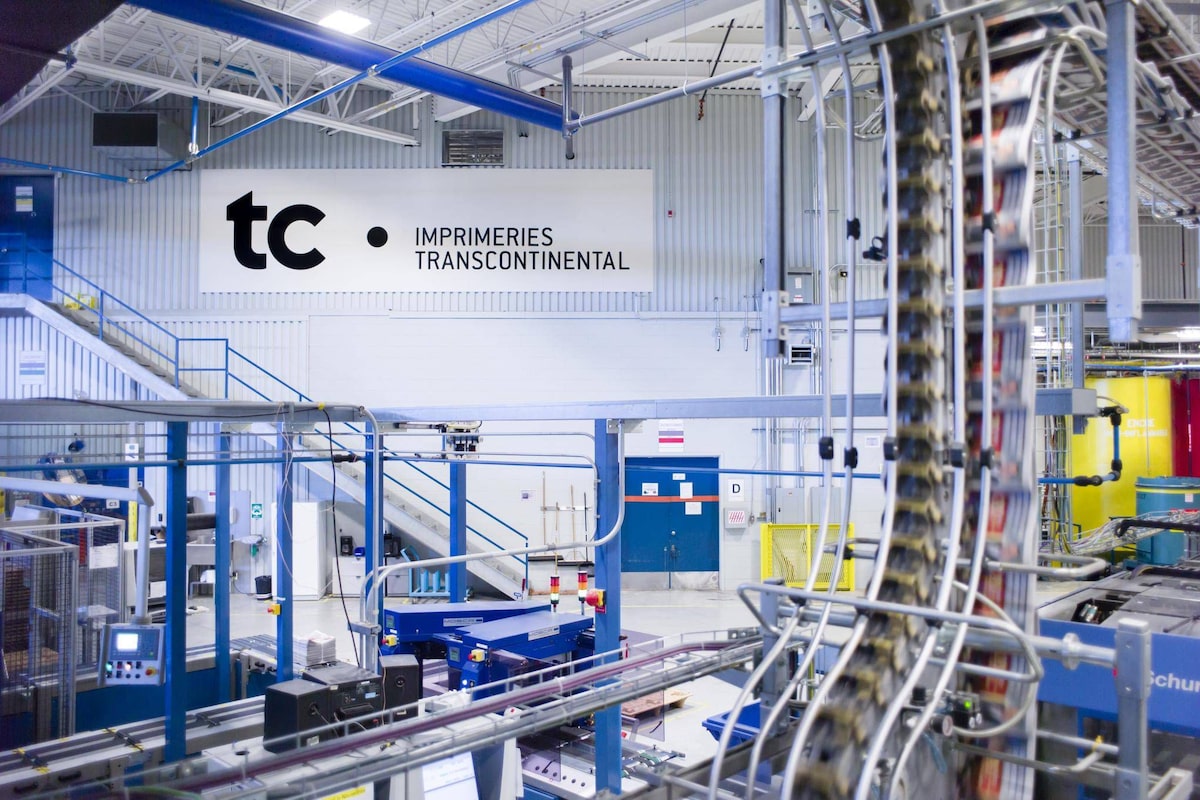
Transcontinental operates 17 Canadian printing sites across six provinces, producing marketing materials such as retail flyers as well as books, magazines and newspapers.Transcontinental/Transcontinental
Transcontinental Inc. TCL-A-T is doubling down on Canada through a multibillion-dollar sale of its flagship packaging business.
The Montreal-based company said Monday that privately-held, Cincinnati, Ohio-based ProAmpac Holdings Inc. is buying its largest division for slightly more than $2.2-billion, including debt and lease obligations. Transcontinental earns the majority of its revenue, roughly $1.6-billion out of $2.8-billion total during its last fiscal year, from the 25 package-making factories it operates across eight countries.
Shareholders will receive most of the sale proceeds directly in the form of a special $20-per-share dividend that will be paid after the deal closes in early 2026, the company said. That payout exceeds the value of Transcontinental’s Toronto Stock Exchange-listed shares before the deal was announced, though the stock was trading nearly 20 per cent higher at $23.66 a share at Monday’s close.
The leftover amount after paying the special dividend, which is expected to be roughly $400-million, will go toward debt reduction, company spokesperson François Taschereau said via e-mail.
Packaging for Transcontinental is mostly an American business, with roughly 73 per cent of the division’s revenue coming from the U.S. and 15 of its 25 production facilities on American soil. Only 9 per cent of Transcontinental’s packaging revenue comes from Canada, where the company operates just three facilities.
“For us, this is mostly a sale of U.S. assets to a U.S. buyer,” Isabelle Marcoux, Transcontinental’s executive chair, said in an interview. “We are excited to stay in Canada and being a sovereign Canadian company with a Montreal head office that is fully committed to growing our presence here.”
The packaging industry has been rapidly consolidating in recent months. Switzerland-based Amcor PLC closed a US$8.4-billion acquisition of U.S. rival Berry Global in April and in November, Bubble Wrap maker Sealed Air Corp. agreed to a US$10.3-billion buyout from U.S. private-equity firm CD&R.
Growing its own packaging business through acquisitions “has proven difficult in the last few years,” Ms. Marcoux said, because companies in the space tend to sell for roughly nine times their earnings before interest, taxes, depreciation and amortization.
“Any acquisition in packaging that we would look at would be highly dilutive. We also saw limited organic growth prospects,” she said.
“We have invested quite a bit in our platform, for recycling for example, but the market was just not growing enough to create value from our investment, so selling became the best option.”
Once the deal closes, Ms. Marcoux said in-store marketing (ISM) products, such as promotional displays and custom signage, will be a key growth driver for Transcontinental. The company has made three acquisitions in that space over the past six months alone: Markham, Ont.-based point-of-purchase display producer Middleton Group in June and in two Canva Group businesses – Saint-Hubert, Que.- based Mirazed Inc. and Winnipeg-based Intergraphics Decal Ltd. – in August.
“ISM is something we are going to focus on,” Ms. Marcoux said. “It has been quite a growing business. Every week we ship at least one thing to 30,000 locations across Canada.”
According to a September, 2025, investor presentation, Transcontinental has grown its annual ISM revenues to more than $250-million from less than $50-million in 2017. Ms. Marcoux said the division is now close to generating $300-million in annual revenue.
Transcontinental also operates a network of 17 Canadian printing sites across six provinces. Those facilities produce marketing materials such as retail flyers as well as books, magazines and newspapers. (The company has been printing The Globe and Mail for the past 27 years).
It also does some niche printing, including vinyl records, which Ms. Marcoux described as “immaterial and quite profitable.”
CIBC Capital Markets and RBC Capital Markets served as financial advisers to Transcontinental on the packaging division sale while Stikeman Elliott LLP and Morgan Lewis & Bockius LLP served as the company’s legal advisers.