
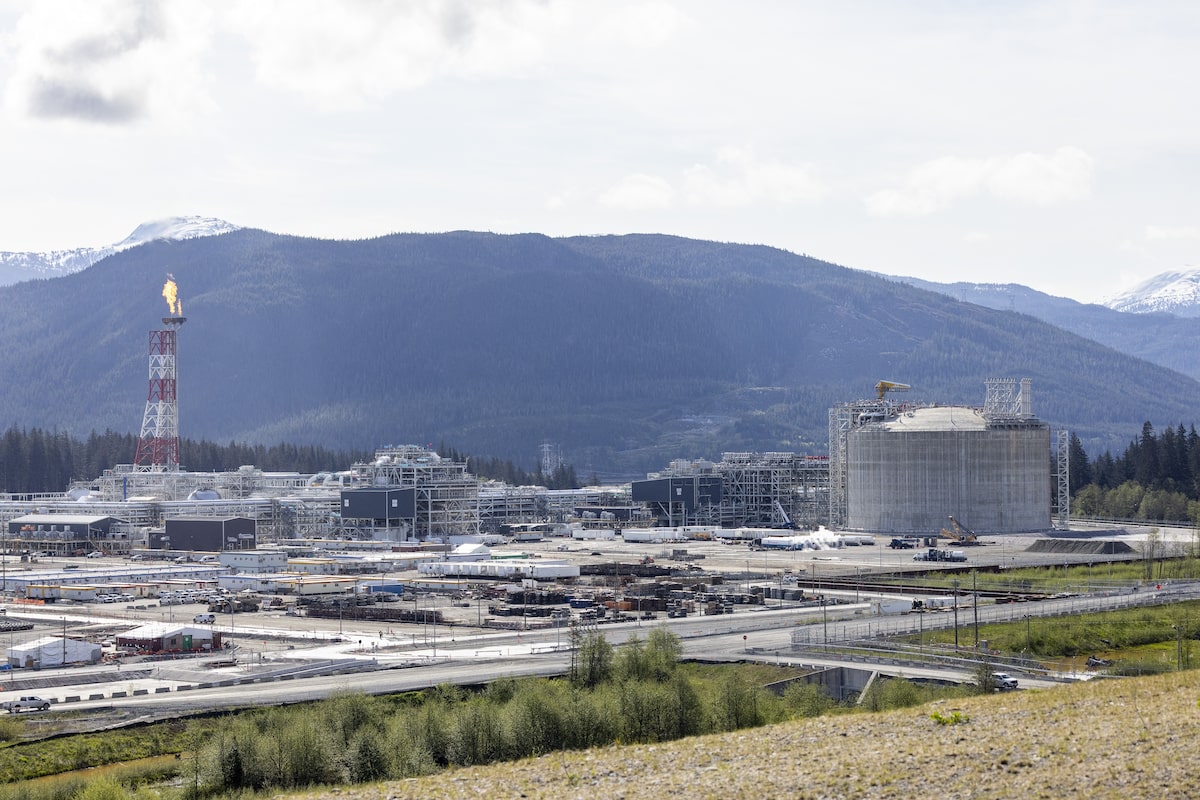
The sprawling LNG Canada export terminal in Kitimat, B.C., in April, 2025.Aaron Whitfield/The Globe and Mail
A new report is giving fresh support to Canada’s ambition to be an energy superpower as the federal and B.C. governments push for increased exports of liquefied natural gas.
Canadian LNG could displace thermal coal at electricity-generation plants in Asia and play a role in reducing global emissions of greenhouse gases such as carbon dioxide, according to the report from the Public Policy Forum in partnership with the Canadian Chamber of Commerce’s Future of Business Centre.
The report said LNG Canada’s Phase 1 terminal in Kitimat, B.C., and new LNG projects in British Columbia are all designed to have lower intensity of carbon emissions than most export facilities in other parts of the world, including those along the U.S. Gulf Coast.
“Canadian LNG has a two-fold climate advantage: At the point of use, it’s much cleaner than coal, and at the point of production, it’s cleaner than many other sources of LNG,” said the report co-authored by Mark Cameron and Arash Golshan.
The report, set for public release Tuesday, stands in sharp contrast to studies from climate groups and environmental think tanks, which say the world needs to focus on renewable energy, not on fossil fuels such as LNG. Critics say Canada should adhere to the Paris climate agreement’s country-specific targets for decreasing carbon emissions, and LNG should not be considered a global solution to combat climate change.
LNG development set to double global supply by 2030, IEA analysis shows
Prime Minister Mark Carney, as part of his quest to make Canada an energy superpower and reduce economic dependence on the United States, announced in September that LNG Canada’s Phase 2 expansion plan made the list of major projects of national interest to be considered for fast-tracking.
In November, he said Ksi Lisims LNG in northwest B.C. has been added by Ottawa to the growing roster of plans submitted to the Major Projects Office, which has the goal of expediting a wide range of developments in sectors such as energy, mining and infrastructure across Canada.
B.C. Premier David Eby has thrown the provincial government’s support behind LNG while opposing the concept of a new oil pipeline to the northwest coast from Alberta.
LNG Canada became the country’s first export terminal for natural gas in liquid form when it began shipments to Asia from Kitimat in June.
“By continuing to control domestic emissions and engaging in international climate co-operation, Canada can expand its role as an energy exporter while aligning with global climate objectives,” Mr. Cameron and Mr. Golshan said in their report, which drew on analysis by Navius Research Inc.
The heads of the Public Policy Forum and Canadian Chamber of Commerce issued statements to welcome the report’s findings.
“This analysis represents a win for the economy, Indigenous reconciliation and the environment,” forum president Inez Jabalpurwala said.
Tony Keller: Does Canada need a new oil pipeline? Maybe. More LNG? Definitely
“Cleaner energy is Canadian energy,” chamber president Candace Laing said. “Canada has a strategic advantage here, from cleaner production to Indigenous partnership.”
But critics such as the International Institute for Sustainable Development reject the portrayal of LNG as a transition fuel, warning that there are potent methane emissions, which contribute to climate change, during the production of natural gas through fracking.
“Canadian LNG exports are likely to increase global emissions by adding to fossil fuel consumption and slowing the transition toward renewable energy,” the institute said in its analysis released last week. “New Canadian LNG is incompatible with climate targets.”
A review released last month, commissioned by the B.C. government, said expanded fracking for natural gas in northeast B.C. is at odds with the province’s climate goals. “The government’s current pursuit of increased gas production and new LNG export opportunities threatens to set back progress,” said the review led by climate policy experts Merran Smith and Dan Woynillowicz.
Besides examining LNG, Mr. Cameron and Mr. Golshan looked at the role that Canadian conventional light oil and Alberta’s oil sands could play to help diversify markets as the U.S. trade war persists.
“A barrel of Canadian oil is very likely taking the market share of a higher-carbon barrel, rather than increasing total barrels burned,” according to their report titled Refuel: What Canadian LNG and oil exports could mean for global emissions.
LNG Canada project underlines change in public opinion on energy sector, Champagne says
To attain higher shipments of LNG and oil to markets overseas, “Canada must diversify its export markets, particularly toward fast-growing regions in Asia,” the co-authors said.
LNG Canada is expected to make a final investment decision next year on whether to forge ahead with the Phase 2 expansion of its terminal in Kitimat, located on the Haisla Nation’s traditional territory.
The Phase 2 expansion would initially double the plant’s total potential capacity to 28 million tonnes a year, though LNG Canada expects that the export capability could be even higher.
LNG Canada has found greater efficiencies in its equipment, allowing it to produce more of the fuel than originally estimated, Shell PLC-led LNG Canada said in a statement to The Globe and Mail.
The Canada Energy Regulator recently granted LNG Canada’s request to amend its export licence to boost the maximum allowable quantity of LNG exported by up to 6.4 per cent a year.
Ksi Lisims LNG developer welcomes shift in political support for industry
The variance doesn’t alter the total quantity of exports spread over the 40-year licence’s term. But it means that LNG Canada has permission to crank up output over the course of a year, resulting in a potential jump in exports to as much as 15 million tonnes in each of Phase 1 and Phase 2, for a total of roughly 30 million tonnes annually.
A B.C. project aiming to open in 2029, the Nisga’a Nation-backed Ksi Lisims LNG, plans to have capacity for 12 million tonnes a year, which would make it the country’s second-largest export terminal for the fuel, after LNG Canada. Ksi Lisims plans to make its final investment decision next year.
But Ksi Lisims is facing opposition from Indigenous groups in northwest B.C. such as the Lax Kw’alaams Band, Metlakatla First Nation and Gitanyow hereditary chiefs.
There have been numerous delays in Canada’s fledgling LNG industry over the past decade. Two B.C. projects are under construction: Woodfibre LNG, near Squamish, and Cedar LNG, in Kitimat.
The Haisla own 50.1 per cent of Cedar LNG, while Calgary-based Pembina Pipeline Corp. holds 49.9 per cent.
Haisla leaders support LNG but they vehemently opposed the now-defunct plans for the Northern Gateway oil pipeline project that sought to locate the export terminal in Kitimat.