
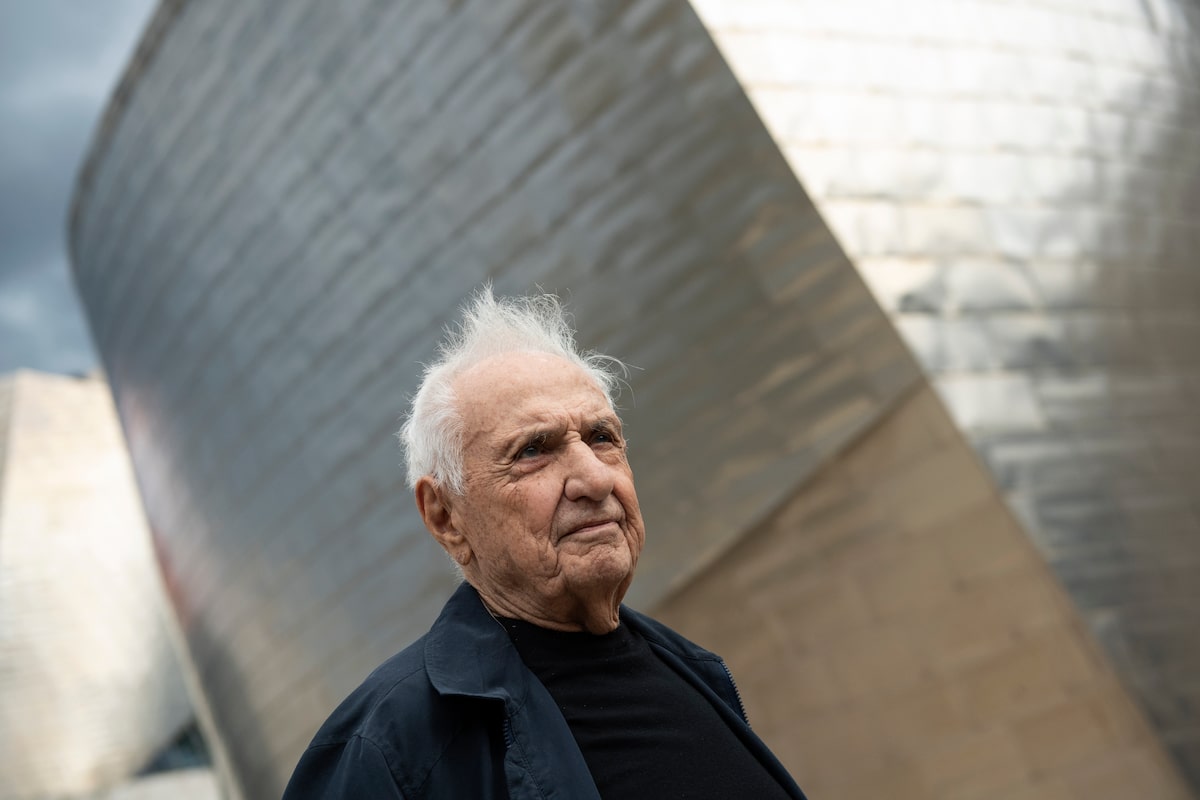
Architect Frank Gehry in front of the Guggenheim Bilbao Museum during its 25th anniversary celebrations in the Spanish Basque city of Bilbao, in October, 2022.ANDER GILLENEA/AFP/Getty Images
When I heard this past Thursday that Frank Gehry had died, so many memories came cascading back. In 2002 we had begun a six-year journey together, with Ken Thomson and his family, and with staff and board members, to imagine, plan and build something new at the Art Gallery of Ontario. More space for art. A more gracious welcome. Programming space that felt truly engaging. A building that connected to the city.
In the early stages of planning and fundraising, the AGO board gathered in New York. We met with Dan Doctoroff, a deputy mayor in the administration of Michael Bloomberg. He was leading many public projects to create spaces to enhance New York as a cultural destination. It was our journey too.
He said at the time: “Frank will do something great for you, and stay in it with you, because he cares about cities, and Toronto is his hometown.” And he was right. In the fall of 2004, we were at an impasse and challenged on a few matters (the project did, finally, come in on time, and on budget) and Frank was frustrated.
Unexpectedly, I received a call from the art teacher at Alexander Muir public school on Gladstone Avenue, where Frank had attended kindergarten and first grade in 1934/35. Would Frank come to a school assembly and talk to the students, by then kindergarten to Grade 8, about his life as an architect? I called him and he said yes without hesitation.
A few weeks later, in September 2004, we pulled up in front of the school, where we were greeted by the principal, the art teacher and a group of students. As we walked past the sport trophy case, we realized that there was now a sign in tinfoil that said “Welcome Frank Gehry” with about a dozen small model buildings made out of popsicle sticks on the shelves. I remember seeing Frank’s posture change, and his walking into the auditorium joyfully as 400 students all clapped and roared when he entered.
Frank Gehry, legendary architect of some of world’s most iconic buildings, dies at 96
He sat on a stage and took questions, told stories and made funny asides that made the students laugh. As he came down from the stage I asked him how it felt. “I cried,” is all he said.
Before we left he asked to see his classroom in the original part of the building. And when we walked in, he did what architects do, scanned the room – assessing volume and light, the height of walls and the placement of the desks in relation to the blackboard. “It’s bigger than I remember,” he said. “But I remember it. And I loved this place.”
Around that time, I spoke to Frank about the evolving plans for the gallery and overall feeling of the building. At this point, Frank, along with his associate Craig Webb, had considered and developed almost 80 modifications to the original ideas and proposals, and was constantly thinking about what might be enhanced or eliminated.
“I think you imagine space in relation to how your body feels as you move,” I said. “Height of walls. How close you are to other people. How they interact.”
Frank wasn’t engaged. “Whatever, Matthew,” he replied. “I don’t think so. It’s just fancy words.” And that was that.
Opinion: Frank Gehry created a new language of architecture
In mid-November of 2008, Frank came to the opening celebrations for the expanded Art Gallery of Ontario. He arrived that morning with an aura of some sadness. His eldest daughter was dying of cancer, and he and I had recently spoken of what it meant not to have Ken Thomson with us to celebrate what had been accomplished in our hometown.
We were sitting alone in the restaurant, looking out the window to Dundas Street, when a streetcar passed close to us, just under the promenade on the front of the building. “That’s it, Matthew,” Frank said. “Sitting on the front porch watching the streetcars going by. That’s what I wanted. To be close to outside, to the street in Toronto.”
We did the news conference, answered lots of questions, and then found ourselves alone again. I brought up my long ago question. “I said to you once, that you think of buildings in relation to how your body feels as you move. And you said no.”
Without missing a moment, Frank looked at me and said, “You’re probably right.”
Frank Gehry was the great architect of empathy. He challenged with twisted forms and daring materials, but returned always to the great dialogue in space between the domestic and the institutional, the grand and the intimate. His spaces for art always put artists and their work first. How is it seen? What will serve the artist’s voice best?
Frank Gehry considered moving back to Canada after Trump’s 2024 election, Chrétien says
He didn’t believe that we primarily thought about the world in linear ways, and he was not afraid to engage with, and then find ways to tame, chaotic instincts. His through line was the life within form that then became life within space.
His buildings always seem, to me, to have the footstep bounce that the 80-year-old Frank had when entering that school auditorium. At an impasse once in 2005, he came into the gallery on a winter morning with a small snow-covered woollen tuque on his head, saying: “I think I’ve got it. I sat in Grange Park for an hour. I took art classes there when I was a kid. And I think I just got scale in relation to the neighbourhood.”
Something deep was unlocked, just as Dan Doctoroff had said to us a few years before – a key to the language of the building tied directly to Toronto as the city of deep memory. He took the sprawling scale of Toronto, and the spreading form of the art gallery, and suggested a kind of intimacy. He pulled from inside himself the feelings of a seven-year-old and what gave him both comfort and a sense of adventure – warm wood, modulated light, views of the city, spiralling staircases – all to make us feel at home.
Home is where you have the potential to feel the comfort of belonging, and of connection to others. Home is created by a feeling of safety with the hope that you can be yourself. Frank realized the reimagined Art Gallery of Ontario two blocks from his grandmother’s house on Beverley Street, where he often spent Friday nights and weekends, taking the streetcar from three kilometres away, on Dundas Street. When he woke up in the morning, he walked to Saturday morning art classes at the gallery from his grandmother’s house.
That he brought such feeling to the creation of lived form was a gift to all of us – imagining what comfort means as you see, and experience, the building blocks of place, light, scale and material. The feeling of connection. I know this to be true: that he created such an architecture of belonging at the Art Gallery of Ontario, and that it changed the lives of many.
Matthew Teitelbaum was the Michael and Sonja Koerner Director of the Art Gallery of Ontario from 1998-2015, and Director of the Museum of Fine Arts, Boston from 2015-2025.