
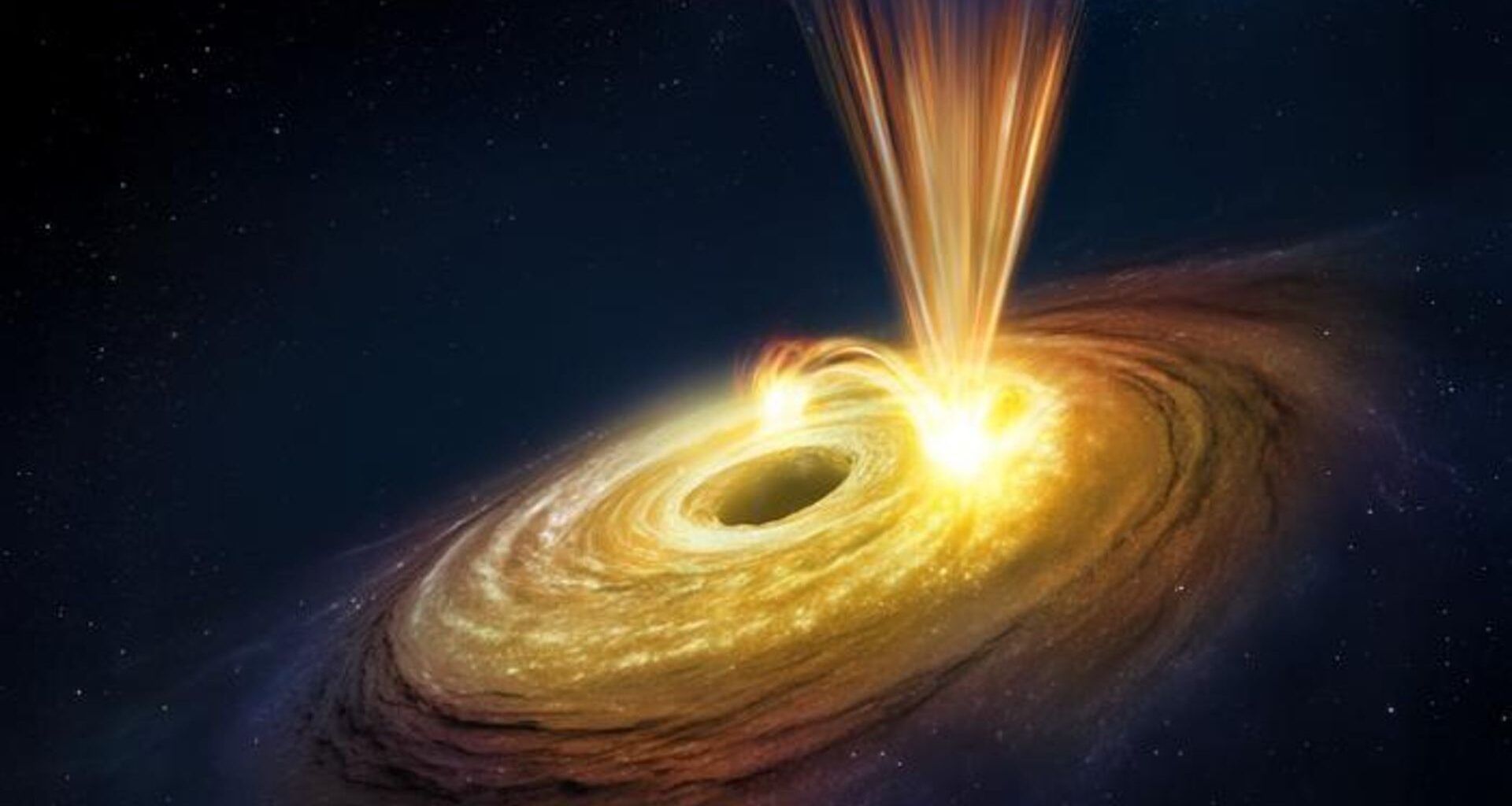
Supermassive black holes are notoriously messy eaters, but the behemoth at the heart of spiral galaxy NGC 3783 really takes the cake — and then flings it out into space at a fifth the speed of light.
Astronomers recently spotted a gale of hot, charged particles erupting from this black hole in the aftermath of a powerful X-ray flare that occurred just a few hours earlier. As one of the study’s co-authors, Matteo Guainazzi,described it in a statement, picture a cosmic storm “similar to the flares that erupt from the sun, but on a scale almost too big to imagine.” Guainazzi is a project scientist on the European Space Agency‘s XRISM X-ray telescope, which led to these results.
You may like
Unleashing a Cosmic Storm
Astronomers using XRISM first spotted a brief but intense burst of X-ray radiation erupting from the area around the black hole. A few hours later, XRISM picked up the blast of wind unleashed from the same area racing outward at 134 million miles (216 million kilometers) per hour. XRISM’s instruments measured the speed and structure of the wind and pinpointed its source, while instruments on the XMM-Newton X-ray telescope helped measure the extent of the cosmic storm. Space Research Organization Netherlands astrophysicist Liyi Gu, who is another author of the study, and colleagues say the process that spawned the storm is not much different from the process that causes solar flares and coronal mass ejections from our own sun — just on a gargantuan scale.
“The winds around this black hole seem to have been created as the active galactic nucleus’s tangled magnetic field suddenly ‘untwisted,'” said Guainazzi.
The magnetic field around our sun is a restless thing. It’s constantly in motion, and sometimes its magnetic field lines snap and then reconnect. That violent severing and rejoining kicks off a solar flare, a short burst of radiation from the sun’s surface. The same process often flings a massive glob of plasma (electrically-charged gas particles) out into space.
But the supermassive black hole lurking at the core of NGC 3783 is 30 million times the mass of our humble sun, and the magnetic field writhing around is millions of times stronger, so when its lines snap and reconnect, the resulting flare is an eruption of almost unfathomable power.
And, while a typical coronal mass ejection erupts from our sun at more than 3 million miles (4.8 million kilometers) per hour, remember how the blast of wind from NGC 3783’s supermassive black hole clocked in at more than 134 million miles per hour. That’s about 0.2C, or 20% of the speed of light (just barely fast enough to be considered relativistic, if you’re counting).
Supermassive temper tantrums and the fate of galaxies
Supermassive black holes (at least, the ones actively drawing in material from their host galaxies) are known for producing relativistic jets: streams of plasma that blast out in opposite directions from their magnetic poles. Some pairs of relativistic jets can stretch out over more than a million light years, wider than the arms of their host galaxies. These jets can reach speeds much closer to the speed of light and last much longer than this recent one-off burst, but they’re powered (in part) by processes similar to what happens in the magnetic field around a supermassive black hole.
Relativistic jets, and just-barely-relativistic flares like this one, aren’t the only processes happening around the edges of supermassive black holes. The area of space near a black hole, called the accretion disk, is a region where powerful magnetic field lines dance and where matter gets accelerated to truly ludicrous speeds as it falls inward toward the black hole — and where that speed, and occasional bursts of energy, can fling that matter into space and sometimes out of its host galaxy altogether.
You may like
This recently-observed burst of cosmic wind gives astrophysicists a glimpse into the mechanical details of at least one of these processes, and that could help unravel some of the ways in which a supermassive black hole’s voracious but often messy eating habits shape the future of its galaxy.
If a black hole pulls in too much material too fast, or if it tosses too much material out of its host galaxy, it can cut off its own food supply and grind star formation in the galaxy to a grinding halt. On the other hand, pushing bursts of plasma back into the galaxy can trigger new waves of star formation. It’s a complicated feedback loop, and it’s one physicists want to understand in more detail.
“Windy active galactic nuclei also play a big role in how their host galaxies evolve over time and how they form new stars,” said ESA research fellow Camille Diez, a coauthor of the study, in a recent press release. “Because they’re so influential, knowing more about the magnetism of active galactic nuclei, and how they whip up winds such as these, is key to understanding the history of galaxies throughout the universe.”
A paper about this work was published on Dec. 9 in the journal Astronomy and Astrophysics.