
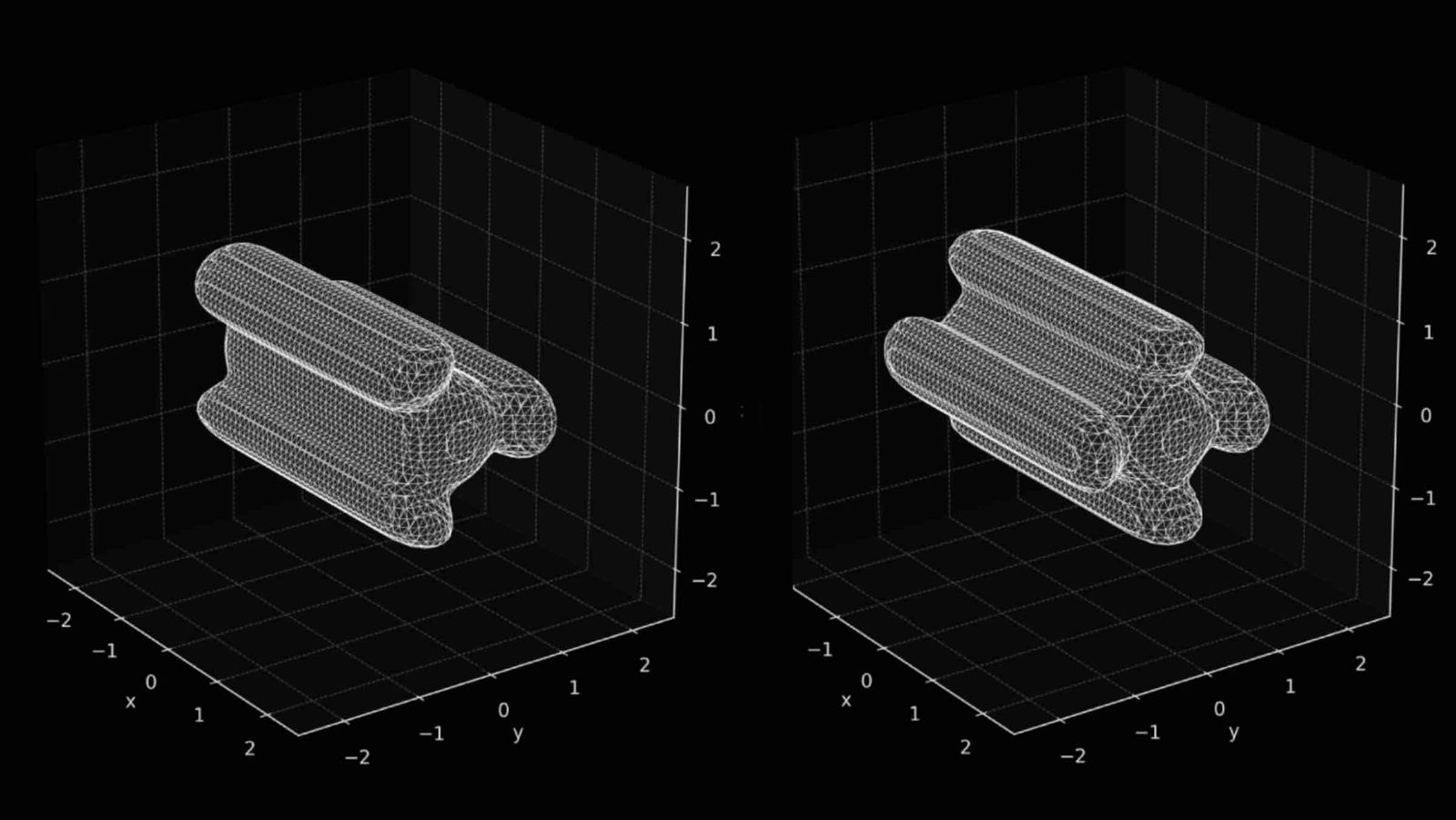
A new warp-drive study proposes a novel segmented design that could sidestep many of the problems in the original decades-old concept, bringing the possibility of hyper-fast space travel one step closer to becoming a reality.
Warp drive theory has quickly evolved since the mid-90s, when a concept developed by Mexican physicist Miguel Alcubierre was first described in a landmark paper that provided a scientific basis for hyper-fast travel within general relativity.
While the concept of warp drives was initially popularized in the futuristic realm depicted in Star Trek, Alcubierre took the idea to paper, shaping the fictional idea into a conceptual reality—one that, someday, could potentially also be realized through advanced engineering.
“The resulting distortion,” Alcubierre wrote at the time, “is reminiscent of the ‘warp drive’ of science fiction,” though adding that “just as it happens with wormholes, exotic matter will be needed in order to generate a distortion of spacetime like the one discussed here.”
Since that time, aerospace engineer and applied physicist Harold “Sonny” White has been chipping away at the problem Alcubierre first posed. Now, White and his colleagues at Casimir have proposed a bold reimagining of faster-than-light (FTL) warp drive geometry, one that replaces the classic smooth “warp ring” with a set of discrete cylindrical structures, called warp nacelles, as he and his colleagues describe in a new paper.
Building off of Alcubierre’s foundation of a spacetime “warp bubble,” White introduces a new framework that pinpoints exotic energy in tunable, engine-like structures, while the interior of the bubble remains stable and habitable to a prospective pilot.
“The results of this study suggest a new class of warp bubble geometries that are both interior-flat and structurally segmented into cylindrical ‘nacelles,’” White told The Debrief in an email.
However, White’s newest take on the warp drive concept bears more than just a passing similarity to its fictional forebear.
“The resemblance to the twin nacelles of the USS Enterprise is not merely aesthetic,” White told The Debrief, “but reflects a potential convergence between physical requirements and engineering design, where science-fiction architectures hint at practical pathways for real warp-capable configurations.”
“From my earlier work with the Alcubierre metric, I knew it should be possible to construct warp bubbles based on a nacelle-like topology,” White said. “The historical IXS Enterprise design was an early step in that direction. We envisioned that two warp rings placed in close proximity could generate a capsule-shaped warp bubble rather than the standard sphere.”
“That thought process showed how two distinct topological elements, in that case two rings, could be used to reshape and elongate a spherical bubble,” White added.
Putting Exotic Energy to Work
In Alcubierre’s original model, the spaceship he envisioned consisted of a donut-shaped ring of “negative energy” that surrounded the ship. Consistent with Einstein’s general theory of relativity, this type of conceptual propulsion demands a large amount of exotic matter and produces strong spatial gradients that can lead to extreme tidal forces, among other things: possibly even catastrophic particle acceleration at the bubble wall.
In December 2021, White and his team reported the discovery of a small-scale, theoretical warp bubble, serving as a sort of quantum-level analogue to faster-than-light travel. It was by no means a real “warp bubble” capable of moving a spacecraft, although according to White, it represented a first step in exploring the concept at a microscopic scale.
By contrast, White’s more recent theoretical work is not formulated at the quantum scale, but instead remains a classical general relativity model of spacetime geometry.
“Our new work, published in Classical and Quantum Gravity, is a more rigorous and complete mathematical exploration of that idea,” White told The Debrief. “It generalizes the concept and shows how warp bubbles can be engineered into more logical and spacecraft-friendly volumes instead of relying solely on the original spherical geometry.”
The recent study takes another look at the suggested limitations discussed in the past theoretical work, by reimagining the smooth warp ring as a series of cylinder-shaped energy channels, spaced around the bubble like the engine pods you often see on sci-fi spaceships.
Using the ADM 3+1 formalism (a common framework in numerical relativity), White and his team introduce mathematical calculations for characteristics associated with both the original Alcubierre bubble and the new “interior-flat cylindrical nacelle” configuration.
“ADM 3+1 is a powerful framework because it allows us to treat spacetime the way an engineer approaches a dynamic system,” White explained. “Instead of wrestling with an undivided four-dimensional entity, ADM decomposes spacetime into three-dimensional spatial slices that describe the instantaneous geometry, and a one-dimensional evolution component that describes how those slices change in time.”
“For space warps, this decomposition gives us direct control over the key ingredients. The lapse function sets clock rates inside the bubble. The shift vector governs how space flows around the craft. The spatial metric determines the curvature profile.”
The overall goal of their work, White and his co-authors argue, is to facilitate functional operation of the craft, while ensuring that the inside of the warp bubble remains as stable as possible.
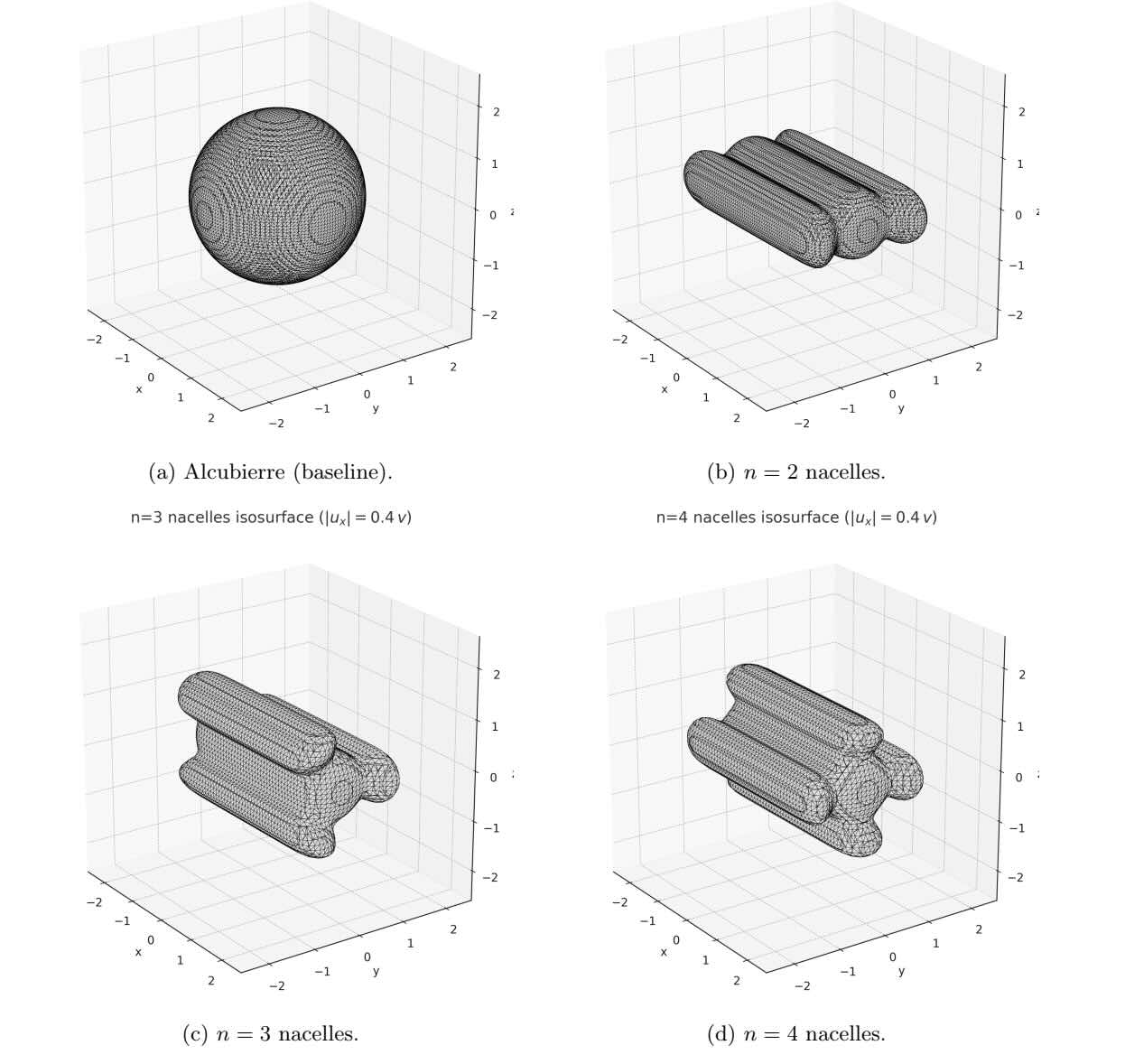 The original warp bubble looks like a smooth sphere. The new design splits the energy into separate cylinder-shaped tubes, like little engine pods, with tapered ends. This lets scientists control where and how the energy is used, instead of having one big, fuzzy ring (Image Credit: White, et al, Classical and Quantum Gravity, 2025).
Refining a Conceptual Warp-Drive
With the basic shape of the warp bubble now tentatively defined, once finalized, its center would remain flat while the required energy is distributed into several separate engine-like pods surrounding it. The ends of these pods are structured so that space curves only within those regions, keeping the interior stable and calm while the external geometry does the heavy lifting.

“No tidal forces, zero-g, clocks on board the spacecraft are synchronized with mission control clocks,” White explained, noting that the resulting design is “quite ideal and a nice characteristic of the original Alcubierre metric.”
The original visualizations resemble a single donut-shaped ring of exotic energy. However, the revised designs (see image above) break this ring into several tube-like pods encircling the warp bubble. Each tube plays its own role in bending space locally, creating something that looks more like distinct propulsion units rather than a single continuous ring.
White stresses that his approach remains consistent with relativity, without relying on speculative new physics. The shift, he says, lies in geometry—and how a warp bubble might one day be “constructed” if exotic matter becomes achievable. His work also suggests that smoother gradients and segmented structures could alleviate some of the safety concerns associated with the original Alcubierre concept.
Naturally, many will want to know whether this strategy could eventually guide the design of propulsion systems for real warp-drive spacecraft, although White says that day, if it arrives, is still well into the future.
“Warp drive physics is still in its infancy, so there is a lot of work yet to be done for us to determine how we might practically manifest something like this in the lab,” White told The Debrief.
“The most common question I get asked is, ‘When will we have warp drive?’ My crystal ball does not work any better than anybody else’s, so I don’t know if it will be 20 years, 200 years, or never.
“I know what I need to be doing next, though,” White said, “so I will do that.”
While practical application remains distant, White and his colleagues’ study provides warp-drive theorists with a new direction and a clearer path to potentially engineerable geometries. By tuning the number, width, and length of these nacelles, future researchers may be able to explore warp configurations that are more reliable, modular, and physically feasible than those proposed in earlier models.
White and his colleagues’ new paper, “Interior-Flat Cylindrical Nacelle Warp Bubbles: Derivation and Comparison with Alcubierre Model,” was published in Classical and Quantum Gravity on December 8, 2025.
Chrissy Newton is a PR professional and the founder of VOCAB Communications. She currently appears on The Discovery Channel and Max and hosts the Rebelliously Curious podcast, which can be found on YouTube and on all audio podcast streaming platforms. Follow her on X: @ChrissyNewton, Instagram: @BeingChrissyNewton, and chrissynewton.com.